Showing posts with label black island. Show all posts

9/08/2006

Reading: The Worst Journey in the World

Very nearly one hundred years ago R.F. Scott, E.A. Wilson and "Birdie" Bowers starved and then froze to death in their tent, on the "Great Barrier," permanent ice shelf on the way back from the South Pole. In "The Worst Journey in the World" Apsley Cherry-Garrard recounts the build-up to this catastrophe, drawing on Wilson's and Scott's diaries and letters to illustrate their suffering right down to the very bitter end. Although it is an exhaustive and well-written account, I had never quite grasped how it could be that the threesome, only some 11 miles shy of their next carefully layed depot of food, could have spent day after day in their pitched tent, waiting for a blizzard to pass before continuing along, all the while knowing they were at the point of death. Why, even in nasty weather, did they not continue and make a final attempt to reach the depot? I now understand.

After the long day yesterday, with eleven of us lounging in the single combination living room and kitchen, stuffing ourselves, snoozing, and reading, we enjoyed a communal DVD screening of "The World's Fastest Indian", a cute but forgettable New Zealand road movie in which Anthony Hopkins spends his life savings to travel to the United States and race his motorcycle at the Bonneville Salt Flats. Mike, one of the riggers, split his attention evenly between the film and the real-time wind speed readout feeding to the laptop by the telephone and VHF radio. He tells me there is a word in English for "going crazy from the wind," which I haven't googled yet, but put it in the comments if you know what it is.

The kitchen at Black Island is full of homey little touches to make you feel comfortable and help ease the difficult transition you may experience after arriving on a new continent.
Photo: courtesy of The Black Island Heritage Preservation Trust


There are three levels of weather here: Condition 3 is "normal" and in it prudent and standard outdoor activity is authorized. Condition 2 is defined by wind speeds between 45 and 55 knots, or temperatures below -75 C or visibility of less than one quarter mile. In Condition 2 nobody should leave central McMurdo base (or, in our case, the immediate environs of Black Island). People not in a building should immediately go to one. In Condition 1, defined by wind speeds greater than 55 knots, or temperatures below -100 C, or visibility less than 100 feet.Parked Bully in horizontal snow, about fifteen feet outside the door.

As we watched the film, and Mike watched the wind speed, it became pretty clear that even if nobody was announcing it (all eleven of us currently at Black Island were in the room watching the movie) we were technically in Condition 1. Under Condition 1 nothing moves. At McMurdo, you must remain wherever you find yourself when the Condition is announced. Were we to follow the law to the letter, the six of us sleeping down in the "Night Train" would instead need to curl up on the sofa together, or spread sleeping mats in the battery room. At the end of the film I checked the wind: 63mph, or exactly 55 knots, the cutoff between Condition 1 and 2. Moments later, a lull. The computer had the windspeed at 38mph. But by the time I got on Big Red and my neck gaiter, mittens and boots, the wind was once again ripping. I opted not to check the readout again, turned on my headlamp, and headed for the night train, seventy-five yards away. I took blowing snow full in the face at some 50 knots and stumbled towards the two parked Pisten Bullies some ten yards from the door. "Telephone" Keith kept an eye on me from the door. "I'll just sort of watch how you get along," he said. This morning he told me that as soon as I had passed the Pisten Bullies I was gone from sight. On the ground I could see some duct-work that I knew led about a third of the way down the hill to the Night Train, and marked the direction of the course. Reaching the end of it, I looked up. I thought I could see a building in front of me, but I wasn't sure. I was nearly blown over. I had little idea where I was going in the driving snow. Finally a broad pale shape loomed up in front of me and I pulled myself directly into the wind up onto the stairs. The door of the Night Train is an old, heavy, walk-in freezer door, and it opens out. I could barely open it, as the wind was pressing it closed, but I had managed the 75 yard traverse. I tugged the door open, slipped through, and let the wind slam it decisively behind me. That Scott, Bowers, and Wilson had remained lying in their bags, getting hungrier, colder and weaker, edging closer and closer to death, rather than pack up and attempt to continue the 8, or 11, or more, or less infinite miles onward to their next depot, through the blizzard, now made sense to me.

After a beautiful day today the wind is coming up again this evening, so we will see if we actually manage to get out of here tomorrow.
9/07/2006

This is Black Island Traverse, come in please...

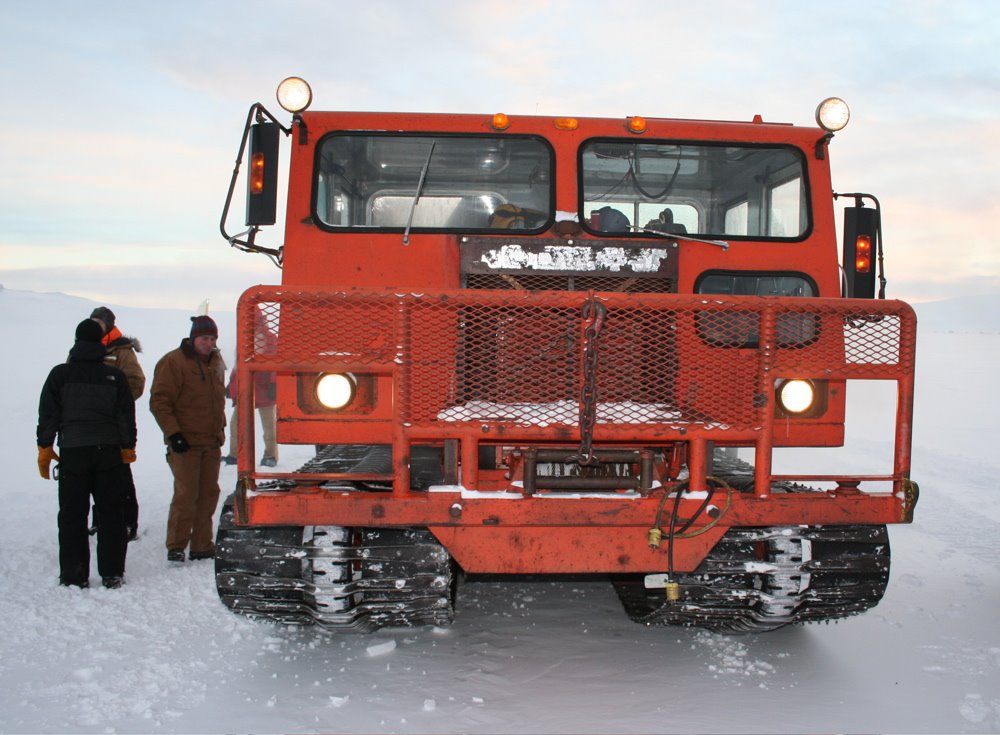
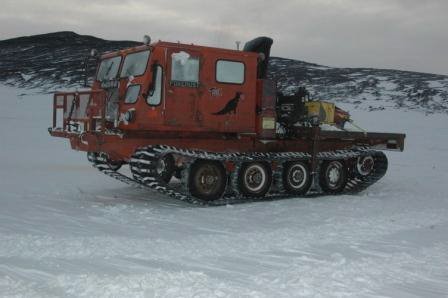
Yesterday morning at about 9AM we set out across the permanent ice shelf in three Pisten Bullies, accompanied by T-Rex, a geriatric tank-like flatbed truck with treads instead of wheels. The Mighty T-Rex. from: Vehicles of McMurdo

"18,600 pounds of pure Joy." Photo: Will Brubaker


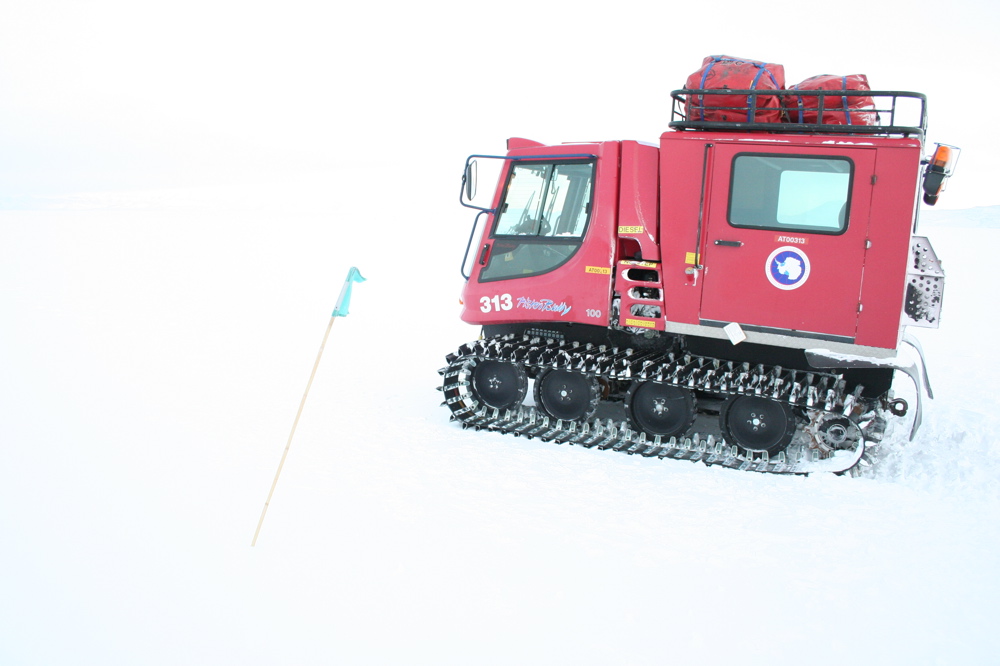
I can tell you that Piston Bully 313, since I drove it for the five-hour trip, has a top speed of 14 miles per hour on flat ice. Where's the snow? Where's the sky?
Pisten Bully 313 from: Vehicles of McMurdo


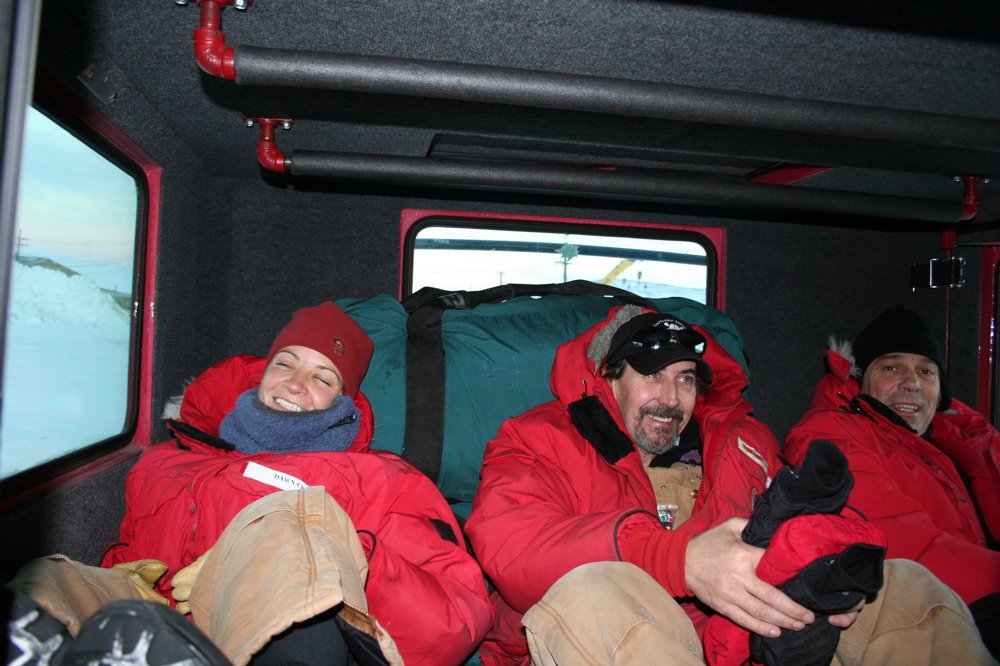
We identified our convoy to MacOps (McMurdo Operations) as the "Black Island Traverse" and scheduled hourly check-ins. The Pisten Bullies were crammed with gear: Survival bags, with food, sleeping bags, tents, stoves, and first aid kits; our own sleep kits; food for four nights; tool kits "on T-Rex;" bags of ECW gear, GPS units and radios. Dawn, Keith and Syl:
Dag, it's crowded in the back of this here Pisten Bully


The drive to Black Island is 56 miles on a roundabout route over the permanent ice shelf, but Black Island itself is only twenty miles as the crow flies from McMurdo station, across the sea-ice. "Sea-ice" defines that ice which normally melts every year and is at this time of year generally six to ten feet thick, while the "Permanent ice shelf" is thousands of feet thick and lasts "forever," at least until global warming really kicks in.


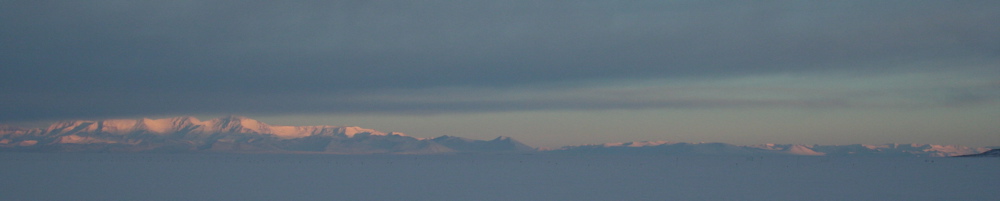
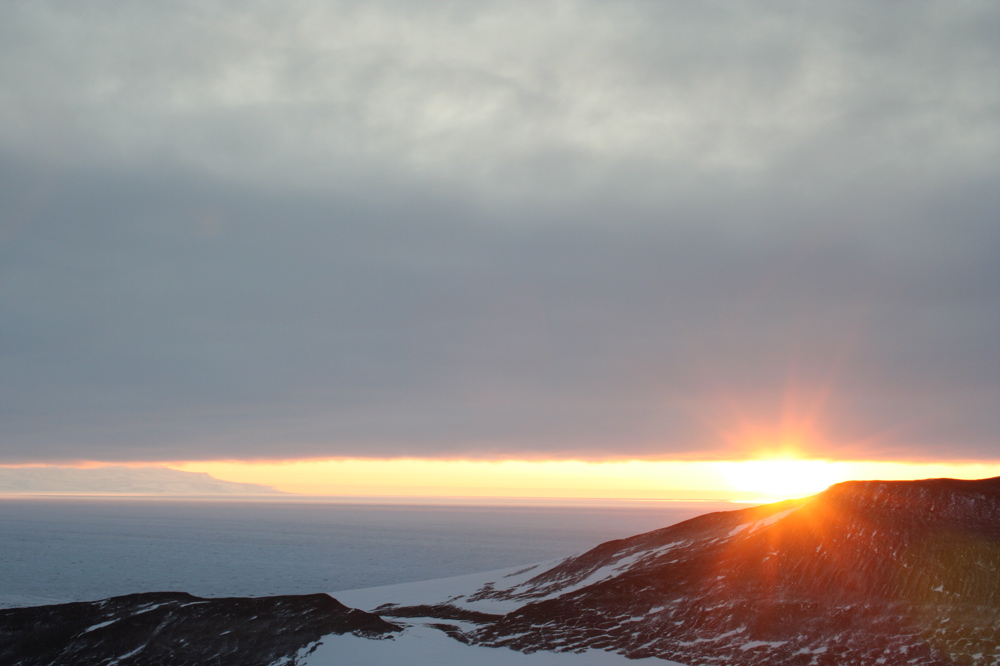
After waiting two days for the weather permitting, we have fabulous weather for the drive. The sun comes fully out, only to hover on the horizon all day, without ever moving up any further in the sky, and the Royal Society Mountain range is illuminated with a warm pink light. With the sun directly behind us, the Pisten Bully, spewing clouds of snow from its treads, makes a spectacular shadow on the snow in front of us. Imagine an enormous frog wearing a billowing wedding dress and you get an idea of the shadow which led us along the ice. Although a truly unique experience, I was reminded of driving through the Sahara, where one has no idea of the logic of the roadway; the fact that one is driving alongside regularly staked markings of bamboo instead of fifty yards to the right, or to the left, or a mile to the right, or to the left, seems not to matter (until one drives into a crevasse, hidden by drifting snow). The fine dust blowing off the vehicles and impeding visibility and the importance of maintaining the convoy also reminded me of the Algerian desert.


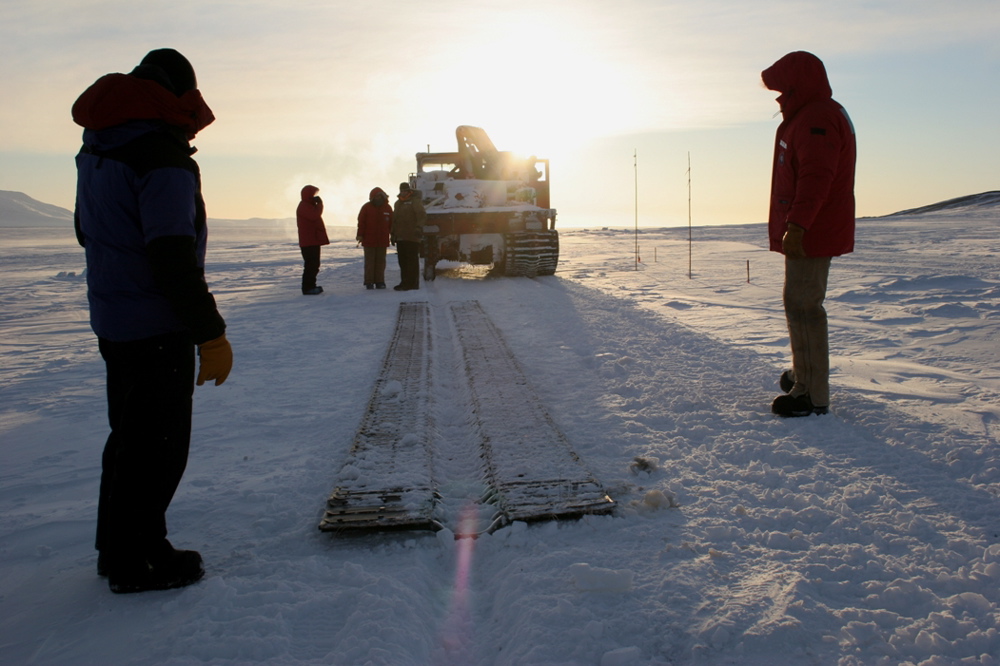
Four hours into the trip one of T-Rex's belts broke. A lattice of rubber plates held together with a spine of curved steel bars, it lay stretched out in the snow like an enormous snake skeleton. T-Rex looked far less military and rather tragically impotent with only one belt. Will and Dave, the boys from the heavy shop, used a Pisten Bully to wrangle the belt back into position, and Will backed T-Rex up and onto its own belt. We abandoned the scene, dividing into two groups, but learned later that after two and half hours of struggle in very cold conditions it was ultimately impossible to create enough slack to reconnect a shorter version of the belt.

Will takes care of T-Rex like it is his own child, and he was not amused when Ants named this photo the "Self Laying Track Vehicle"
photo: Anthony "Ants" Powell


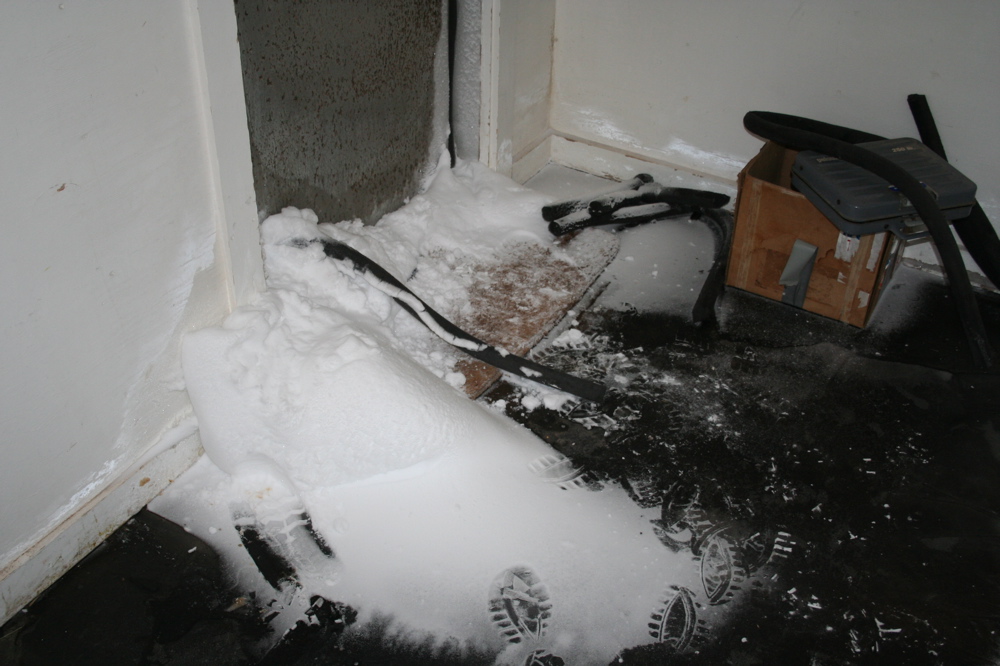
After arriving at Black Island we set to work shoveling snow out of the "Night Train," an eight man dormitory just down the hill from the main building, which is a combination of a kitchen, living room, food pantry, and rooms full of batteries and equipment for telecommunications and the storage of power from the windmills. Nobody had been to Black Island, or at least nobody had slept in the Night Train for the last three months, and it was full of snow in strange piles, on the sofa, on corners of mattresses, in a huge drift by the door. The snow here is so fine that like Saharan dust it works its way through even the tiniest holes. Even an invisible crack under the front door eventually allows in piles and piles of snow. Formations like stalactites hung from the ceiling in places where a tiny pinhole had allowed one granule at a time to enter. We removed many cubic yards of snow and then fired up the "preway," a diesel stove that soon had the place toasty, but dense with fog, like a sauna.Interior Snowdrift


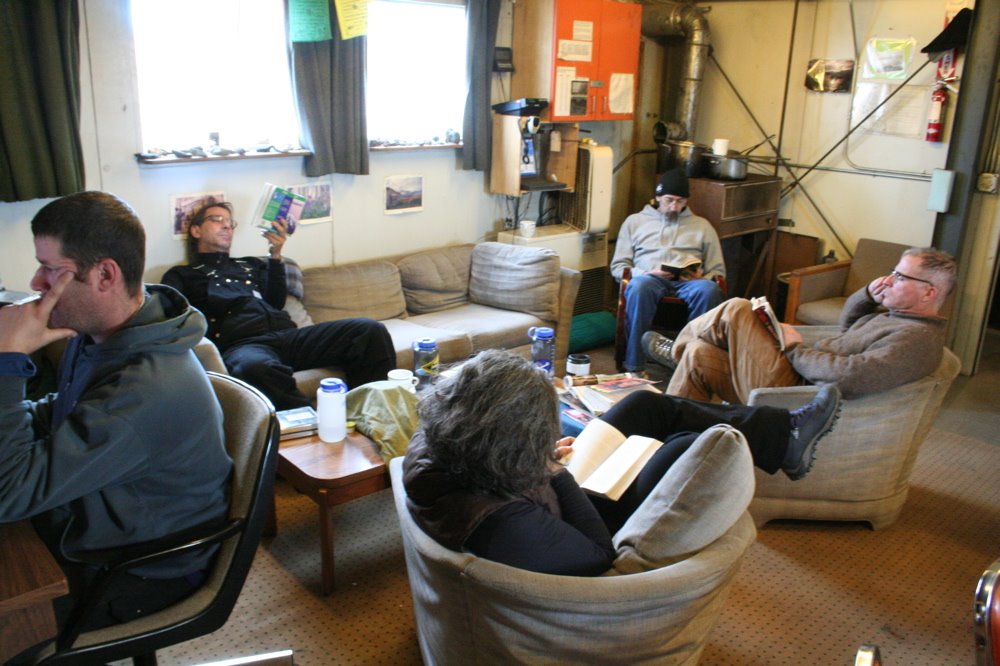
After the arrival of the T-Rex party and fajitas and wine in the main building, we put on our Big Reds and made our way back down to the bunkroom, which is more or less a mobile home on stilts, with ancient, doubtless asbestos, floor tiles, and graffiti covering the walls with the wisdom of former visitors. i.e. "Australia is just like Black Island, except much, much, much, much better." In the course of the evening we came to understand why the bunkroom is called the Night Train. As the wind rose over the course of the night the entire building began to rock, creak, and whistle in the wind, as if we were in a couchette crossing eastern europe. By morning the laptop in the main living room giving constant windspeed readings indicated 40 knots, and by 2:30PM visibility was about 50 meters in horizontal blowing snow moving at 60-70 knots. No outdoor projects of any kind have been accomplished. We sit around the formica coffee table and read books, take turns on the computer and eat Dawn's chili, although beans and bunkhouse are universally declared a bad combination by the seasoned ice visitors. The wind direction holds firm out of 180 degrees due south, the source of all of Antarctica's nastiest weather.Rien a Foutre


I recorded spectacular wind noises in the hall and especially inside Black Island's ping-pong ball, a fifty foot in diameter Buckminister Fuller geodesic shell for a massive parabolic transmitter, connected to the main building by a series of hallways and refigerator doors. I remember as a child we had a large sheet of aluminum in the basement that when shaken or beaten made thunderous noises with infinite and ominous theatrical applications. The inside of the ping pong ball in seventy knot winds sounded much the same as that aluminum sheet, but magnified tremendously in scale. The constant rippling and pulsing of the huge triangular panels, stretched taught over aluminum triangular lattices, created an amazing wall of sound. The inside of the dome reminded me of the sets for Brazil

In the living room the wind rattles and sings mournfully in the chimney. Nonetheless the diesel stove heats the indoors to a sweltering 80 degrees F or so, which has a soporific effect on the room full of quiet readers. Only Will disappeared for the entire day, slaving over some beastly diesel engine or other, reemerging like a troglodyte from deep underground, slimy and coated with black grease, just in time to complain bitterly as he watched the rest of us gobbling the last crumbs from a pan of brownies. Otherwise only Dawn worked, cooking dinner and baking cookies. There is little to do but sit and snooze and eat, like a large family in a too-small vacation house sitting out a thunderstorm.
Parcheesi, anyone?