Showing posts with label india. Show all posts

9/30/2012

Half the Sky on PBS


Naptime at New Light, a children's hostel and daycare in the Kalighat red light district in Calcutta, India. Founded and run by my friend Urmi Basu, New Light aims to break a cycle in which caste, environment, tradition and stigma combine to force children to follow the footsteps of their mothers into prostitution.

Half the Sky, the PBS / Show of Force production based around Nick Kristof and Sheryl WuDunn's bestseller about women confronting the most gruesome problems and issues they face in the (primarily) developing world, will finally be broadcast this coming Monday and Tuesday, October 1st and 2nd, at 9PM EST, on PBS. (Channel 13 in NYC). But check, as they say, your local listings.

Working on this series consumed much of my 2011; I made multiple trips to Asia and Africa, many of which I blogged about in one way or another in these pages last year. Working on "Half the Sky" was a deeply moving and rugged experience, and I hope you'll find the time to watch it. This is one of those rare cases where I really do feel that a film has the potential to bring about positive change in the world!


A wheelchair made from a $2.99 WalMart lawn chair, at the Edna Adan maternity hospital, in Hargeisa, Somaliland. Edna's hospital trains midwives, an incredibly successful, simple, and comparatively inexpensive way to combat the staggering rate of maternal mortality in Somalia.

6/08/2011

Auspiciousness Maximization Strategies


Any country as large as India has profound regional variations that are manifested in culture and politics, tugging and teasing at the fabric of national unity. Kashmir is only the most obvious example. Around Darjeeling, in the Himalayan foothills, the original citizens of the mountains have more in common with the Nepalese and Bhutanese they are sandwiched between than they do even with the other residents of their own state of West Bengal. They want autonomy, and a state, to be called Gurkhaland. One senses that independence from India itself would be just fine with them. In the vast south, over much of peninsular India, the people speak Tamil, militantly avoiding Hindi in the manner of Barcelonans refusing to speak Castillian. They enjoy the most progressively vegetarian cuisine on earth (meat-serving restaurants are labeled "non-veg"). They are darker skinned, and have their own burgeoning movie industry, threatening the supremacy of Bollywood. It's called Tollywood. T for Tamil.

My friend and sister-in-law, Melanie Dean, speaks Tamil, and she is an expert on much of what is distinct in the region. Her doctoral dissertation, recently completed, and which she will be defending before the august sages of the Uni of Penna tomorrow,  discusses Tamil Nadu superstitions related to the concept of the "evil eye." In Tamil culture, an excess of admiration is often interpreted as a possible threat to the thing admired. For instance, it is considered very bad form to goo and gush over a newborn, complimenting it on its good looks, chubby cheeks and overall deliciousness. Your envy is showing, and you likely mean the child harm. (I wish a bit of this would rub off in Brooklyn, where the abundance of children one is all but required to lavish with praise quickly becomes exhausting).

I'm a sucker for whatever bits of voodoo and hoo-hah survive into our more and more culturally homogenous iPad age, and while in Tamil Nadu recently (I'm just back as of three days ago) I kept my eyes peeled for manifestations of popular belief. I wasn't really sure what I was looking for, so I just snapped photos of things I don't see in Red Hook every day. I then sent the snaps along to Melanie. Knowing she was in the mad crush of preparing for her dissertation defense, I didn't have high hopes that she would have time to share the knowledge, but on the other hand, it isn't every day that the illustrious antarcticiana offers outsiders the one-way ticket to fame and glory represented by a guest post in these pages. Within hours the hot copy was on my screen:


You've taken pictures of just the very things that sent me down the road of this crazy dissertation I just completed. They are all apotropaic in the sense that they attract auspiciousness (in the case of the kolams or rice flour designs drawn on the ground), or they repel inauspiciousness (in the case of the other items you photographed which are evil eye or drishti amulets). The threshold of the home (or business), as a liminal space, is the most vulnerable to evil influences and energies. So, as you have no doubt noticed, it is at the entrance to homes and businesses that you find the greatest concentration of such evil-eye repellent forms.
The rice-flour designs on the ground are called kolam in Tamil and are drawn only by women and girls, usually at the crack of dawn. These types of patterns have mathematical properties that computer programmers are actually quite interested in. They can get very complicated and are drawn freehand by women. These skills are passed down from mothers to daughters. Kolams are a sign that everything in the home is well. They invite auspiciousness into the home, and especially the goddess of prosperity: Lakshmi. They are ephemeral art forms, akin to sand mandalas. They are meant to be trampled and dispersed, and it looks like you have a pic of one in just this state. 


The two Kolams above and below were photographed on the same threshhold, one in front of each of two metal gates giving access to the courtyard. They appear to have matched before one of them was mussed by pedestrians.


Some people say that putting out a kolam is like feeding a thousand souls, because ants take away the rice flour and eat it. Kolams, with their lines that have no beginning and no end, are understood to confuse evil spirits, who are baffled by them. 


The famous anthropologist Alfred Gell called such designs (like kolams and Celtic knots) "demonic fly-paper" for their ability to "trap" and distract the attentions of wayward spirits. (A great video on kolams can be found here.)


 Veve for Ogoun, scanned without permission from Maya Deren's Divine Horsemen:The Living Gods of Haiti

An interesting aside: Above and below are veve, ritual drawings of Haitian vodou, which, coincidentally or not, share a number of attributes with kolam. Both are "drawn" on the ground by carefully allowing a trail of flour or meal to escape from between the thumb and forefinger. Both invoke the supernatural. Both are ephemeral artworks which may begin to be dispersed almost as soon as they are finished. "The veve is not a permanent record," wrote Harold Courlander. "It is made as an act of supplication or veneration, and once it is finished it has no further value. In the ensuing ritual and dance, the veve is obliterated by the feet that pass across it."*

And, from Alfred Métraux: "These emblematic drawings have a magical nature. Merely by tracing them out a priest puts pressure on the loa [spirits] and compels them to appear.... (T)he loa will be irresistibly attracted by the magic of the veve...."**
Veve for Legba, perceived as the guardian of portals and doorways--the "liminal space" and threshold of the spirit world. Also taken from Divine Horsemen.
Your pic of the amulet dangling down is a classic "evil eye" or drishti amulet. It consists of a rope of human hair (grotesque and chosen for just this reason!) which holds a conch shell, a palm fruit (?) wrapped in yellow, turmeric smeared cotton string, and a chunk of alum. Alum in particular has interesting evil eye repellent properties. When you burn it, it pops and makes a lot of loud noises which are said to be evidence of drishti. This combination of the hair rope with the conch shell, etc., is quite popular.


Finally, you've got a very nice pic of an evil eye-repellent coconut demon head! Demon heads are made from papier-mache, they are painted on pumpkins, and they are also-somewhat more rarely-painted on dried out coconuts. These demons (called butam in Tamil) usually have horns, big mustaches, and a tongue sticking out with a scorpion on it. Such scary and ugly amulets are supposed to draw the attentions of onlookers (and potential evil eye casters) who will then be frightened or disgusted by the amulet and look away--their evil eye averted. This one appears to be hanging outside a shop. Places of business are protected from evil eye just like homes.


The shopkeeper of the store adjacent to this spectacular coconut-head saw me photographing it, and I struck up a conversation with him that went something like this:

Me: What on earth is that?

Shopkeeper: We have a strong belief here, that if you have something very beautiful, someone can come and admire that thing, and somehow take something away from it. We call it drishti. That coconut relates to that.

M: Make it less beautiful?

S: Yes. perhaps damage it, in some way. And our ancestors, you know, they were not such fools as we may think, so there may be something in that. To prevent it, you must hang something hideous, something ugly there. To guard against that.

M: But I rather like the coconut. What I'm enviously admiring is the very amulet that is supposed to repel me. Story of my life.


*Courlander, Harold, The Drum and the Hoe, Berkeley, 1960, The University of California Press, pg. 125.
**Métraux, Alfred, Voodoo, New York, 1959, Oxford University Press, pg. 165.

(All italicized text courtesy of Melanie Dean, to whom I am extraordinarily grateful for this erudite and illuminating contribution. Best wishes to her on the eve of her doctoral dissertation defense. She cannot but emerge diplomaed and victorious even if she brings to it only a fraction of the clarity and concision demonstrated in this post.)

6/03/2011

Curb Yourself

Today's Semiotic Malfunction is also from Ooty, in Tamil Nadu, India. However, given the way cars are driven through the streets here, this may not be an error; perhaps it is meant as a warning to pedestrians rather than to would-be parkers.

5/30/2011

Leeches, Part Deux: Leech avoidance in the Himalaya

You may wish to read part one of the leech sock saga, if you haven't enjoyed it already


On the trail in Lava, near the Bhutanese border, northern West Bengal

...The leech socks remained tucked into the bottom of my backpack during a two-week stay in Somaliland. Somalia may have certain security issues, but leeches are not one of them. After a pleasant sojourn amongst the acacias of the Horn of Africa, I then flew to Calcutta and took an overnight train to the base of the Himalayas, in the northern extremities of West Bengal.  In Darjeeling, I hired a jeep to drive me east, to the village of Lava, surrounded by leech country. Here, finally, I would have a chance to put the leech socks, and the handiwork of my friend Ashley Singer, to the test. 

One looks a right nerd wandering the muddy cobblestoned streets of Lava in puffy blue gaiters, so I stashed the leech socks in my field bag and headed for the hills. After less than a kilometer climb up into the forest, I paused to catch my breath. There, bobbing and weaving at the tip of my boot, was my first leech. I flicked it off. Now paranoid, I had no desire to sit down anywhere to put on my socks, as this would doubtless allow hordes of leeches direct access to my soft, white flesh. Swaying on one foot, I removed the boot from the other. Standing on the one leg like a stork, I realized I was imminently going to fall over and harm myself. I sat down hastily on a somewhat dry rock and "socked up" in a hurry.

Like a lover, leeches smell your heat, inching their way towards where you stand in a moist and misty forest grove, contemplating the bounty and beauty of nature. Do you think inchworms are cute? There are only two differences I can find between them and their Austro-Asian cousins: arboreal leeches are black, and they like to suck your blood. They move exactly as inchworms do, by alternately moving the front and back halves of their bodies, stretching forward, then bending double as they bring their rear grabbers up to meet their front. This might look cute in green; on a leech, that moment of indecision when the creature lifts up on its hind whatevers, swaying its body this way and that, is particularly revolting. Because you know it is sniffing the air for flesh, your flesh.


If you think the answer to this problem is not to sit on mossy logs, then beware the leech that senses your warmth below and drops silently out of a tree onto your hat like a ninja. Or the posse of leeches that wait on the underleaves of a shrub, grabbing onto your pants as you brush past. I suppose technically they are insects, but I call them devilspawn.

User view

For the next seven hours or so, I thrashed about in the jungle, searching for rusty-bellied shortwing, blue-fronted robin,  hoary-throated barwing and other birds most people have never heard of.* Between bouts of sweating profusely, I obsessively examined the rich blue denim surface of my socks, I found nary a leech, and can therefore proclaim the leech socks an unqualified success. 

Warning: Graphic images follow. Parents, please control your childrens' internet privileges. I cannot blame any failure of the socks for the disturbing images you are about to see; I suspect the guilty leech came from somewhere up above.


Undoubtedly mashed to death by the binoculars bouncing on my chest, the remnants of the disengorged leech are here clearly visible.

*All seen except the blue-fronted robin. Leeches or no leeches, I suppose I shall have to go back.

Now with New and Improved Extra Melty Deliciousness!

Today's Semiotic Malfunction is from Ooty, in Tamil Nadu.

5/28/2011

I love me some cloud forest!


In and around the village of Lava, in the Himalayan foothills of West Bengal,  two weeks ago.

5/26/2011

Rickshaw Richard

The indignities of the economic disparity between the poor and the rich are many, but the rickshaw is in a class of its own. In the west we routinely hire those less fortunate than ourselves to do the jobs we would never do: "illegal" Mexicans are paid substandard wages to pick our tomatoes while they live eight to a motel room; maids trying to get a toehold in the new world scrub our toilets. Nonetheless, the typical enlightened westerner is revolted by the human-powered rickshaw, a basket on wheels pulled through the streets by a jogging coolie. One person reclines in a padded chair, elevated above the other. His fellow human, reduced to a beast of burden, runs ahead, all the while pulling this wicker chariot by two sturdy steel bars. The truths this relationship exposes are too raw.

There are few places where rickshaw-pulling remains a thriving trade. I did not see a single one in Vietnam or Cambodia in the two months I spent in South-east Asia this winter. Rumor has it they have been banned. In Vietnam, even the far more civilized tricycle taxi, or trishaw, seems endangered. Tourists are happy to ride in those, but in the era of the ubiquitous motorcycle taxi they are no longer a popular form of transportation for the locals, who are in far too much of a hurry. In Calcutta, however, rickshaws are still to be found on almost every block.

Photo: Shiva Sripathi Passenger: Uday Sripathi

5/22/2011

I don't just want the muscle mass, I want the uncontrollable anger...


While wandering past Shivam Medicos, Chemist and Druggist of the central market in Darjeeling, India, last week, I noted that muscle-building supplements are given display-case prominence here in the land of the Gurkha, India's most notoriously fierce and loyal fighters. For all I know, these are over the counter steroids, but I rather suspect that like many "dietary supplements" sold in the United States, Mega Tripple Mass Truly Hardcore Supplement is essentially a concoction of vitamins.

The packaging, however, suggests that the box contents are intended to reproduce the effects of steroids, and I'm not just talking about the bulk and definition of your tricepticals. With Mega Tripple Mass you obviously get necklessness and skin-stretching muscle definition, but apparently you will also acquire the beady eyes, testicular shrinkage,* and irrational, semi-rabid fury of the chronic steroid abuser.

The extra "p" is for "Pissed Off"


*Granted, the testicles are not illustrated on the box, but we feel certain they have suffered some shrivelage.

5/10/2011

The Broadway Hotel, Kolkata


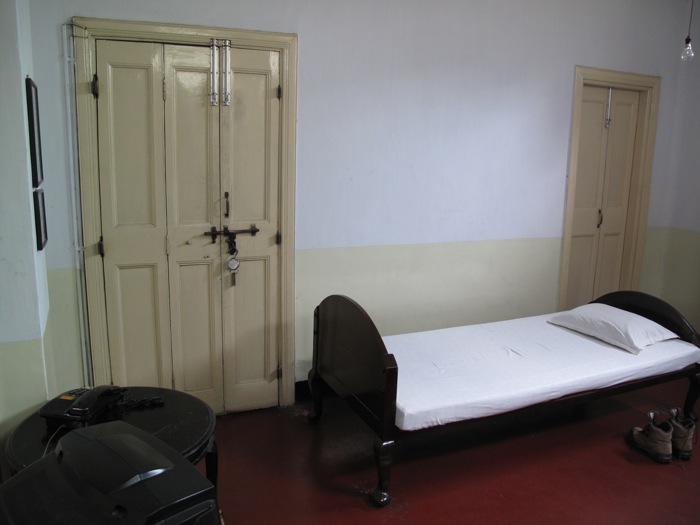
Yellow shutters and soot-crusted screens. In the bar, curtains, the warm beige of dim lightbulbs and eighteen ceiling fans on full; their whirring rush of air dulls the incessant honking outside on Ganesh Chandra Avenue. (Calcuttans simplify life by using the horn in lieu of brakes, clutch and turn signals). The dark wood-wainscotted walls of the Broadway Hotel saloon are made of primeval hardwoods no longer available at any price. Smoking is prohibited these days. A sign announces that it "is an offense,” but the tall walls are a suspicious dingy ochre, as if they had had the chance to collect smoke for many long-passed decades. This hotel does not have a faded grandeur; it has whatever it has always had, unchanged.


The waiters wear wrinkled burgundy Nehru smocks with black embroidered patches above their hearts, reading: Broadway Hotel. Oh, how I wish there remained such a place on Broadway! Squat red leatherette chairs crowd against brown formica tabletops buffed almost white in places; there is little left of the original faux-burl woodgrain pattern. Mildew specked mirrors along one wall double the already ample space, which has soaring ceilings. The soap at the men's handwashing station is dispensed from a swinging tin bottle that pivots on a mount, bolted to the wall above the sinks. If it ain't broke please Lord don't fix it.


When I alight from the elevator cage the children of the manager are laughing and howling in their adolescent Sikh turbans, playing narrow soccer on the polished red cement floor of the fourth floor corridor. Moments after I have dropped my bags on the single bed, the half-deflated miniature basketball is kicked through my still-open door. On purpose, I am certain. It rolls about the room, and within seconds the curious duo are peering through the curtain at the door, sticking their noses right into my room, demanding to know how tall I am. I've been here ten minutes, and I could live here forever.


 The hotel's website (they are not out of date) almost proudly announces that none of the rooms are air-conditioned. The bed, edged away from the wall, better to be under yet another churning ceiling fan, has no top sheet. This saves everyone time and bother. You would be no more likely to require a top sheet than to walk out into Calcutta wearing a sweater.

It is 11am. I stretch out under the helicopter downdraft, close my eyes, and lean into the single pillow. I have flown all night from Africa, with a 2am to 6am layover in Mumbai. I couldn't be more tired, but I am ecstatic to find myself in the most splendid ten dollar hotel in all of Asia.