hitch a ride on the riverboat queen...
The Mekong River is so central to the life of Southeast Asia that some people refer to the Lao, Cambodians and Vietnamese collectively as "the people of the Mekong," despite the tremendous racial diversity spread across these three countries. Picture everything south of Cairo, Illinois, in Louisiana, Mississippi, Arkansas, Missouri, western Kentucky and Tennessee as an isolated peninsula jutting into the South China Sea, transpose the Mekong for the Mississippi, and you will begin to grasp the prominence and significance of this vast watery artery.
home, sweet floating shack...
Like the Mississippi of Twainian yore, the Mekong is simultaneously home, harbor, highway and horror, its inexorable flow the lifeblood of commerce, agriculture, transport and the creative imagination. From its banks the Khmer Rouge ambushed transport ships bringing supplies up to embattled Phnom Penh from Saigon before either city had fallen, and down its waters floated countless bodies, victims of the genocide. But without it Southeast Asia would not be the rice basket of the world, one enormous system of paddies providing tons of food to millions of people.
moveable tourist beach...
And just as in the glory days of the Mississippi Riverboats and that river's seething, teeming commerce, the Mekong is a place some people are born, raised and grow up without scarcely going ashore. Last week we and a horde of other tourists hoping to experience the romance piled into a sleek speedboat for the five hour journey upriver from Phnom Penh to Siem Riep, on the far side of the Tonle Sap, the vast inland sea that is an appendage of the great river. The boat was narrow and claustrophic, like an airplane fuselage without wings, and we and many others opted for the airy and exhilarating "top deck". A sunburn waiting to happen.
just paddle up and knock on the door...
One need not fear the annual floods, which spill the banks and flood vast expanses of the land, when one's house floats. Along the Mekong there are entire floating cities. Fishermen raft together in family groups in mid-stream, working their fish traps. Towns built on the banks spill into the river; what were once docks become watery neighborhoods. We zipped past it all.
the Cambodian flag flies over the Tonle Sap...
Originally the diary of 4 months spent in Antarctica working as a documentary film sound recordist, this blog has evolved into an online repository for the thoughts, travels and trivia of the writer Richard Fleming. For McMurdo Station, Antarctica, and polar exploration, see August through December of '06. Currently you are likely to find in these pages chronicles of my actual and literary meanderings, as well as notes on my many other passions. Also, did I mention I wrote a book?
1/12/2011
1/07/2011
Genocide Tourism
“You want Tuk-tuk?” It is a question familiar to anyone who has visited Cambodia. This is the battle-cry of the entrepreneurial motorized tricycle driver, stationed outside of every hotel in Phnom Penh. A Tuk-tuk is a brightly painted miniature caravan, pulled by a motorcycle; walk a block or two here and you will be offered four or five chances to take a ride in one. You shake your head, no. “You want Tuk-tuk?” The driver asks again. He has a smiling, friendly, underemployed face. “You want to visit the killing fields?”
The Killing Fields? One thing to understand about Tuk-tuk drivers is that they offer their most popular excursions first. The way the driver says these words makes the place sound like a boutique for shopping, or perhaps the latest trendy restaurant, somewhere one would surely like to go. A destination. In Phnom Penh, the killing fields, that gruesome piece of real estate synonymous with the Cambodian genocide of the late 1970s, is a major attraction, even while its scars still run deep. Welcome to disaster tourism, Cambodian style.
No Tuk-tuk is needed today; the Tuol Sleng Genocide Museum is just across the street from the hotel. It is a former school complex, four three-story buildings that once housed a primary school and a high school in the center of the city, before being converted by the Khmer Rouge into the torture center known as S-21. For this space to have been repurposed once again as a place for learning, even about such a grim history, is already a powerful metaphor. The Khmer Rouge cadres massacred intellectuals, students and professors, treating knowledge as dangerous and subversive. They exterminated as much as a quarter of the population.
On a recent afternoon, most of the visitors to Tuol Sleng are tourists, many of them passing briefly through Phnom Penh on their way to Siem Riep and the temples at Angkor Wat. There are many of them, making their way through this very simple and very powerful exhibition. It is little more, really, than a terrible place left virtually untouched since the Vietnamese forced the Khmer Rouge out of power in early January of 1979. The former classrooms crudely divided into tiny cells not fit for animals. Walls now crowded with headshots of the victims.
What brings people here? Why take time out of a hard-won vacation to wander through these unremittingly grim rooms? Posted on the walls of the buildings at Tuol Sleng in the style of “No-Smoking” signs are drawings of a grinning man, covered by a red circle with a bar. They mean “please don’t laugh, or smile.” It’s not a welcome directive on a holiday. But horror, empathy, curiosity and incomprehension combine to form the most powerful of emotions; these are the same ingredients so often exploited by Hollywood to have the maximum impact on moviegoers.
Inside, nobody is smiling. The most chilling and evocative spaces are in the first building, where neither the torturers nor the museum curators did anything to change the layout. The rooms are large, with unforgettable checkerboard patterned floors of alternating white and yellow tile. They would have been cheery classrooms. In each room is a simple steel bed frame and a few of the mundane props of torture: a shackle, an iron bar. On each wall is a single photograph, impossibly faded and grainy. It is an old and weathered blow-up of one of the images made here by the combat photographer Ho Van Tay, of what he found after the arrival of the Vietnamese. The fourteen bodies left by the fleeing Khmer Rouge are buried in the courtyard outside, in plain white vaults, but until Van Tay arrived, their corpses were still chained to the beds.
The photographs are murky, almost pitted, and perhaps past due to be reprinted, but upon close inspection one realizes that the exact bed sitting in the center of the room is the same one in the photograph hanging on the water-stained wall. In the image, the checkered floor tiles are gray and white, but they are clearly the very same tiles that are under your feet. One understands suddenly that the room, the floor, and the bed all match, and that only the body, twisted in its final agony, is missing from the current reality of the scene. It is a visceral, emotional moment. One visitor felt it was intensely private. “You feel you are a voyeur, looking at something you shouldn’t be seeing,” she said. “And so for someone else to come into the room when you are there, it’s as if you’ve gotten caught.” But the point, of course, is that one must see, and must not forget, and the feeling of are bearing witness is another of the reasons so many visitors come here.
Back out in the sunshine, under the barbed wire and the swaying palm trees, the Tuk-tuk drivers are still waiting and hopeful, but they seem to have mercy on the contemplative mood of the departing museum guests. "Maybe tomorrow?" one asks quietly. "The killing fields?"
1/05/2011
Happy New Year!
A handful of hours after takeoff on December 31st, which is to say at about noon New York time, we celebrated New Year's with a brief announcement from the Cathay Pacific cockpit that it was countdown time in Hong Kong. Given the sun shining outside the windows as we flew north over Ontario, it was a bit difficult to get too excited about it, but the chief steward promptly handed out dunce caps to the crew. All tried bashfully to refuse to wear them, but a directive had been issued from somewhere, and on went the hats. Four minutes later, there wasn't a single one to be seen. In the brief interval, I took photos, perhaps adding to the stewardesses' sense of unease.
12/27/2010
Snowpocalypse
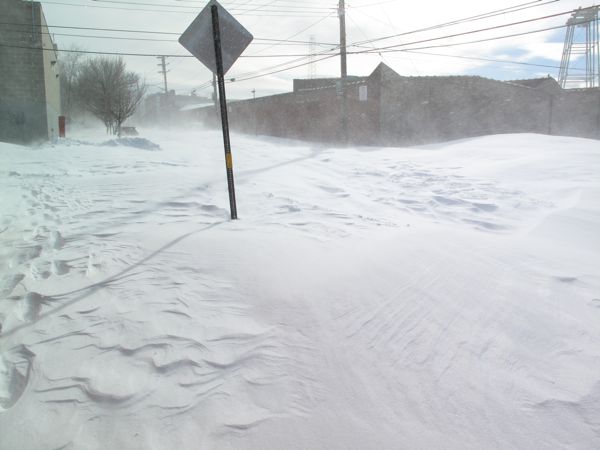
I was all ready to start posting about the strange joys of celebrating Christmas on the west coast of Florida, including the epic head to head battle that went down at Christmas dinner between a pre-stuffed vegan Tofurkey and a Hawaiian-style, 1950s kitsch brown-sugar basted ham, complete with pineapple ringlets. Then the phone rang with the news that yesterday's flight, the homeward leg from Dulles to Newark, had been canceled.
On Christmas evening my family and I were blissfully walking on St. Petersberg beach, watching pelicans diving into the azure Gulf of Mexico; the next morning I battled my way back to Red Hook, flying via Chicago to Philly and then training, subwaying, and bussing my way back to the 'nabe. Just in time to wake up to this:
12/21/2010
Priceless original art, found in my truck
After dinner tonight in Bay Ridge I walked back to the trusty Toyota pickup, parked on 67th St. As I was turning the key in the door lock, I spied two pale disks like sand dollars in the bed, apparently placed with care, one in each of the two forward corners. Once home, a moment's googling revealed them to be examples of the prolific oeuvre of Brooklyn artist Beriah Wall.
As revealed in this New York Times article, Wall works in a studio in his Red Hook basement, making me wonder if these delightful little coins hadn't been rattling about in the back of my truck for some time. He churns them out by the thousands and dots them about the urban landscape. But, again, they really seemed to me to have been placed with care in the back of my truck. The way they were sitting they sure didn't appear to have been driven over the bouncy BQE.
One says "Tweet" on one side, and "Twit," on the other. The other says "For" on one side, and "Ever," on the other. The Tweet / Twit one has Christmas colored glaze. Both have Wall's initials, "bW" on them; before googling I wondered if this wasn't short for "backed with," the old terminology for describing the flip side of a 45rpm record. As in Tweet, backed with Twit.
I was smiling all the way home. What makes this great art is its demonstration that a random act of unsolicited charity is irresistible. Less than a penny's worth of baked clay, mass-produced in a spirit of love and anarchy; a different kind of currency, something to cherish.
12/18/2010
Swedish court case documents leaked to Guardian UPDATED
In a rather ironic public revelation of private information, all the sordid details in the official Swedish proceedings against Julian Assange have apparently been leaked to the Guardian newspaper, so you can be your own judge of whether or not the complaints against Assange, which include accusing him of "the worst sex ever," merit the involvement of Interpol, an international manhunt and nine days in a British prison arguing for bail.
What's interesting to me is the second sentence in the story:
The case against Assange, which has been the subject of intense speculation and dispute in mainstream media and on the internet, is laid out in police material held in Stockholm to which the Guardian received unauthorized access.
This certainly sounds like an admission that someone in Sweden leaked documents to the Guardian, yet another demonstration of the central and essential role of leaking in journalism....
UPDATE: I will say it shows poor judgment that Assange allowed himself be photographed wearing these sunglasses, given that they make him look like a two-bit pimp or an aspiring pornographer....
...
12/04/2010
I'm hoping putting "wikileaks" in the title of my blog post will prevent anyone in the government from reading it. UPDATED
The current hoopla over the latest gigantic stock of documents made public by Wikileaks is remarkable for a number of reasons, but there are two I find especially interesting. One is that the current divulgation of more than a quarter of a million diplomatic cables has been met with an exponentially higher level of political outrage and media attention than resulted from their significant releases of US military documents over the last year. Even the devastating "Collateral Murder" video demonstrating an American helicopter crew's callous and casual disregard for Iraqi life made only a small ripple in the general consciousness in comparison to "cablegate." Are the diplomatic cables just the proverbial straw breaking the camel's back? Or is there something fundamentally different about the diplomatic cables versus the military papers? The other interesting aspect of the current episode is the pseudo-Chinese attempt at censorship on the part of my government, unequivocally totalitarian in its effort, and entirely retrograde in its willful ignorance of the realities of the very digital information technology that makes Wikileaks possible.
Profiled in the New Yorker as recently as last June, Julian Assange, the public face and founder of Wikileaks, expressed his frustration that journalists had not done the necessary legwork to exploit previous leaks. Cablegate represents an evolution of Wikileaks' strategy; unsatisfied with the muckraking impact obtained by simply leaking the documents, the organization seems now actively to be assisting the media in finding the stories buried within these vast piles of digital paper. The Guardian, and the New York Times through them, as well as Le Monde, Der Spiegel and El Pais (interesting that the chosen outlets are all in staunch western democracies, but that's probably a subject for another time) are described as Wikileaks' "media partners," and in this round of leaks they were given access to the documents well in advance of their release to the public via Wikileaks.org.
This strategy may have something to do with the extraordinary level of attention being paid to Cablegate, but equally important is the way that people choose their news. The internet lets people decide exactly what they want to read, and the fascination with the cables is not unrelated to our celebrity obsession. Depending on your perspective, war in Iraq and Afghanistan is either a horrifying misuse of American power or a necessary but unpleasant part of the global struggle against Islamic terror. Either way, there's nothing remotely sexy about its inner workings. We don't know the people involved, and we are apparently numb to the spectacle. Not so #cablegate, in which the personality quirks of famous world leaders are revealed and analyzed. Sarkozy, we learn, really is a shallow egomaniac, vulnerable to flattery. Putin and Berlusconi are not only gangsters, in case you didn't know, but they're close buddies, gangsters bro'. René Preval really is aloof and introverted and probably drinks too much. (Okay, he's not exactly Brad Pitt on the celebritometer, but he is the president of Haiti). We love imagining what the iron-jawed and un-cuddly Hillary Clinton is saying in all those apologetic telephone calls she's been making to offended world leaders.
Rather more interesting and much more disheartening is the US government's response, which seems to me to be a sort of China-lite, #fail, attempt at closing the barn door after the cattle have long since left for the pasture. Pressure on Assange and Wikileaks has come in every imaginable form, from leaning on the private sector in an attempt to cut off funding by getting them booted off of Paypal and inspiring Amazon to stop hosting the website to personal attacks in the form of an extraordinarily coordinated international smear campaign which has in recent months made Assange's name virtually synonymous with the word "rape." (Assange might make for an icky bedroom playmate, but in the rare story that actually presents some of the details of the Swedish "case," it hardly sounds like he's a rapist. And even this story has a misleading headline).
The flacks so deftly coordinating the smear campaign must be not be the same ones handling PR for the government, which has issued directives that federal agencies should prevent employees from accessing Wikileaks. Apparently if you are at the Library of Congress, preserver of the word and the freedom of it, you'll find that their computers no longer offer access to Wikileaks. The fatuous justification for this authoritarian Cuba-style nonsense is essentially the government saying "the documents are still classified until we say they aren't, (and we're going to take our basketball home with us and so nanny boo-boo, there will be no game)." And this regardless of whether or not they have been published or discussed in the New York Times or already exist as torrent files on hundreds of hacktivist hard drives. This is embarrassment mitigation? How embarrassing. The USA certainly must know that there is no putting this cat back in the bag; Assange just asserted that he has already sent out 100,000 encrypted copies of the entire archive, just in case anything foul should befall him. He does that with the press of a button. Welcome to digital distribution.
The frontal assault on the First Amendment just makes us look like floundering incompetents who don't practice what we preach. The whole situation is reminiscent of our new-millenium lack of credibility when it comes to condemning torture; it's a challenge to present your nation as the guiding moral light in a dark and savage world while at the same time preventing librarians from reading the same documents that are on the front page of the world's leading papers. I don't often find myself standing on the same soapbox as Ron Paul, but as he wrote yesterday in a rather poorly articulated tweet, "In a society where truth becomes treason, we are in big trouble."
Welcome to the globalization of information. We'd love to grab Assange for treason, except he isn't American. Also there's another major problem, which is that he doesn't appear to have done anything illegal. The US Attorney has dredged up the constitutionally questionable "Espionage Act" of 1917, which was most successfully used to prosecute unsavory socialists ninety years ago, and which makes it a crime to pass along information with intent to damage the United States. I'm not a lawyer, but anything Assange and Wikileaks have done, the New York Times, the Guardian, El Pais and so on have also done. (As recently as last April he was here, and on the Colbert report. If you want a litmus test of how successfully he has been rebranded as a criminal and a pariah, consider how long it is likely to be before Assange is able to sit for another relaxed chat in a major American television studio). The key to the ongoing persecution (not prosecution) of Assange lies in the multi-pronged attack. As long as the "rape" flag can be held flapping in the breeze at the top of the flagpole, nobody needs to engage with whether the leaks themselves are in any way criminal. Despite ongoing attempts to conflate the crime represented by the original theft of the documents with Wikileaks' subsequent dissemination of them, it seems pretty clear that no laws have been violated.
The problem, perhaps, is the unprecedented scale of these leaks, a biproduct of our digital age. In the traditional model, the budding investigative journalist prays for the day when an anonymous disgruntled insider will hand over to them that one single piece of paper that is proof of nefarious government or corporate activity. Nobody goes after them, except perhaps the evildoer. This is the stuff Pulitzer prizes are made of, and it is in exactly this fashion that wrongs from Watergate to Abu Ghraib have historically been exposed. This is why transparency is to be prized. Someone sent Wikileaks 250,000 potential revelations, instead of just one, and they published them. If you're upset about it, go get the leaker. To assault Assange because he created Wikileaks is like refusing to build a bridge because someone might jump off of it.
UPDATE: Assange turned himself in to British authorities today, December 7th to face the Swedish allegations. Here is the hilarious 20th paragraph of the New York Times story:
The charges involve sexual encounters that two women say began as consensual but became nonconsensual after Mr. Assange was no longer using a condom. Mr. Assange has denied any wrongdoing and suggested that the charges were trumped up in retaliation for his WikiLeaks work, though there is no public evidence to suggest a connection.
Assange is being arrested based on morning-after remorse, what we might call "retroactively nonconsensual sex," or "uncomfortable breakfast syndrome." But what's really amusing about this 'graph is the second sentence. Even the most poker-faced of press secretaries would be incapable of denying "that the charges were trumped up in retaliation for his WikiLeaks work" without bursting into giggles. Isn't demanding "public evidence" of the connection a potent argument for the very work of leaking that Assange is dedicated to?
In their editorial about the leaks, El Pais seems to agree with me that the significant difference between these and prior leaks is just a matter of scale. "There is no historical precedent for this in term of scope," they write. And: "We are, in a sense, freer now than we were before, which is as much as journalism can hope to achieve."
11/25/2010
Nothing exceeds like excess: Eataly versus Caputo's
The latest culinary shangri-la in Manhattan is Eataly, a 42,500 square foot (as advertised on their facebook page) megamall, cattycorner from the flatiron building at 23rd St. and 5th Ave. People love this place, and even if people are sometimes trying, I love food, so I made it a priority to go for a visit as soon as possible after my return from France. The feeling has something of a collision between a supermarket and a food court. There are seven restaurants dotted throughout a vast retail space filled with piles of every imaginable Italian delicacy. It's a bit like an airport in the way that the eateries are simultaneously inside but apparently doorless and open to the wide world. Picture all the seating in one of the lozenge-shaped terminals at LaGuardia removed and replaced with gleaming shelves of pasta.
The strangely Sbarro's-looking brick-oven pizza joint at Eataly. I quite like the disco-ball ovens, perhaps the legacy of Mario Batali's Lower-east side club-crawling days.
A few of the olive oils on offer at Eataly.
I haven't sat myself down and eaten in the place yet, and especially in New York one imagines that this is the principal point; Eataly isn't a food store with dining options, it's really seven restaurants using the shopping possibilities as the justificatory glue holding them together in one location. But from the shopper's perspective, there is fabulous stuff in Eataly: fresh figs, enough olive oil to make an artificial lake, dangling legs of prosciutto, an entire cookbook shop, and a bakery where you can watch bakers behind glass plumping and cossetting their loaves in preparation for loading them into the oven.
The bakery-behind-glass at Eataly, my favorite feature.
Eataly is, all in all, spectacular, teeming with happy customers and goggle-eyed tourists whose minds seem to be blown by the amazing offerings. With all that abundant goodness, I've been wondering what it is about the place that rubs me the wrong way. The other day I stopped into Caputo's, at 460 Court St. in Brooklyn, for some of my favorite grilled and marinated artichoke hearts, and it hit me.
Caputo's Fine Foods
Caputo's, for those who haven't been there, is a tiny Brooklyn food shop run by two Italian brothers. Over the last few years they have gradually taken over daily operations from their parents, a transition that accelerated after the passing of their mother, who I believe to be the originator of the artichoke hearts. If I can trust my palate, the brothers have not changed anything about the artichoke hearts, nor so much as one square inch of formica countertop, making Caputo's a sort of old-world throwback to a time when the Lower-east side was dotted with "Appetizing" stores and dozens of family salumerias thrived in the Italian immigrant neighborhoods of South Brooklyn.
The cheese counter at Caputo's, which dominates the front of the store, forcing customers to snuggle past one another sideways on their way to the olive bar.
The store is roughly the size and shape of the railroad apartment I lived in for fifteen years on Essex St. Long, narrow, and claustrophobic, it is perhaps ten feet wide, although for much of its length most of the space is consumed by a glass fronted display counter full of cheeses, peppers stuffed with provolone, marinated mushrooms and, yes, the grilled artichoke hearts, so that customers coming in and out must edge carefully past one another. I'll estimate that Caputo's offerings are crammed into approximately 500 square feet. Therefore the entire store would fit into Eataly 85 times over.
Curatorial minimalism characterizes the window display at Caputo's.
The entirety of Caputo's.
Although the Manhattan Eataly is modeled after the debut Eataly in Torino (yes, obviously, Eataly is a chain, with more planned), this is nonetheless a contrast between American excess and an old-world sense of proportion. And while I'm certain the army of buffed and perky employees at Eataly were obliged to sit through classes on the differences between Coppa piacentina and Capocollo di Calabria, with a quiz on just which pastas are made with doppio zero flour, my preference for Caputo's is also about trusting the curatorial instincts of the family. There isn't room in the shop for five hundred olive oils, but I have a high degree of confidence that whatever they have will be excellent. The other day I bought a bottle of Chilean oil there, something I would never do at Fairway (and would be surprised to find at Eataly). It is delicious. I'm certain I could wait in the vast olive oil aisle at Eataly for the resident oil expert to come and regale me with tasting notes and biographical data on the producers of dozens of bottles, but at a certain point, please, just pick your ten best and let's move on. It's the creeping cancer of choice.
Some of the pasta at Eataly
A bit more of the pasta selection at Eataly
In case you need some dried pasta, Eataly has some.
By now I'm paralyzed. Eataly has more square footage devoted to selling rafts of dried pasta than the entirety of Caputo's.
This is not a joke. It's Andreas Gursky does pasta, except it's real, not photoshopped.
The pasta corner at Caputo's. All made in the USA, because they make it themselves. You don't like it? What's wrong with you? It's not imported from Italy? So therefore you don't like it? What are you thinking? Go somewhere else, then. This pasta is delicious, so delicious that I only cook it only special occasions. Otherwise it would be dangerous.
11/24/2010
11/11/2010
Shaolin Sourdough
Amongst those participating in the grape harvest last month in the Loire were three residents of the local zen monastery who took time away from their practice to help out during the vendange. Agricultural work is congruous with Buddhist monastic life, just as it is with the lives of Belgian Trappistes and Dominican grappa distillers. Many of the pre-phylloxera vines in the eastern Loire may first have been planted by religious communities.
The zen monastery, they told me, is self-sufficient in wheat. They grow it, harvest it, mill it, and bake bread with it throughout the year. My friend Magali invited me to come and have a hands on lesson on her next baking day, but to my great regret I let the wine life take over, and failed to fit in a visit. I'm now using this as my excuse to justify my earliest possible return to the Loire.
However (if I say so myself), my ongoing bread experiments back home in Brooklyn continue to yield excellent results. Like winemaking, and perhaps any fermentation-based enterprise in which one attempts to harness the anarchic wild yeasts of the outside world, every episode, whether failure or unqualified success, brings with it knowledge. Baking is a constant process of learning, and therefore a metaphor for life.
Breakfast of Champions
In which I combine my interest in zen calligraphy with my current addiction to baking bread.
(Technical data in the comments)
11/04/2010
Preparations 503 and 506
At risk of offending the fine folks who invited me to their shit-shoveling festival a few weeks back in the Loire valley, as recounted a couple of posts ago, I want to revisit the subject of biodynamic farming, because I'm now feeling I let those promoting the agricultural theories of Rudolph Steiner
off a little too easily. It's easy to do so, and I think I know why. Because the goals of biodynamic farmers are so closely aligned with the natural wine, organic, fresh and local, and slow food movements, the more kooky elements that go into biodynamics have never emerged as a favored target of secular humanists. With all the evil in the world, why bother going after the possibly self-deluding biodynamic farmer? Furthermore, there seems to me to be little doubt that Steiner was prescient in comprehending the ravages of what would become industrial agriculture, and biodynamics is broadly concerned with soil health and sustainability, more than sixty years before that term became the overused mantra of the green movement. Why risk the perception that you are opposed to a thriving ecosystem, healthy eating, and happy animals by attacking biodynamics?
I wrote in that previous post that biodynamics "typically goes well beyond the basic prescriptions for organic farming." This is essentially true, but only if we are talking about the kind of co-opted organic farming decried by Michael Pollan, in which giant, industrial farms produce "organic" products on vast monocrop farms in order to exploit the marketing value of the term. And that wasn't what I meant: "organic" used to mean, to me, small, thoughtful pesticide-free farming of diverse plantings in a varied and complete ecosystem. Compared with this sort of agriculture, the ways in which biodynamics "goes well beyond...organic" seem upon further reflection to be limited to the mystical and the magical, namely the bizarre Steinerian preparations 500 through 508. The question then becomes: are the results of the biodynamic method superior to the results from any other less dogmatic approach to artisanal, pesticide and chemical-fertilizer-free farming? Are biodynamic farms superior in any way to other farms farmed by farmers deeply invested in soil health, the environment, and tasty eating?
Preparation 506, in which Dandelion flowers are blanched and then packed into the peritoneum of a cow. This tiny bundle is then buried over the winter before being used as a sort of homeopathic additive to compost.
There are plenty of believers eager to point out that scientific evidence exists for the superiority of biodynamics. Some basic googling will bring up a host of such claims, but nothing I waded through went one simple step further and told you what that evidence is, or, heaven forfend, actually linked to a study demonstrating the point. If you want to enter deeper in this debate, take a look at Biodynamics is a Hoax, in which Napa vintner Stuart Smith pulls absolutely no punches under the subheading "Someone has to speak up."
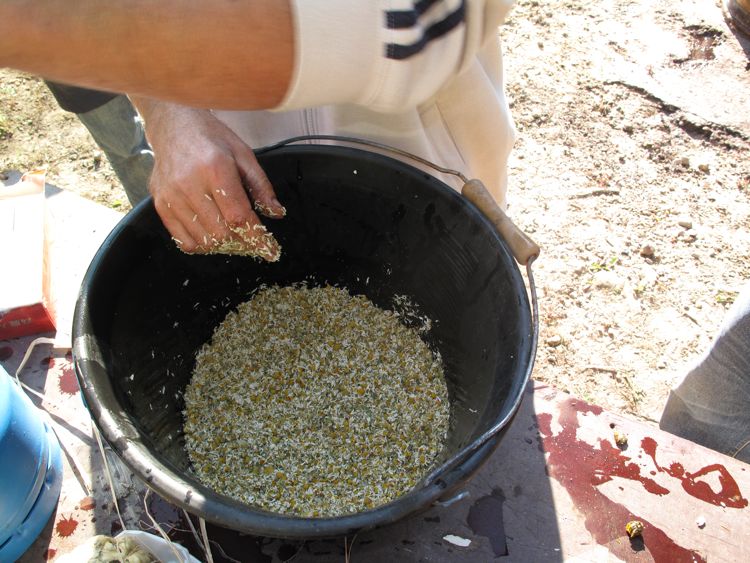
Chamomile flowers awaiting deployment in Preparation 503.
The moistened flowers are pushed through a funnel, stuffing for a length of cow intestine.
The finished product, a chamomile sausage. It's very attractive, but the problem is that I can't find anyone who can explain why adding this to your spring compost will "reactivate" the soil...
There is, sadly, a more cynical perspective from which to consider the success of biodynamics, at least in the wine world. Thierry Puzelat, with whom I spent most of October learning how to make wine, is a very good example of the kind of conscientious farmer who cares deeply about his land and vines and produces excellent plonk without subscribing to the strange prescriptions of Mr. Steiner. He has no quarrel with biodynamic farming, and buys plenty of grapes from friends like Bruno Allion who follow the Steiner line, but his own attitude is "show me the evidence." He told me that it is remarkable how often groups come in to the Puzelat cellars for a tasting and ask him "are these grapes produced in biodynamie?" This before so much as taking a sniff of the first glass. In other words, biodynamics has become so trendy that for some the Demeter stamp of approval is more important to their drinking experience, or their self-perception of what sort of wine drinkers they are, than what the wine actually tastes like. While I have yet to meet a biodynamic farmer who I felt was insincere or concerned with anything more than creating the best possible farm environment, in the face of fetishizing like this I'd be very surprised if there aren't some vintners out there who are burying horns full of manure just because they think they will turn to gold.
After the preparation of the magical packets, we dug a hole in the ground and lined it with old slate roofing tiles, in order to avoid cutting open the parcels with a shovel in the spring dig. I have a similar attraction/skepticism for the rituals of Haitian vodoun, which also often involve the meticulous preparation and burial of small parcels, known as wanga.
The burial.
Subscribe to:
Posts (Atom)