Showing posts with label communication breakdown. Show all posts

2/09/2011

Language Barrier


Asia sometimes feels like a wall of incomprehension, a collection of impenetrable languages. After almost a month here, I still don't speak more than a few words of Vietnamese (coffee, beer, noodle soup, my repertoire is exhausted). It is disorienting to pass day after day in streets filled with language that I can only register as noise, and I'm in awe of travel writers who spin compelling and informative narratives out of experiences lived surrounded by alien tongues. Writing about Latin America seems so much more natural to me, as a spanish speaker, than trying to decipher what is going on beneath the surface of a place like Vietnam. Still, one can't learn the language of every single place one visits before writing about it.

A couple of my recent posts have suggested (at least to me, and perhaps to close readers, if I have any) that Vietnam is all go, go, go, a country brimming with youth and focussed on the future, the streets teeming with motorbikes, an avalanche of free enterprise, the war a distant memory. It is an easy impression to get, and without language it might be difficult to get any other. But it isn't altogether correct, especially the last point.

Be clear that the language barrier is the traveller's problem. The dilemma is that to experience "the real Vietnam," one needs to avoid the tourist enclaves, where the English-speaking Vietnamese are gathered, making money by speaking English. The people one meets with whom communication is easy are almost certainly in the tourism business. They are guides, travel agent operators, hotel desk clerks, and the odd exile or emigrant, returned for a visit. But in avoiding them, communication becomes limited to gestures, a pantomime routine of eating, sleeping, and laundering. So one has to take one's stories where one finds them.


At the Cat Tien National Park canteen, a brief conversation with a tour guide on his lunch break starts when he asks me how long I have been in the park. Four days, I say. He looks Vietnamese, but his English is so good he might be a tourist.

"Where are you from?" I ask, just in case. I had embarrassed myself minutes earlier by asking four Taiwanese birdwatchers, one of whom attended Stanford, if they were Japanese.

"I'm from Saigon." Nobody calls it Ho Chi Minh City, except government officials. "You?"

"New York, America."

"I ask my people where they are from, and they say they are British, but on my paperwork it says they are American." I understand he is talking about his clients. "They like to look at birds."

"They lied to you about where they are from? Why would they do that?" (I have yet to meet anyone in Vietnam who resents me for being American.)

"Maybe they are British, but they work or live in the USA, sometimes it is like that. That's all."

"Maybe. You have a tour company?"

"I take the permit from my friend. Once, I had my own tour company. But, too much politics. I don't like. I know politics. After the war I was sent into exile."

He looks my age, with just a few gray hairs on his well-combed black head. But he is almost ten years older: "I joined the army when I was eighteen," he says. "I wanted to make the change to the Air Force, and become a pilot."

This was in 1972, when joining the South Vietnamese armed forces already must have looked like a bad idea on the ground. It would have required a certain amount of optimism. Youthful enthusiasm, perhaps. I don't say so though, for there is something odd and pointed in his delivery. He has slipped with an ease uncharacteristic of the people here into a sort of war memorial mode, without any real prompting from me.

"A tiny, dark room," he says. "No support. Shackles on my ankles. Eat. Sleep. Toilet. No food." He gestures to the miniature dish on the table into which one pours a personal serving of soy-sauce as a condiment. "Rice. One bowl, a little bit bigger than this, every day. All the time dark."

"You mean something like internal exile," I say. "Where were you?"

"Mekong Delta region," he says. "Prison."


Prison can be a metaphor for exile, but he means, quite plainly, that he was in prison. It is particular tragedy when the darkest days of a life are forever remembered as the most profound. My friend has slipped so easily into a terrible reverie, thirty-five years later.

"How long were you in exile?"

"Nine months. I shrink. My stomach shrink. I get thin. Before, I used to eat. I liked to eat. Now, still, I eat little." He points to his half eaten lunch of instant noodles. "I am full."

"No support," he says again, "no support at all," and I understand why his clients might have claimed to be British.

7/13/2010

Economic Recovery Barometer, Bronx and Queens billboard edition

A couple of days ago the NYT ran a breathless story to let us all know that even if times are tough, at least Wall Street is hiring, "in anticipation of an economic recovery." One of the ideas it promotes is that we New Yorkers should all feel good about this, because of the potential trickle-down effects on the local economy. A closer read, with some peering between the lines, suggests that Wall Street is hiring largely because the banks that are too large to fail turned the economic bailout into yet another gigantic cash-sweeping opportunity, and they are so flush with lucre that they need a few extra bodies to help them squeeze the lemon dry.

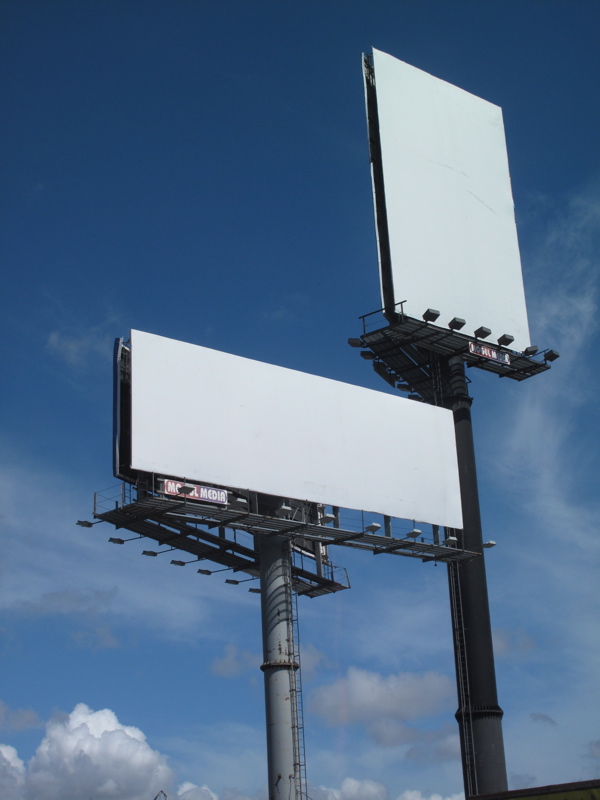
Here at antarcticiana we have our own notions about how, when and why to call an economic upswing, including the scintillating theory that our nation's economic health can be judged by the billboard rental rate. On a recent drive up to the Berkshires, for what could be termed either a delightful long weekend or just another routine four-day-long stretch of underemployment, the number of blank billboards lining the highways of Queens and, further north, the Bronx, continued to impress. These images may not have the crisp composition of our earlier Gowanus series, but I think they are none the less poignant for having been snapped from a moving car in classic BQE stop-and-go traffic. To us, this spells ongoing slowdown.


One emerging trend is that with such broad expanses of unsold canvas left dangling for so long in prime eye-catching territory, graffiti and street artists are beginning to seize control of the visible landscape.


5/17/2010

Your message here...

Who's gonna work, make the economy grow, if we all hang out in the street?
Well, I don't know, and I don't care, just as long as it ain't me!
Hangin' out with the street people, they got it down,
Hangin' out with the street people, just driftin' from town to town.
I wouldn't trade places with no one I know, I'm happy where I'm at...
Some people would rather work; we need people like that….
                                                         -- Bobby Charles


Nothing says "ongoing economic downturn" with quite the same forceful poignancy as a disused billboard. Gowanus is full of them, towering rectangles of dull gray tin spotted with the patchy remnants of abandoned advertising campaigns. At the moment the only message they are sharing with the motorists of the Brooklyn-Queens Expressway is one of empty failure. If there is a particular stage of global slump in which advertising is abandoned altogether, surely we have reached it.

Don't get me wrong, it's not that I wish these mute slabs were still decorated with glossy promotions for soft drinks and home improvement stores. I hate the damn things, and consider them an unconstitutional infringement on my right to enjoy unobstructed views and breezes, and to be free of unwanted visual clutter as I make my way along the roadways my tax dollars pay for. Billboards are nothing less than a form of pollution, and they should be banned nationwide, just as they are in Vermont. But in Brooklyn we have them, so for now I'll settle for finding them more evocative, meaningful, and even beautiful, in their messageless state. With their museum-quality enameled steel frames, these huge erased canvases make for a kind of vast outdoor art exhibition; in a different context the people with all the money might be drooling over them and writing fat checks.


But in light of the current economic crisis I think it is also useful to consider these empty billboards as metaphors for not spending. We live in a country where consumer spending makes up more than 70% of GDP. Our economy would be worse than completely stagnant if we were to stop consuming enormous amounts of stuff all the time. This is what prompted Rudy Giuliani's silly remark in the wake of 9/11 that city residents should "go shopping," to prove that not even terrorists can keep them from their comforting, habitual activities. It is also why real efforts at environmentalism are perennially marginalized and disparaged. "Green" living isn't about whether your coffee filters are made from recycled materials, it has to be about radical constraint on buying and using and replacing, and therefore, radical constriction of the economy. Rampant consumption is essential to the current economic model.

Consumer spending, except for the sliver of it that can truly be said to be spent on absolute necessities, is essentially marketing driven. Absolute necessities are what they call in Latin America the canasta basica, the "basic basket" of so many grains of rice and loaves of bread and tablespoons of oil required for minimal survival; I'm not talking about iPhones.


Except for the vast masses of the poor, people in general have lost sight of the once meaningful distinction between want and need. We have created a culture and an infrastructure in which what were once luxuries are now thought essentials. Given the chronic starving of public transportation in the United States, and the pattern of one hundred years of urban and suburban development, for instance, most now accept the personal automobile as a necessity. So, too, the cellphone. How absurd. Such things are pillars of our consumer society, but we prospered just fine without them. Worse, in order to justify ourselves and support this environmentally catastrophic model, we have very successfully exported (one of our last major exports) this aspirational, consumptive mode of life across the globe. 


Advertising would have ceased to exist long ago if it were not effective. But because advertising is so loathsome, and because the creators of goods and services are naturally biased to believe that the market will recognize the superiority of their offerings without the intercession of anything so crass as promotion, many businesses ironically still look at it as a luxury, even as they use it to convey the idea that what they manufacture is a necessity. Given that consumer spending is in large part a creation of the advertising industry, the direct result of a marketing and media machine, what does a breakdown in the communication apparatus like the blighted billboards of Gowanus mean?

Is there a glimmer of hope reflecting off these dull gray surfaces?


Blank slate for a new way of thinking.

An advertisement for nothing. I'll have some of that, please.

6/07/2007

My Cellphone Got Run Over by a Bus


I know, you're thinking I'm behaving like the yellow press, stooping to any eye-catching headline just to grab up some readers. But it isn't true. Or rather, the headline is true. Some sinister force is at work, trying to keep me disconnected from our over-connected world. After leaving the mobile telephone in Germany on my recent trip there and going phoneless for a good ten days while the antiquated snail-mail system struggled with international delivery, it finally arrived some time last week. But reunification was short-lived. Yesterday I drove up to Court St. to buy some mat-board and managed in my prematurely senile way to set the phone on the hood of the truck while wrestling the 32 X 40" sheet into the cab. Then I drove off. Because the large sheet of card risked damage from the stick-shift I drove cautiously down the hill. So cautiously that it was only some twelve blocks later, on the cobblestone stretch beyond the BQE, near the garbage transfer station, that I heard through the open window the thunk of an object falling from my truck onto the pavement. In a flash the thought entered my mind: PHONE! I rounded the corner onto Lorraine and pulled over onto the sidewalk, already looking back over my shoulder. Turning off the truck, I jumped out just in time to watch a school bus lumbering down the street. I could clearly see the phone, nestled in a little divot in the cobblestones. The front wheels of the bus missed the phone by inches. I hastened towards the corner, but the rear wheels of the mighty yellow behemoth scored a direct hit--the phone lifted up into the air after the wheel had passed, as if in the throes of a final, mortal vibration. To my astonishment, once recouperated, the phone powered up again. I can still receive calls, but can't make any, as the keypad no longer functions. Don't send any text messages; at the moment I can't read them. On a positive note, the new and improved display has a beauty all its own, like the sheen of motor oil on a fresh rain puddle.