Showing posts with label cooking. Show all posts

4/11/2014

Not just another night at WD50

I had a crazy start to the week. My friend WoWe asked me if I wanted to join him and see what might dribble out the end of my pen while he photographed a gang of international culinary superstars spending 72 hours in New York to prepare for an all-star tribute dinner for Wylie Dufresne. Okay, I said, sounds like fun. Here's one of many possible dispatches:

3 Dufresne dishes, with his famous "Shrimp noodles" on the right.

Last Tuesday afternoon on Clinton Street in Manhattan's Lower East Side, chef Wylie Dufresne's molecular gastronomy restaurant WD50 appeared to be closed. The sun streaming over the tenements made the windows glow a dull, mottled brown: they had been blocked out from the inside with lengths of butcher's paper, as if the place was under renovation. Inside, however, the kitchen was a hive of activity, full to bursting with an astonishing gathering of some thirty head chefs from the best restaurants around the globe. Apples were being cored and mousses were being frothed. Magnus Nilsson of Sweden's Fäviken and Agata Felluga of Jour de Fête in Strasbourg were hip to hip, braiding shallot shoots into little nests of “Longevity” brand noodles, purchased in nearby Chinatown. René Redzepi of Noma, ranked #2 on the influential World's 50 Best Restaurants list, was sampling a variety of hot chile infusions with Ben Shewry of Melbourne, Australia's Attica (#21). Iñaki Aizpitarte (#17) and Kobe Desramaults (#72--the “50 Best” actually has 100 restaurants on it) were piping caviar-laced chicken liver parfait into those cored apples.

Wylie Dufresne was not present. In the basement, event producer Alexandra Swenden had assembled a team that was madly editing video footage to be tweeted and uploaded later in the evening. Out in the dining room, seemingly immune to all the stresses of the kitchen, the impresario Andrea Petrini had only one concern: with hours to go until dinner would be served, could this giant international secret possibly be kept from the pioneering chef whose restaurant they had all occupied?


Agata Felluga, Blaine Wetzel, Virgilio Martínez, Fulvio Pierangelini, Claude Bosi, Daniel Burns, Ben Shewry, René Redzepi, Alex Atala, Rosio Sanchez, Ana Ros, Rodolfo Guzman, Karime Lopez, Magnus Nilsson, Danny Bowien, Daniel Patterson and Gabrielle Hamilton are just the people in this photograph I got to meet and chat with and even interview over the three days of Gelinaz! preparations. Daniel Boulud is in there, too, but I didn't really get to talk to him. I did meet him, at Frankie's Spuntino on Monday night. He walked up while I was talking to Frankie Falcinelli and when Frank introduced us he said “do I know you? I don't think I know you.” I don't think he intended to be rude, I imagine he was just wondering if I was some Gelinaz! chef he hadn't met yet, but I never quite recovered enough to ask him to talk to me later. David Chang and I had plans, but apparently he started running the kitchen at WD50 to get things back on schedule Tuesday night and so he eluded my interviewing stamina. That's why I'm only an accomplished home cook, not a chef. All the other people who aren't named: I hope to meet you another time and I don't mean you any disrespect.

This surprise dinner for one of their own was the most recent in a series of undefinable culinary events presented by Gelinaz!, a loose collection of chefs that is part think-tank, part spectacle and part gathering together of friends who like to cook. Petrini, a longtime food journalist and talent scout, is the co-founder and the cement that binds them together, much like the transglutaminase “meat glue” that Dufresne uses to make his infamous shrimp noodles. Coincidentally, this is likely the actual dish immortalized in the recent premiere of HBO's Silicon Valley as “liquid shrimp.”

Gelinaz! started in 2005 “as a joke,” Petrini told me. His good friend, chef Fulvio Pierangelini “was known world-wide for being a pain in the ass, always complaining that people were stealing his ideas and his recipes. So I proposed that he go onstage with a bunch of other chefs who were re-imagining his dish and we would do away with copyright forever.” Perhaps the only thing all subsequent Gelinaz! events have had in common is this core idea of many chefs concocting their own versions of a specific dish. At a June, 2013 event in Ghent, Belgium, diners were served twenty interpretations of an 1861 Cauderlier recipe for chicken in pig's feet jelly.

We live in an era uniquely obsessed with food and its preparation. Cookbooks, now almost invariably tied to a particular chef and restaurant, are one of the few thriving areas in “old” publishing, despite the mind-boggling number of recipes and preparations available on the web. As evidenced by HBO name-checking Wylie Dufresne, high cuisine is pop culture, and an art-form. Last night's dinner is as worthy of conversation and serious discussion as the latest Wes Anderson film or that recent museum show that just opened. “We live in difficult times,” Petrini explained to me as I was trying desperately to dodge hot saucepans and scurrying sous-chefs. “Food is something that can reassure us”. The old standard of excellence in food was the Guide Michelin, which, Petrini says, “judged food by the criteria of the upper classes.” The idea was that a regular family would save its money to go to a great restaurant, perhaps once or twice a year. Today, that seems absurd. “For young people,” Petrini says, “food is everywhere.”

On the web, we have instant access to menus and photographs from the most far-flung of the world's temples to eating. Places like Nilsson's Fäviken, in a remote corner of rural central Sweden, would likely never have become must-eat destinations without the information era. But meticulously prepared food is not a commodity that can be ordered from Amazon. The global promise of the internet has also brought a great uprooting which with food has had the paradoxical effect of making us desperate to regain a sense of place, a sense of craft. We want access to unique ingredients and preparations that in the past might have remained unknown. Craft in general, and food in particular, is an antidote to the emptiness of consumer culture, and to the mass production and anonymity that are the less welcome side effects of the information technology explosion. Food grounds us, and an innovative, memorable meal is something everyone can aspire to create. It is no coincidence that so many of the World's 50 Best chefs here, many assisted along their way to stardom by Petrini's significant influence as its french chairman, are foragers, cooks who make it a point of pride to use ingredients so fresh and so local that they are often found growing only in the immediate surroundings of the restaurant. Places like Noma and Attica turn the winemaking notion of terroir into a guiding culinary principal.


Monsieurs Wylie and Andrea

Petrini is modest, with a profound sense of humor he expresses daily in his wry smile and his choice of wardrobe. At WD50 he was wearing a pale lemon-colored flannel shirt trimmed all the way around at the bottom with a row of dangling white lace balls that looked as if they might have been stolen from your grandmother's lampshade. “I'm not trying to influence anything,” he said, but chef after chef commented that they first met Petrini because he came to eat at their restaurant when it was still comparatively unknown. Rodolfo Guzman struggled for five years to keep open his restaurant Boragó, in Santiago de Chile. Then he was named #8 on the Latin American 50 Best list. “Overnight, we were booked one month in advance,” he explained to me, while picking through his arsenal of endemic Patagonian murtilla berries. “It was like a gift. It's why I am here.” Redzepi remembers meeting Petrini at Noma only a few months after he had opened: “That's why he knows everybody, because he discovered everybody.”
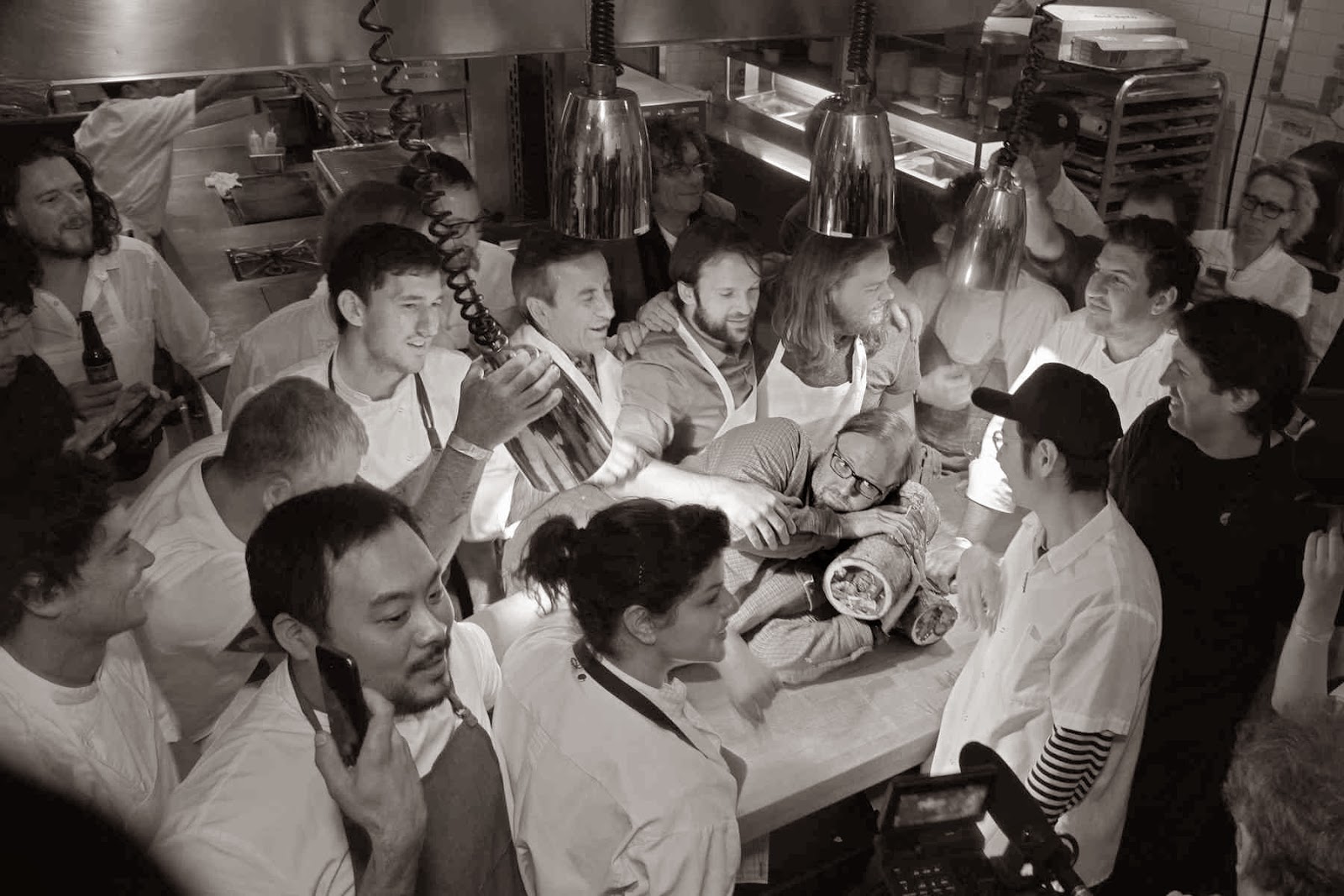
The chefs gather around unwitting host / roastee / honoree Wylie Dufresne, stretched out on his own work table.

At WD50, time was running short. The sun had set, and Dufresne was due to walk through the doors at 7:30 PM, lured to the restaurant on his day off by bogus reports of a refrigeration catastrophe. The ten-course meal--what Petrini called “remixes” of three of Dufresne's signature dishes, including the shrimp noodles—was as ready as it could be. Seventy non-paying guests—each chef had invited two—were hushed into silence in the dark dining room. In the kitchen behind, the lights dimmed; the only sound to be heard was the roar of the range hoods. Thirty of the world's best cooks had worked seamlessly together preparing for this moment, their egos apparently left at home. Now they crouched in the gloom in their colleague's kitchen. Precisely on time, Dufresne entered. In the middle of his own dining room he was greeted with a wide-screen television playing videotaped greetings from one chef after another. “Where are they?” he murmured in the dark, “where are they?” Suddenly, the lights went on, and there they were, hugging him, and serving him reimaginations of his own food. At once the world seemed smaller, friendlier, and a whole lot more delicious.


Alex Atala, Wylie Dufresne and René Redzepi

All photographs courtesy WoWe

Update: I don't want to jinx anything, as it hasn't run yet, but this story has now been acquired by the Suddeutsche Zeitung. If you want your own story, be in touch, as I have many more. 

Another Update: A gently longer version of this story will run in the Suddeutsche Zeitung Feuilleton tomorrow, April 19th, with more images by WoWe.

7/13/2013

A Jarring Experience

Due to various travels, it has been several Saturdays since I was last able to visit the stellar Fort Greene Farmer's market, which spreads out along the south-eastern flank of Fort Greene Park on Saturdays only. I'm not sure if it was the long absence that made everything look good to me, or whether the abundant late rains have helped farmers grow a bumper crop, but it all seemed extraordinarily fresh, green, firm and splendid. The result, of course, was massive overshopping. At the end of wandering up and down the vegetable stands Ruby's folding perambulator could scarcely fit in the trunk of the car, for it was crowded to bursting with bunches of beets, carrots, onions, eggplants, okra, amaranth, lemon cucumbers, more beets, cilantro, squash blossoms and zucchini.

Once home, with the bounty spread out on the dining room table, the excess was obvious. All this perfect legumery would rot and shrivel in the crisper drawer long before we would ever get around to eating it. There was only one possible solution: a long afternoon of pickling.


7/03/2013

Mulberries for Ruby (with apologies to Robert McCloskey)


On a recent trip to Greece, to visit what might best be described as a sustainable techno-hippie commune, I was astonished, again, by the number of olives growing everywhere. Every curve, every rise of the land, every back yard and neglected plot held stands of the trees, their distinctive gray-green leaves swaying in the Aegean breeze. I asked one of the cofounders of the Telaithrion Project if each and every one of the thousands of oliviers that I had seen from the car window had a putative owner. "Absolutely," he said. "But it is cheaper for the people to go to the store and buy olive oil than to bother harvesting and pressing their own, so many people in this village just let us help ourselves to their olives."

When I got back to Red Hook I described this vision of thousands of unharvested olive groves to my dear friend Erika. Both of us were somewhat horrified by the thought of all those splendid olives falling down to the ground and going to waste. We're accustomed to paying twenty dollars for a liter of fine oil at Caputo's or carefully tasting the $6.99 per pound selection of olives at the bar at Fairway. What paradise to have your own olive tree in your own backyard, we mused, without even taking into account the climate that comes with one! I told Erika that the folks at Telaithrion aren't certain exactly how much of their diet comes from foraging, but that they think it might be as much as 20%. When I had arrived, in their front yard, there were bedsheets spread on the ground beneath two mulberry trees, to collect the fruit.

"Now when you start talking about mulberries," said Erika, "I guess I kind of get it. We have a giant tree up in Rockland County, and I admit we don't do a very good job of harvesting the fruit." It's easy to fantasize about other people's fruit trees, but when it's in your own backyard it's harder to make it happen. In New York City? Who has the time?


Actually, Ruby and I do. My peripatetic freelance existence makes for some intense work when I'm on, but when the calendar is empty I bake bread, make preserves and lounge about the house with my seven-month-old daughter to my heart's content. Inspired by the greeks, and without so much as asking Ruby if she wanted to participate in my jammy schemes, I plonked her in her stroller and we headed out into the wilds of Red Hook in search of mulberry trees. (There are no olives.)

Like wild animals, mulberry trees leave tell-tale sign. Looking down the block from the corner the rich dark berries may be invisible on the tree amongst the green leaves, but the swollen, dark fruits scattering the sidewalk are a dead giveaway. 

Low-hanging fruit: An early June mulberry branch, brimming with berries. I can't tell you where, or I would have to kill you.

Above, a typical presentation; an unruly tree has long ago breached the confines of its owner's yard, shading the entire sidewalk with its fruit-laden boughs. Perhaps because they are smudged and smeared by passing pedestrians, who tend to collect a seedy, gooey purple paste on the soles of their shoes, mulberries are not on the New York City Parks Department list of officially sanctioned trees. Although there may be exceptions, the eager forager must therefore typically go in search of the overhanging branches of trees planted on private property. Although nobody has ever come out of their house and accosted me for stealing their berries, this possibility does give urban mulberry gathering an added frisson, the thrill of the trespass. My sense that Ruby's irrepressible grin would help take the edge off any such potentially unpleasant encounters was just another reason to bring her along.


Ruby enjoys the shade of a mulberry tree. Note the dense scattering of fallen fruit on the sidewalk behind her.
Ruby slumbers, while daddy harvests.

Ruby dozily guards the slowly filling mulberry pot with her stroller.

Here an aggressive mulberry has forced its branches through a chain-link fence, soiling the sidewalk with its sugary offerings.

A few days shy of ripe. (I picked the ripe ones before taking this photograph.)

Mulberries come in two varieties, purple, and white. In Red Hook, at least, trees with purple fruit far outnumber those with white fruit, but I did find a few of the latter variety, which are mixed in, above. I believe them to be sweeter, and more highly prized, but perhaps I just think that because they are more scarce.

A healthy bowlful, on the kitchen counter.

The same berries, after macerating overnight in two cups of sugar. Some people skim off the foam before they begin cooking down the jam, but I don't bother.

A case of half pints. I would estimate it took approximately 20 cups of berries to make these, and approximately two-and-a-half mulberry-picking man-hours.

An extra half jar, for immediate use.

TECHNICAL NOTES:

Most recipes for mulberry jam call for an obscene amount of sugar, as much as one cup per cup of berries. That's not mulberry jam, that's mulberry-flavored simple syrup. The problem is that even with low-sugar pectin, mulberry jam won't set very well unless the pectin reacts with a lot of very hot sugar. For me this isn't a problem; I don't care if the jam is runny. You are most likely going to be spooning this over vanilla ice-cream anyway. I used about three cups of sugar for every 8 cups of berries.

You need:

8 cups of berries
3 cups of sugar
1/2 cup of fresh or bottled lemon juice (you want this for the acid, not the flavor, so bottled is fine, and perhaps more consistent).

Ball Jars (about six half pints)

Wash your berries really well; they are, after all, urban berries, subject to soot and exhaust and I know some of them fell on the sidewalk when you were collecting them. Some nerdlins try to remove the tiny green stems. Really? They are very, very small, and I can't see them having a deleterious effect on the final flavor.

Mix the berries and the sugar in a bowl, then gently crush some of the berries with a potato masher or the back of a large spoon, to release some of the juice. Cover and refrigerate overnight. While the berries are macerating, get a good night's sleep.

Clean and then sterilize your ball jars in a boiling water bath. Put your jar lids to soak in the hot water once the jars are ready.

Put the contents of your berry bowl into a saucepan and bring it to a gentle boil over medium flame. Stir while simmering for a minute or five. (If you want to go the pectin route in hopes of firm and spreadable jam, follow the direction that came with your pectin and add the appropriate quantity now--probably a lot more sugar will be required....) Stir your lemon juice in well and turn off the heat.

Pour your jam into the jars, preferably with a canning funnel, and set the lids. Tighten your jar bands finger tight and process the jars in a boiling water bath (fully submerged) for ten minutes.

Spoon over vanilla ice-cream and enjoy.


2/24/2013

Kimchi Jjigae Creole


Lately I have been making my own kimchi. Laden with raw garlic and vegetables, naturally fermented and entirely additive free, this spicy Korean condiment is said to be one of the healthiest foods on earth.   Properly made, kimchi is a living creature, a bubbling, blistering Far-East version of sauerkraut, a simple, humble cabbage brewing in its own juices. The thing lives, its flavor constantly altering as desirable bacteria munch and soften the once-crispy vegetables into submission. Nonetheless, I had always thought of it as a substance to be dabbed sparingly around the edges of other dishes, like hot sauce, or mustard.  This despite the fact that it is very easy to make vast vats of the stuff. In Korean markets in Flushing it is sold in quarts and half-gallons and even gallon tubs, and since it is a live ferment in continuous transformation, its shelf-life is not infinite (or even near-infinite, like hot sauce and mustard and ketchup). Connoisseurs believe kimchi peaks after ten days to two weeks, and that month-old kimchi will soon push what is essentially an ongoing process of decomposition into unpleasantly sour and funky realms. I determined, therefore, that I have been thinking about kimchi in the wrong light. It is not meant simply to accompany, to drizzle or augment. At least in Korea, it is to be munched with abandon, spooned up by the tubful, spread in thick slabs. If not, what to do with tremendous volumes of it?

I remember a perhaps apocryphal story, told to me before I really knew what kimchi was, about the abundance of garlic in Korean cuisine (in which kimchi is arguably the primary vector for garlic-delivery). A British ambassador to Korea, back in London at the end of his tour of duty, attended the opera. There, seated in his tuxedo on the ruby and gold-brocade chairs, watching the performance unfold, he discovered that he and his elegant wife had become pariahs. The stodgy Britains seated within their orbit were, despite the embarrassment of it all, getting up and abandoning the theater. So strongly did the diplomatic couple reek, with the garlic of dozens of Korean state dinners positively leaching out of their pores, that the other patrons departed well before the fat lady sang.


Gradually, I am becoming less obsessed with ethnic culinary authenticity, but one still wants to know if one's kimchi would fly in Incheon. I consulted with some Korean-Americans of my acquaintance. Sohui Kim, chef, neighbor and co-founder of the always excellent Good Fork restaurant (she does a killer steak with kimchi rice) declared it delicious and tasty, if rather too sweet. A few days later, tasting the same batch, the artist Nancy Hwang also questioned the sweet edge to my kimchi*. Then she said: "have you made kimchi tig-eye yet?"
"Kimchi what?" I sputtered.
"Oh that's one of the best things about making kimchi," she said. "You wait until it is almost too funky too eat, and then cook it down, usually with pork. It's the best."

When cooked, kimchi takes on an almost lurid, orange hue

When I typed in "tig-eye," Google corrected me, and I learned the Korean word for stew: Jjigae. Kimchi Jjigae, specifically, is the cure for those large, late-stage volumes of kimchi, which, like bread starter, gets more and more sour the longer it ferments. An indefinable moment arrivess when the stuff just gets too damn funky, the sourness oppressive. It is then time to make kimchi stew.

Due to how ridiculously delicious this is, this pot of kimchi jjigae was almost completely consumed before I remembered to photograph it It's a good thing there's anything left in the bottom of the pan.

There are many kimchi jjigae recipes online, with various added proteins, ranging from pork bellies to silken tofu. Some include both. I didn't have any tofu on hand, but I was recently returned from New Orleans, with an armful of smoky, cajun pork products. I chopped a wrinkled slab of tasso and a couple of onions and sauteed them until the onions were browning around the edges and the tasso had darkened and began offgassing tantalizing smokehouse aromas. Then I chopped about three brimming cups worth of three-week old kimchi and stirred it in. At this point, the Jjigae is all but finished. Just add water** sufficient to make your dish have a nice, soupy-stewy consistency, bring to a simmer and let bubble for five to twenty minutes. Serve with rice.

Looking down the barrel of kimchi oblivion. To the very bottom of a half-gallon jar. It's clearly time to make more.

*I've been experimenting, and none too scientifically. I have a vague recollection of adding a dollop of gochujang to the brine in this batch. Gochujang is basically hot pepper paste sweetened with corn syrup, and I've since been informed that adding it to your kimchi is highly unorthodox and would certainly result in that notably inauthentic sweetness.

**You can also add my new favorite substance, and word, gookmool, which are the intense kimchi juices that collect as a slurry at the bottom of the kimchi jar.

1/19/2012

Time to Make the Cookies! UPDATED


Although I was showered with gifts yesterday on my birthday, the best present I received came last weekend when I fulfilled a Christmas promise to my niece, a budding baking aficionado, and invited her out to Brooklyn to make cookies and bake bread. This was just about the most fun I can remember having in months. First we traipsed around Fairway hand-in-hand, collecting ingredients. Then dough was kneaded, peanut butter, butter and assorted shades of brown sugar were creamed together. Bits of batter plopped onto the floor, swelling loaves were spritzed with a waterjet to generate steam. We formed blobs of insanely delicious mixture into golf-balls and tined them with forks. The kitchen filled with delicious smells. We tasted the results. So much better than any amusement park!


Photo: courtesy Ashley Singer

01/31/2012 UPDATE:
 Just found, the cutest shopping list in the history of shopping.

1/09/2012

Making too much of Gumbo


Although it was not an event officially sanctioned by the Association for the Promulgation of Gumbo, dinner at my house last night owed a lot to the founding spirit of that organization. Call it the fraternity of consumption. Never having invited twenty people to dine at once before, I was typically concerned that there wouldn't be enough food. While at this point I pretty much grasp what dinner for eight should look like when laid out on the chopping board, were two and half pounds of okra, two chickens, and my last few sticks of Laplace, Louisiana andouille going to be enough for the gathering hordes? The affirmative RSVP rate was running at about 96%.


Not to worry. Despite my protestations that I had everything under control, "although a bottle of wine would be welcome, if you feel like bringing one," everyone bought food, and dessert, and wine, and I probably could have fed forty.


Just one little corner of the groaning board. Wild rice with a trio of mushroom species bundled up in lotus leaf, by Ordoubadi. With friends who bring platters like this to your gumbo social, you can almost get away with not even bothering to cook at all, and just blaming the lack of gumbo on a last minute scorched roux accident. But I'm ahead of myself. "First," as it says at the beginning of hundreds of Louisiana recipes, "you make a roux."


Roux, along with okra, is one of the defining, character-bestowing ingredients in gumbo. White flour, slow-fried in bubbling oil, must be whisked constantly to avoid it carbonizing and infecting your gumbo with the acrid taste of arson. Donald Link, of the brilliant Cochon Restaurant, in New Orleans, whose gumbo recipe I was following, writes that "the process of making roux can be hypnotic.... Watching the oil and flour mixture slowly change color and begin to take on its unique aroma gives you plenty of time to be alone with your thoughts."


Indeed, with the narcotic swirling of the whisk, I began almost to hallucinate. The surface of  bubbling roux has the quality of primeval swamp, as if, ultimately, life may emerge from it, the product of some wondrous accident of science and heat. The world and my thoughts, reflected in this toasting caramel lake, put me in mind of that film school classic, Jean-Luc Godard's cosmos as experienced in the swirling bubbles on the surface of a cup of coffee. It's from "2 ou 3 Choses que je Sais d'elle," and while sort of fun, it is almost staggering in its pretentiousness:


It is now time to admit the artistic debt the Association for the Promulgation of Gumbo owes to Godard in its own cinematic debut from early 2011, even if our version is perhaps too minimalist to reach the same heights of pretension:


Almost ready: one wants the roux, says Link, to be the color of a dark copper penny.

Lots of stock.


Perhaps the defining moment in the preparation of gumbo is the addition of the so-called Holy Trinity, along with abundant cajun seasonings, to the lava-like roux. This mixture of equal parts finely chopped onions, celery, and peppers is an obvious manifestation of Louisiana's French culinary heritage, for the Holy Trinity is essentially a mirepoix, with the peppers substituting for carrots. Once this flavor-base is added to the stock, the only remaining question is what sort of gumbo the dish will become. Will it be foot of pork or pile of crawdad? Back of crab or eye of newt? Just about anything can go in there, because no matter what you do next, now it's unquestionably a gumbo.


This one was andouille and chicken, cooked until the chicken was shedding off the bones into string. Last to go in is the okra, a symbol of fertility and virility thanks to many attributes, from its proud, firm shape to its womb-like interior cavity, bursting with seed and slime. Okra likely originates from Africa and was brought to the new world for or by slaves to grow and eat, and Cubans call the vegetable quimbombo, a word almost identical to various West African Bantu names for okra. Gombo, ngombo, gumbo, okra is synonymous with the dish.


The (mostly) Manhattan contingent, the Brooklyn locals having (mostly) wandered home in a gumbo-induced stupor by this point. This and the first photo courtesy of WoWe.


That is the bottom of the kettle you see there. Malheuresement le gumbo est terminé.

1/01/2012

Loafing on New Year's Eve


I'm attracted to superstition, but I'm not superstitious, except perhaps when it comes to natural processes. It doesn't seem to me to be black magic to feel that if the rivers are flowing and the clouds are blowing and the trees are growing as they should, then there is room for optimism. This is the source of the solace I take from the natural world, from wild places. The tide has gone out, but it will come in again.


So I took it as an auspicious auguring that the loaves of bread I baked as my contribution to a New Year's eve dinner last night were, if I say so myself, magnificent. The dough behaved as I expected it to, it swelled and rose in accordance with my understanding of the natural cycle of fermentation, understanding gained after significant effort and observation and much poking and prodding of moist compilations of flour and water. This is a blow-hardian way of saying that my sourdough starter is kicking ass right now.


It has been months since I used commercial yeast. I have no use for the stuff. An untouched jar of it sits in the fridge in the ghetto of mouldering condiments. This bread is made from water, flour and salt, one less ingredient than the Germans allow in their beer. Unless you count life itself as an ingredient, the wild, living yeasts of the air, which find their way into the starter to feed and multiply and expand. When they are doing their job this well, it is hard not to take it as a sign that it will be a glorious 2012!

I'm not bragging, I'm just saying: I would put these loaves up against Balthazar's in a shaolin kung-fu battle for bread supremacy. I apologize that there is no crumb shot, but I didn't want to bust any of these open before taking them to dinner, and snapping pictures of my own bread laid out on the groaning buffet table seemed dreadfully gauche, even for me. Technical details in the comments.