Showing posts with label New Orleans. Show all posts

2/24/2013

Kimchi Jjigae Creole


Lately I have been making my own kimchi. Laden with raw garlic and vegetables, naturally fermented and entirely additive free, this spicy Korean condiment is said to be one of the healthiest foods on earth.   Properly made, kimchi is a living creature, a bubbling, blistering Far-East version of sauerkraut, a simple, humble cabbage brewing in its own juices. The thing lives, its flavor constantly altering as desirable bacteria munch and soften the once-crispy vegetables into submission. Nonetheless, I had always thought of it as a substance to be dabbed sparingly around the edges of other dishes, like hot sauce, or mustard.  This despite the fact that it is very easy to make vast vats of the stuff. In Korean markets in Flushing it is sold in quarts and half-gallons and even gallon tubs, and since it is a live ferment in continuous transformation, its shelf-life is not infinite (or even near-infinite, like hot sauce and mustard and ketchup). Connoisseurs believe kimchi peaks after ten days to two weeks, and that month-old kimchi will soon push what is essentially an ongoing process of decomposition into unpleasantly sour and funky realms. I determined, therefore, that I have been thinking about kimchi in the wrong light. It is not meant simply to accompany, to drizzle or augment. At least in Korea, it is to be munched with abandon, spooned up by the tubful, spread in thick slabs. If not, what to do with tremendous volumes of it?

I remember a perhaps apocryphal story, told to me before I really knew what kimchi was, about the abundance of garlic in Korean cuisine (in which kimchi is arguably the primary vector for garlic-delivery). A British ambassador to Korea, back in London at the end of his tour of duty, attended the opera. There, seated in his tuxedo on the ruby and gold-brocade chairs, watching the performance unfold, he discovered that he and his elegant wife had become pariahs. The stodgy Britains seated within their orbit were, despite the embarrassment of it all, getting up and abandoning the theater. So strongly did the diplomatic couple reek, with the garlic of dozens of Korean state dinners positively leaching out of their pores, that the other patrons departed well before the fat lady sang.


Gradually, I am becoming less obsessed with ethnic culinary authenticity, but one still wants to know if one's kimchi would fly in Incheon. I consulted with some Korean-Americans of my acquaintance. Sohui Kim, chef, neighbor and co-founder of the always excellent Good Fork restaurant (she does a killer steak with kimchi rice) declared it delicious and tasty, if rather too sweet. A few days later, tasting the same batch, the artist Nancy Hwang also questioned the sweet edge to my kimchi*. Then she said: "have you made kimchi tig-eye yet?"
"Kimchi what?" I sputtered.
"Oh that's one of the best things about making kimchi," she said. "You wait until it is almost too funky too eat, and then cook it down, usually with pork. It's the best."

When cooked, kimchi takes on an almost lurid, orange hue

When I typed in "tig-eye," Google corrected me, and I learned the Korean word for stew: Jjigae. Kimchi Jjigae, specifically, is the cure for those large, late-stage volumes of kimchi, which, like bread starter, gets more and more sour the longer it ferments. An indefinable moment arrivess when the stuff just gets too damn funky, the sourness oppressive. It is then time to make kimchi stew.

Due to how ridiculously delicious this is, this pot of kimchi jjigae was almost completely consumed before I remembered to photograph it It's a good thing there's anything left in the bottom of the pan.

There are many kimchi jjigae recipes online, with various added proteins, ranging from pork bellies to silken tofu. Some include both. I didn't have any tofu on hand, but I was recently returned from New Orleans, with an armful of smoky, cajun pork products. I chopped a wrinkled slab of tasso and a couple of onions and sauteed them until the onions were browning around the edges and the tasso had darkened and began offgassing tantalizing smokehouse aromas. Then I chopped about three brimming cups worth of three-week old kimchi and stirred it in. At this point, the Jjigae is all but finished. Just add water** sufficient to make your dish have a nice, soupy-stewy consistency, bring to a simmer and let bubble for five to twenty minutes. Serve with rice.

Looking down the barrel of kimchi oblivion. To the very bottom of a half-gallon jar. It's clearly time to make more.

*I've been experimenting, and none too scientifically. I have a vague recollection of adding a dollop of gochujang to the brine in this batch. Gochujang is basically hot pepper paste sweetened with corn syrup, and I've since been informed that adding it to your kimchi is highly unorthodox and would certainly result in that notably inauthentic sweetness.

**You can also add my new favorite substance, and word, gookmool, which are the intense kimchi juices that collect as a slurry at the bottom of the kimchi jar.

1/09/2012

Making too much of Gumbo


Although it was not an event officially sanctioned by the Association for the Promulgation of Gumbo, dinner at my house last night owed a lot to the founding spirit of that organization. Call it the fraternity of consumption. Never having invited twenty people to dine at once before, I was typically concerned that there wouldn't be enough food. While at this point I pretty much grasp what dinner for eight should look like when laid out on the chopping board, were two and half pounds of okra, two chickens, and my last few sticks of Laplace, Louisiana andouille going to be enough for the gathering hordes? The affirmative RSVP rate was running at about 96%.


Not to worry. Despite my protestations that I had everything under control, "although a bottle of wine would be welcome, if you feel like bringing one," everyone bought food, and dessert, and wine, and I probably could have fed forty.


Just one little corner of the groaning board. Wild rice with a trio of mushroom species bundled up in lotus leaf, by Ordoubadi. With friends who bring platters like this to your gumbo social, you can almost get away with not even bothering to cook at all, and just blaming the lack of gumbo on a last minute scorched roux accident. But I'm ahead of myself. "First," as it says at the beginning of hundreds of Louisiana recipes, "you make a roux."


Roux, along with okra, is one of the defining, character-bestowing ingredients in gumbo. White flour, slow-fried in bubbling oil, must be whisked constantly to avoid it carbonizing and infecting your gumbo with the acrid taste of arson. Donald Link, of the brilliant Cochon Restaurant, in New Orleans, whose gumbo recipe I was following, writes that "the process of making roux can be hypnotic.... Watching the oil and flour mixture slowly change color and begin to take on its unique aroma gives you plenty of time to be alone with your thoughts."


Indeed, with the narcotic swirling of the whisk, I began almost to hallucinate. The surface of  bubbling roux has the quality of primeval swamp, as if, ultimately, life may emerge from it, the product of some wondrous accident of science and heat. The world and my thoughts, reflected in this toasting caramel lake, put me in mind of that film school classic, Jean-Luc Godard's cosmos as experienced in the swirling bubbles on the surface of a cup of coffee. It's from "2 ou 3 Choses que je Sais d'elle," and while sort of fun, it is almost staggering in its pretentiousness:


It is now time to admit the artistic debt the Association for the Promulgation of Gumbo owes to Godard in its own cinematic debut from early 2011, even if our version is perhaps too minimalist to reach the same heights of pretension:


Almost ready: one wants the roux, says Link, to be the color of a dark copper penny.

Lots of stock.


Perhaps the defining moment in the preparation of gumbo is the addition of the so-called Holy Trinity, along with abundant cajun seasonings, to the lava-like roux. This mixture of equal parts finely chopped onions, celery, and peppers is an obvious manifestation of Louisiana's French culinary heritage, for the Holy Trinity is essentially a mirepoix, with the peppers substituting for carrots. Once this flavor-base is added to the stock, the only remaining question is what sort of gumbo the dish will become. Will it be foot of pork or pile of crawdad? Back of crab or eye of newt? Just about anything can go in there, because no matter what you do next, now it's unquestionably a gumbo.


This one was andouille and chicken, cooked until the chicken was shedding off the bones into string. Last to go in is the okra, a symbol of fertility and virility thanks to many attributes, from its proud, firm shape to its womb-like interior cavity, bursting with seed and slime. Okra likely originates from Africa and was brought to the new world for or by slaves to grow and eat, and Cubans call the vegetable quimbombo, a word almost identical to various West African Bantu names for okra. Gombo, ngombo, gumbo, okra is synonymous with the dish.


The (mostly) Manhattan contingent, the Brooklyn locals having (mostly) wandered home in a gumbo-induced stupor by this point. This and the first photo courtesy of WoWe.


That is the bottom of the kettle you see there. Malheuresement le gumbo est terminé.

3/30/2011

Coney Island Rest in Peace


I blogged last spring about joining a joyous New Orleans-style 2nd line parade over the Brooklyn Bridge. This Sunday, April 3rd, more or less the one year anniversary of that event, NOLAphile James Demaria is organizing another. This one is a funeral for the late, great Coney Island.
If you are worried that a funeral might make for a depressing Sunday beside the gray and so-far unspringlike seashore, you don't know much about New Orleans 2nd lines. Furthermore, Demaria remarks on the facebook invitation page that "This event is symbolic of our hopes for Coney Island's rebirth. It's joyous. And hopeful. And if you don't agree with sarcastic fun we don't want you there."

Despite just how strongly I do agree with sarcastic fun, I unfortunately won't be able to attend. But you should. Surf Avenue and West 12th, at 2PM.

4/27/2010

Where there's smoke, there's fire...

We interrupt this orgy of self-promotion (see post immediately below) to bring you the important news that traffic along the Airline Highway in LaPlace, Louisiana slowed to a crawl yesterday when motorists were confronted with billowing clouds of thick and fragrant smoke, pouring out of Jacob's World Famous Andouille. (see post about three posts ago). We received an urgent communiqué from antarcticiana's New Orleans regional correspondent, that fabulous painter, Myrtle von Damitz III, tipping us to the breaking story on NOLA.com, from which I quote extensively:

"Flames have engulfed a rear section of the store, possibly the smokehouse....

"Traffic in both directions along Airline Highway is extremely slow as thick smoke and an acrid smell hangs heavy for several blocks.


"'The car wash guys saw the flames and ran in to tell me to call 911,' said Robin Guillot, owner of the Quick Stop Car Wash, which sits very close to Jacob's. 'We were worried cause we had some cars parked along the side very close to the building.'

"Jerry Lumar was traveling from Norco to LaPlace to get his truck washed when he noticed smoke all over Airline Highway, he said.

"'They have some real good andouille,' Lumar said. 'Thank God nobody was hurt.'"

We agree with Jerry in every way, and we urged von Damitz to stick to this story like a splash of gumbo on a prom dress. A few hours later she sent more info, including comments from LaPlace fire chief John Snyder:


"''our first truck arrived at 3:39 to find heavy smoke in the middle building of the property, which is the smokehouse,' he said.

"The front, or retail portion of the business sustained little or no damage, Snyder said. 'Mostly just the smell of smoke.'

"Most of the inventory was moved to coolers in the back of the business, able to be saved."

Apparently the cause of the blaze was unknown. (I'm not a fireman, but I'll go with "ignited pork drippings." Just a theory.) Thank goodness I still have a giant stick of Jacob's andouille in the freezer to tide me over until they get back up and running.

4/09/2010

Crucial ingredient


It is a rare day that antarcticiana jumps on somebody else's story and recycles it, but on our January stay in New Orleans we were shameless tourists, consulting the local literature and doing everything possible to maximize all forms of excitement, whether culinary, musical, or architectural. It seems only fair to share the good news with our wide and cosmopolitan audience. We're also already big fans of the edible series of magazines, which appear to be defying the generalized hemorrhagic fever cutting down the publishing industry; they're springing up like March crocuses in one small regional marketplace after another.

The very first issue of edible New Orleans appeared in tidy piles in Bywater cafés and restaurants only days after our arrival at the beginning of January, featuring on its cover a row of giant but smoke-wizened andouille sausages dangling in a row above an undoubtedly fragrant puff of woodsmoke. Laplace, Louisiana, the article editorialized, is the andouille capital of the planet.

In the two centuries since the French sold us most of the Mississippi valley for the equivalent of a few bowls of gumbo, the Louisiana andouille has diverged enough from its continental ancestor that they really shouldn't be thought of as the same sausage. Somewhere in France someone doubtless disagrees, but American andouille is ruddier, spicier, smokier, chunkier and more rustic than its finer French cousin. I was aware of the Louisiana variety as a ubiquitous and essential ingredient in cajun cuisine, a sort of local bacon likely to crop up in everything from jambalayas and breakfast sandwiches to chocolate bars, and had bought a package at the supermarket while laying in supplies. Only after I read edible New Orleans did I come to understand that the dull orangey cluster of shrink-wrapped, factory-produced links I had acquired scarcely deserved to print the word on their packaging. Mine were wet and scrawny and soaking in nitrates; the photographed andouille hanging in the smoke were gigantic meat batons, wrinkled and dry from countless hours of smoking. They looked like the sort of preservative-free sustenance that you would hang off the pommel of your camel-saddle for emergency snacking during weeks of trudging through the desert. If there is a culture that rides camels and also eats pork.

Laplace is an hour west of New Orleans. I'm willing to drive much further than that to sample premium hog products, so Laura and I jumped in the truck.

Being known as the andouille capital of the world is perhaps a humble distinction. Once we had arrived, after an hour's drive through salt-blasted cypress stumps, the town's stretch of the "Airline Highway" proved to be a generic and charmless strip of big box stores and auto-glass purveyors ready at any moment to slide back into the swamp. It was a tawdry landscape, and it seemed entirely credible that regional sausage excellence was the town's greatest and perhaps only claim to fame.


Our first stop was at Bailey's "World Famous Andouille," the largest business in a modest strip shared with a hair-salon named Starz and the sort of one-desk-and-a-fax-line financial services firm you might expect to find pushing 5-year ARM mortgages in a roadside mall in Louisiana. But to step through the doors was to enter a womb of regional character and cultural preservation entirely distinct from the mind-numbing familiarity of the chain-store landscape outside. A long row of icy display cases held one product after another critical to the local culinary heritage and entirely unavailable back home in the tri-state area. Forget the andouille, here's a sampling of things I'm fairly certain are not on offer at the local Red Hook Fairway: Hogs Head Cheese (hot or mild), Boudin, Tasso, Smoked Pig Tails, Hand-ground Filé, Rabbits, Green Onion fresh sausage, and Chicken Gumbo, for starters. In fact, most people outside of Louisiana have no idea what most of these things are; I was only familiar with Tasso, the salt-dried pork, because an identical beef preparation with the identical name is still served in Haiti. (It is meat salted and dried to just this side of jerky.) We gobbled some boudin, had a cup of gumbo, and bought a stick, as andouille sausages are known locally. Log might be more appropriate; Bailey's andouille was at least an inch-and-a-half in diameter, and something like a foot long, nothing like the inadequate hot-doggesque links I had purchased in a New Orleans supermarket, about which I suddenly felt ashamed.


Only fifty yards down the highway was our second stop, Jacob's "World Famous" (no relation). Although almost next door, Jacob's sticks proved that there is no one ideal archetype for this king of sausages. Jacob's andouille was dryer, denser, and smaller, if still imposing; I suspected that it and Bailey's version had likely begun their existence as similar sized agglomerations of chopped pork shoulder and spice, but that Jacob's had smoked theirs longer, rendering more fat, shriveling the casing and hypothetically intensifying the smokey flavor. It was the reddest of the three sausages, with the calloused skin of an octogenarian woodsman. Visually, I found it the most appealing. 

"Don't be confused, we are the original Jacob's." In fact, we've been in business since long before the invention of ducts, conduit, vents and maybe even electricity.

But two giant sausages weren't enough, so we left the strip, looking for Wayne Jacob's (some since expired but historical relation) and a sausage trifecta. A few blocks in, on what might have once been the main street before the Airline Highway sucked the life out of it, WJ's is the only spot of Laplace's three towering pillars of andouille manufacture to have seating, so we sat. And ordered lunch, despite the long morning of snacking on pork crackling. Here I made the only misstep of the day, ordering a pulled pork platter. Laura is from North Carolina, and while some Louisianans, Alabamans and Georgians might disagree, you really can't mess with NC pulled pork. I blame myself, not Wayne, or Jacob; this was poor ordering. I should have gumboed or jambalayaed, even though by now I felt I was up to my ears in the stuff. The andouille here was a gigantic meat baton, but I can't tell you anything about the flavor, because I took it as an offering when invited to an upstate Mississippi farm for the weekend, and I never saw or heard from it again. (This post was never meant as a battle of the andouille, but next time I'm in Laplace I promise to do a side-by-side taste test and post an update).


It's all about the smoke. Pecan is the wood of choice, which contributes to the regional character, pecan orchards being almost synonymous with the deep south. One imagines that an andouille smoked with Massachusetts hickory chips would have Yankee overtones. Nonetheless, back in Brooklyn, and having exhausted my supply of andouille, I scored some double-smoked kielbasa from Eagle Provisions. Desperate to make some jambalaya, I was unwilling to wait for some airlifted sausage to arrive from Laplace (Jacob's and Bailey's will both overnight ship to you, although don't expect Google checkout).  I don't know what kind of wood chips they use in Poland, but the kielbas' was a highly effective substitute.

4/03/2010

The Whitest Second Line I've Ever Seen


In my ongoing delight with all things New Orleanian I jumped on the bicycle this morning and took a ride up to the Brooklyn Bridge, where a NOLA-style Second Line parade was advertised for 10AM, "giving the Big Apple a taste of the Big Easy." At the Brooklyn end of the walkway various NOLAphiles were already in evidence, sporting Saints t-shirts, Mardi Gras beads and the parasols that are twirled during these traditional parades. For those that don't know, a Second Line is a celebratory parade in which dancers lead a growing and organic throng of marchers through the streets of New Orleans, invariably accompanied by a brass band (the actual "second line" [Oops, apparently only sometimes: see the comments, where my good friend CP, NOLA historian extraordinaire, has kindly checked in to qualify this observation]). Second Lines are often organized as memorials, or as part of funerals. The most ornate and well-organized showcase the various social aid and pleasure clubs, black fraternal organizations which provided emergency loans and assistance to the post-slavery Afro-American citizenry, attempting to counterbalance the almost total lack of any social, civic and banking services extended to them by the ruling white elite.


The Brooklyn Bridge Second Line seemed to have no particular purpose beyond an expression of pure and communal Easter weekend joy. Under a piercing blue sky a small troupe of musicians and dancers tromped and pranced up the boardwalk, to the bemusement and smiles of gaggles of international tourists taking advantage of the New York's greatest single free attraction, a Saturday morning stroll across the bridge.


It was an event that, it seemed to me, could scarcely have happened without facebook and the recent revolution of social media. Would the hundreds of strangers gathered there, united only in their Mardi Gras memories or one-time residencies in the Crescent City, ever have responded in such numbers to an announcement on the back page of the Village Voice, or flyers posted on telephone poles? Unlikely. In the barrage of tweets and links that descend each day I can't even remember exactly where or how I stumbled onto the news, but there I was, and what a delightful East River spring morning it turned out to be!


3/28/2010

Pow wow in Taylor Park, Central City, New Orleans

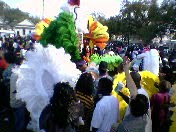
On the most colorful day of the year, photographically speaking, I found I had let the batteries in my trusty G10 run all the way dry. Since nothing happens by accident, it may be that my failure to charge was a subconscious gesture in Freudian sympathy with the Mardi Gras Indians fascinating attempt to control the commercial exploitation of their image.

(As any producer of commercials and films knows, it is absolutely verboten to include corporate logos, signage, and even the facades of actual bricks and mortar stores in televised footage, without clearance. I find this a grotesque overreaching of copyright law. The Denny's, McDonald's and Nike's of the world are happy to bombard us constantly with unwanted billboards, logo-mad clothing, advertising and all manner of intrusions into our visual space, but still wish to keep complete control over the use of their imagery? This is absurd. But if they are legally allowed to challenge the "fair use" doctrine then the Indians should be as well.)

What follows are all that I could manage from the Super Sunday Uptown Indians Parade on a five-year-old cell phone: