10/15/2006

When is the '90s theme party?

One of the reasons I'm enjoying myself here at McMurdo is that the Antarctic lifestyle attracts a lot of people who, like me, seem to refuse to grow up. With its hot cafeteria meals, dorm rooms and shuttle busses, McMurdo's social ambiance might best be summed up as permanent college. It should therefore be no surprise to anyone that theme parties abound. After all, why go out and get drunk and dance all night when you can go out and get drunk and dance all night in silly costumes?

Many of those who attended Saturday evening's "70s" party at Gallagher's pub were too young to have memories of that glorious decade, when Steve McQueen drove cars in movies, a Republican president resigned and funk reached its apogee. It was also the decade in which, as my mother likes to remind me, I told my eighth-grade math teacher that "I just can't get into doing my homework." Rather a number of men inexplicably associated the 1970s with transvestitism and dressed in women's clothing, thereby helping improve the rather dire male-female gender ratio that is the cause of much McMurdo tension. I didn't have a costume, having left the gold-plated razor blade I usually wear around my neck back in Brooklyn, so I made do with pointing out to everyone that all my hair is real, and my own.

All Photographs courtesy of Sylvestre Guidi

Number One Soul Sister

Marsha gets Funky

Barry rocks the electric blue Rod Stewart mullet


Is that an armpit stain? That is soooo '70s

Stand back while I channel Elton John

Put your camera down and dance, cowboy

I'm pretty sure this is almost exactly what Deany looked like in 1979

Mardi Gras Escapee

Will gets wiggy

Laura's upset because she thought the dresscode read "1950s sorority girl" on the invitation

"Guys, where's my Harley? ...Guys. No, seriously. C'mon guys, it's not funny..."

Going home is just like 1988 when you walked out of "Save the Robots" on Avenue B and found to your horror that it was broad daylight outside

How about steamed, with a little butter and lemongrass...?

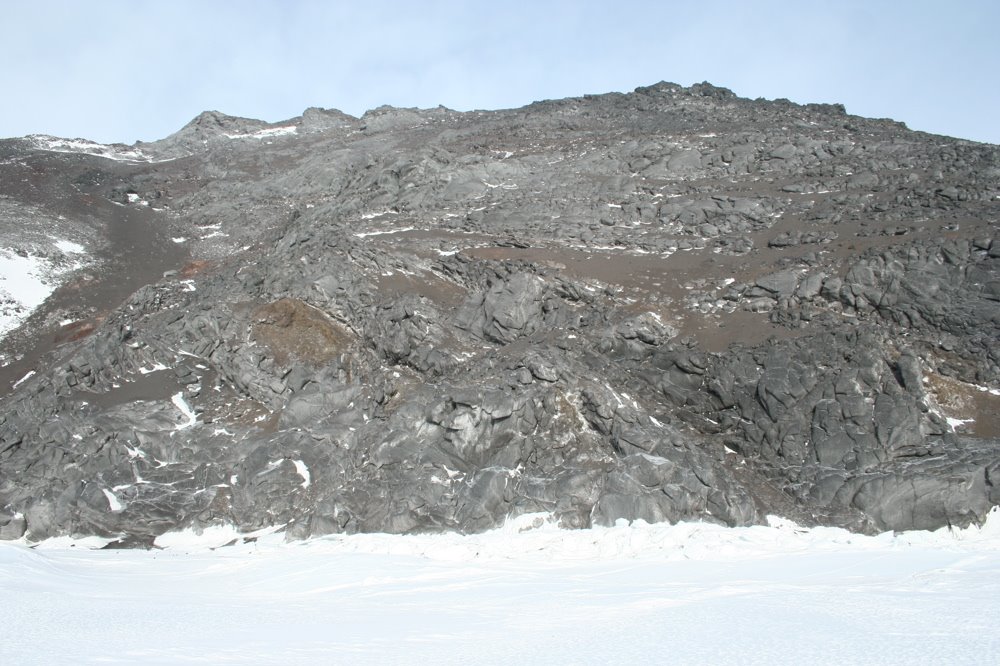
It's much steeper than it looks, that's why they call it Inaccessible Island


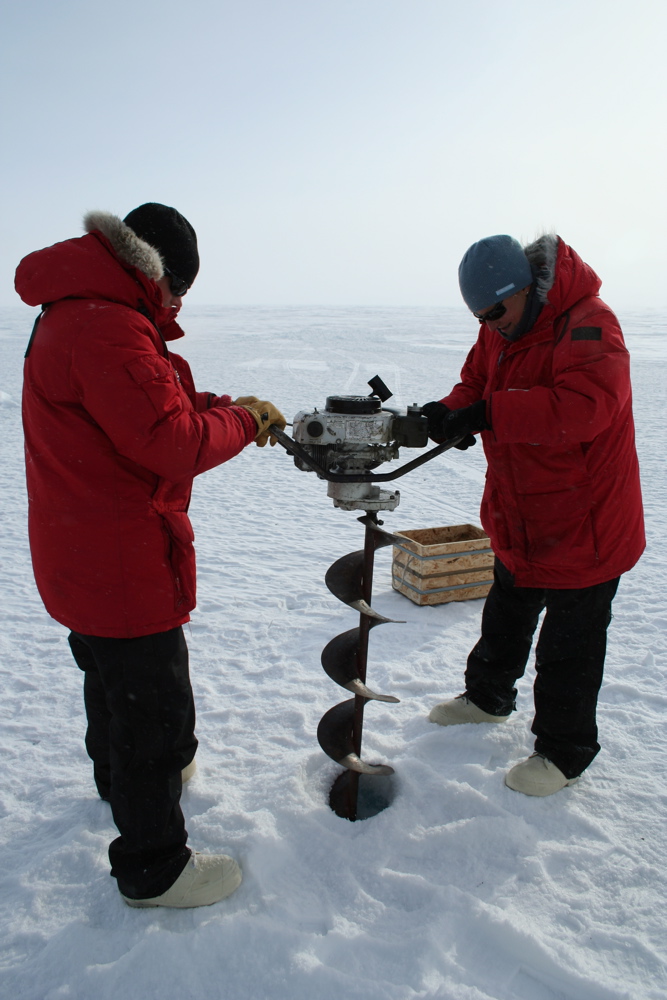
Yesterday, feeling we hadn't been out of McMurdo in an age, and then only in the middle of the night to groggily shoot landscapes, we decided to go fishing at the foot of Inaccessible Island. With a posse of three lady marine biologists and one dude, on skidoos and by Pisten Bully convoy, we headed out for the fishing holes. A Minnesotan friend of mine in college, a veteran ice-fisherman from the land of ten billion lakes, once spent an evening recounting to me the joys of winter fishing in Minnesota. The sport has all the rich cultural complexities and unassailable traditions that characterize all subcultures; in Minnesota the winter fish huts are dragged out into the middle of huge frozen lakes with Ford Pickups, and sit there for the entire season, complete with generators, television for the football games, wood stoves, Hudson Bay blankets and all the other conceivable comforts that make for endless pleasant afternoons of fishing. Namely beer.


What time is kickoff?

There is no structural difference between Minnesotan ice fishing and Gretchen, Mackenzie, and Anne's approach to their scientific work; the only big contrast is in what they do with their catch. My college friend Tim swore that when the fish were biting on the Minnesotan ice he and his buddies would pull them out and slap them to the sides and roof of the truck, where the fish would promptly freeze solid to the cold metal. Once the vehicle had been converted into a sort of frozen fish sculpture they would then drive to McDonald's and go through the drive-through to try and freak out the burger jockeys. Instead our friends the marine biologists do everything possible to keep their catch alive, rushing them into a cooler of sea water the moment they pull them up, to avoid the fish freezing. The water underneath the sea ice maintains an almost constant temperature year-round of negative 2 degrees C, and the fish they catch are extremely intolerant of variations in temperature. They are interesting in part because a sort of natural anti-freeze flows through their veins.

It's never too early to schedule your mandatory ice probe...

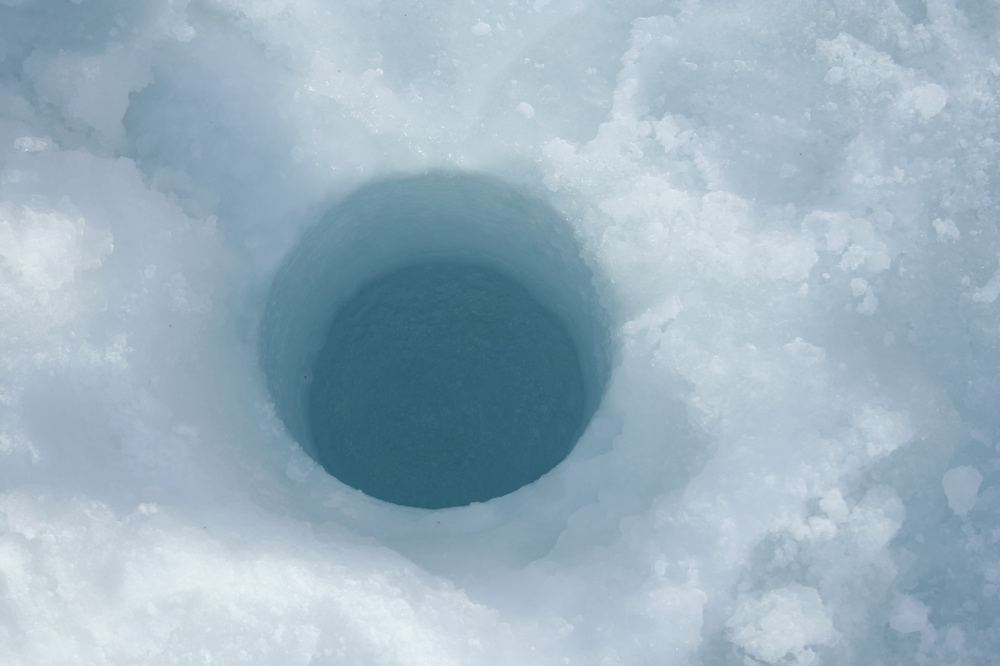
At one point a passing seal exhaled below and a rush of bubbles set the surface of the hole aboil

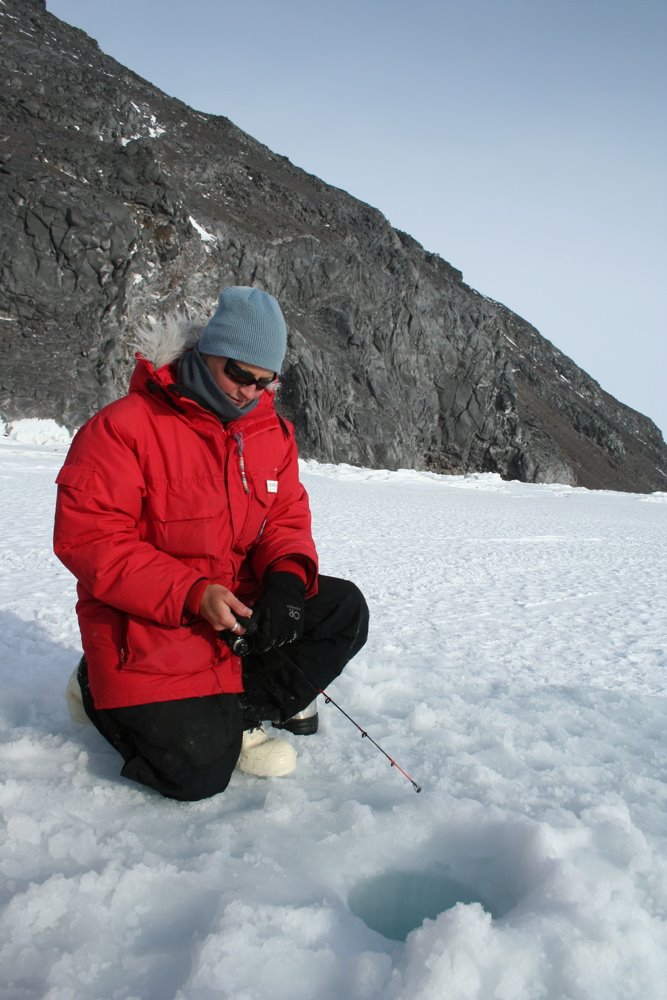
It was delightful to watch these scientists, as competitive in their fishing as any beer-swilling Minnesotans could be, dropping their neon glow-worm lures down freshly-drilled holes off the ends of absurdly short fishing poles--ordered, of course, from a speciality fishing rod outfit in Minnesota. In a couple of hours they pulled out some 35 fish, which are now to be found swimming in tanks on the lowest level of the Crary lab. The moment Anne pulled up a fish Mackenzie would seize her own rod and announce "I'm going in," taking over the hole for her turn.


That's a cute little pole you got there, darlin'


Mmmm, another day done. Time to pop 'em in the skillet!

10/13/2006

Next time wake me up before you take the tent down, please.

In just over a week we will head out into the field with a group of geologists, leaving behind the comforts and stresses of McMurdo life to embark on what I suspect will be much more of an Antarctic adventure than our experience to date. Yes, we occasionally venture out onto the sea ice and drive around in bizarre little tracked vehicles and get frost in our balaclavas, huddling in the wind with thermoses of tea and munching chocolate bars, but at the end of the day we always return to a hot starchy meal in the corporate-retreat style dining hall and sack out in dorm rooms overheated by the glycol endlessly coursing through the radiators. In the Olympus range we won't have any heat and will only run an electric generator when it is absolutely necessary to recharge the batteries for the camera and sound equipment. We are hoping that will only be once a week or so. Some passive solar gain is to be expected in the tents, but the idea that we will never be going into a building to properly warm ourselves up makes for a radical shift.

"Now you just scoop it out." Bija demonstrates how to perform a lobotomy on a Winfly veteran traumatized by the massive influx of giggling summer visitors to McMurdo. Photo: Anne Aghion


We have therefore been spending some time lately at the Berg Field Center, where a crew of earnest, cheerful outdoorspersons of the sort one often meets on the sales floor at EMS or Paragon have been helping us check out our gear. A couple days ago we set up our "Endurance" tent inside their facility. It is a large ribbed structure, sixteen by eight feet. It wasn't particularly difficult to set up in the windless comfort of the seventy degrees warm BFC, and will doubtless be an endless nightmare in mittens and thirty knot winds. I was exhausted to begin with and tried to catch a nap once we had the thing up. Everyone else got out of the tent and I just lay there until the others took it down again and discovered me.

The operation was a success! The patient, in recovery. Photo: Anne Aghion

10/10/2006

Hokusai, Adieu


Today we are absorbed with the mundane task of moving offices. An enormous many-tentacled science project with a staff of fifty requires the entire wing of Crary in which we were previously stationed. It goes by the ominous, cult-like name of Andrill, as in "this whole wing of the building will be Andrill," or "he's with Andrill," and "more of Andrill will be arriving on the next flight," etc. I haven't met anyone who knows really what Andrill is, or what Andrill does, and the ones who are Andrill don't know us and still act like city people and don't say hello, as if, as Anne puts it, one is on an elevator in New York. "Greetings, fellow Antarctican!" I say brightly and cheerily as I pass the unfamiliar faces one finds roaming the halls of Crary lab these days. But with little response. Oh, it must be Andrill. (Okay, I admit it, I'm bitter. I liked the views from our office window, and now we have none. I'm lashing out as I slide down the totem pole. One of them even smiled at me.)

Therefore, sadly, there will be no more views of the telephone poles outside our office. Because it is no longer our office. It belongs to Andrill.

10/09/2006

The Winter Journey, continued: Retribution of the Penguins

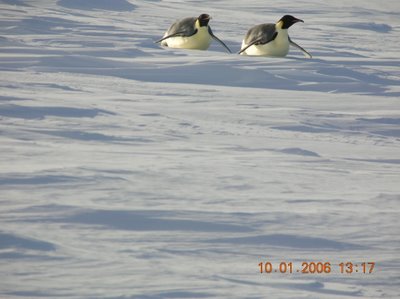
"The water may be frozen, but let's swim across anyway and take a look at those bizarre creatures in puffy red parkas." Photo: M. Deany


The Sunday before last, Sundays being most people's day off, the recreation department had on offer an outing to Scott's hut at Cape Evans. Since we had been there the day before, I didn't go, a decision I regretted when Deany described the trip to me the next day. En route, the group spotted a cluster of blank lumps spotting the otherwise pristine sea-ice just off tent island. These proved to be a curious group of nine wandering emperor penguins, which immediately approached to investigate the strange apparition of triple-height bright big red penguins emerging from an enormous orange Delta. Deany's photos were stunning, as were the videos. This group of emperors took no revenge on the alien daytrippers, for they were allowed to continue on unmolested; in fact they were still lingering about near the flagged route on the way back.

"Mess with us and prepare to feel the wrath of the emperor!"
Photo: M. Deany


Bowers, Cherry-Garrard and Wilson had less luck after raiding the Cape Crozier emperor colony on July 20th of 1910. "We turned out at 3AM and got the canvas roof of our hut, with the door piece, fixed on and built in and made safe with blocks of snow and gravel and rocks anchoring it all round," writes Wilson of the morning of the group's only successful visit to the penguin colony, after having trekked more than three weeks from Cape Evans.
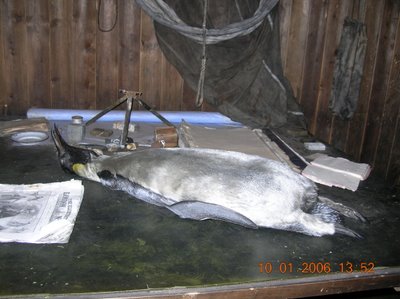
Bad Karma: emperor specimen abandoned by Scott's party or a later expedition, in the Cape Evans hut. Photo: M. Deany

"We collected five eggs, of which only three unfortunately reached camp intact, and these split when they froze on the way home," writes Wilson. They skinned and flensed three emperors for their oil and clambered and staggered back to their hut, where they became blackened and greasy from the foul smoke given off by the blubber. Wilson almost went blind in one eye that night when he was hit by "a spirt of burning oil."
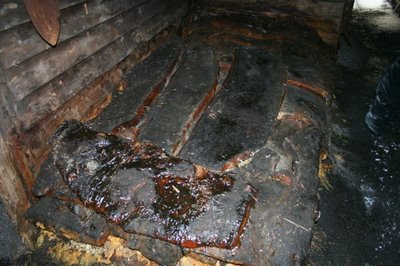
You never seem to have any seal blubber when you most need it: the stockpiled fuel at Cape Evans was of no use to the winter journey party at Cape Crozier. Almost one hundred years later a clammy, fishy smell still pervades the frozen foyer of the hut.


"Our first night in the hut was good save for my eye," he wrote the next day. But in the next sentence he adds "the wind rose to force 8 and had an effect on the canvas roof we didn't quite like the look of." To protect their tent, which they would need on the way home, they pitched it in the lee of the hut. On Sunday the 22nd, "it was blowing 9 to 10 with heavy drift and very violent gusts, and soon after this when Bowers looked out of the hut door he saw that the tent had been bodily blown away, legs, lining cover and all..." Two noncritical bits of the stove were swept away, but much of the rest of the gear that was in the floorless structure miraculously remained where it lay, and they quickly brought it into the hut. Wilson was not a man given to panic, or at least he was not a man who expressed much panic in his diary. Cherry-Garrard, in The Worst Journey in the World, was rather more blunt: "To get that gear in we fought agaist solid walls of black snow which flowed past us and tried to hurl us down the slope.... There was no doubt that we were in the devil of a mess." But the relatively long term tragedy of the tent, whose loss would only become devastating when the men attempted to return to Cape Evans, was quickly forgotten as the storm continued to build, threatening their stone and ice hut, which CG refers to as an "igloo." That evening a pipe connection on the blubber stove melted, rendering it useless, and forcing the men to use their oil-burning primus. "We then settled that in view of the shortage of oil we would not have another meal for as long as possible," wrote Cherry-Garrard.

At this point one imagines the trio lying on their backs in drifted-in reindeerskin bags, fine drifting snow and black volcanic sand pouring through every crack and nook of their sieve-like igloo. The wind is raging, such that the canvas tarpaulin roof, which the men are imagining will serve as their tent on the three week trek back, is flapping with tremendous violence above their heads, steadily shaking loose the sledge and the slabs of snow that they had packed on top of it to secure it. It is Wilson's birthday, and he, unlike the roof of the hut, remains unflappable: "...quite the funniest birthday I have ever spent. The wind was terrific. It blew almost continually with storm force--there were slight lulls occasionally followed by squalls of very great violence, and at about noon the canvas roof of the hut carried away and we were left lying exposed in our sleeping bags without a tent or a roof. The storm continued all day with unabated vigour. There was no choice for us now--we had decided this before in the event of our roof being blown off--we had to remain lying there in our bags till the blizzard stopped."

Warm and Cozy or Soggy and Frozen? You be the judge. A rather mealy reindeerskin bag left at Cape Evans. Photo: M. Deany

While Wilson was considering the hilarity of his birthday circumstances, Cherry-Garrard, beside him in a sleeping bag now half-buried by snow-drift and the fallen rocks that had once secured the canvas roof of the hut, focussed on the certainty of their imminent demise: "...when the roof went I felt that this was the end. What else could I think? We had spent days in reaching this place through the darkness in cold such as had never been experienced by human beings. We had been out for four weeks under conditions in which no man had existed previously for more than a few days, if that. During this time we had seldom slept except except from sheer physical exhaustion.... We had kept ourselves going by enormous care of our feet and hands and bodies, by burning oil, and by having plenty of hot fatty food. Now we had no tent, one tin of oil left out of six, and only part of our cooker. When we were lucky and not too cold we could almost wring water from our clothes, and directly we got out of our sleeping bags we were frozen into solid sheets of armored ice. In cold temperatures with all the advantages of a tent over our heads we were already taking more than an hour of fierce struggling and cramp to get into our sleeping bags--so frozen were they and so long did it take us to thaw our way in. No! Without the tent we were dead men." Having for want of fuel already not eaten for more than 24 hours prior to the roof blowing off, the men huddled in their bags, singing hymns and melting snow in their mouths to drink as days passed. Cherry-Garrard reckoned it force 12 winds, a full-on hurricane, ripping past them where they lay behind the low walls of their makeshift structure, now fully open to the elements. "The winds of the world were there, and they had all gone mad," he wrote. "I have never heard or felt or seen a wind like this. I wondered why it did not carry away the earth."

To Be Continued: Will our heroes survive the great tentless winter storm? Or will the string of bad luck that has plagued them since the snatching of the penguin eggs do them in once and for all?

10/08/2006

Purple Haze All in my Brain


We went out from 2AM to 6AM this morning to capture the last moments of this season's Antarctic night. A four-month long day, unbroken by sunset, is about to start. I am fried and badly need to sleep, and it was cold and windy, but the visions were unparalleled. Sadly I see that I need to clean my camera lens; a dark, round spot graces all these otherwise sublime images.... I'll take care of it after my nap.

10/06/2006

Big Gray Aeroplane

We went out to the sea ice runway yesterday to say goodbye to my main man Phil and film the departure of a C-17 transport full of departing friends. The shared experience of living in an industrial company village surrounded by endless expanses of brilliant icy wilderness makes for quick and profound friendships, and we saw not a few tearful goodbyes. Another hundred or so summer residents arrived, swelling the ranks of the unknown faces at the galley. Amongst them we can only hope that we will find new friends as fast and true as those who have just flown off. Because every year everyone here seems to have a slightly different schedule, some working a 14 month contract one year, a winter and summer only the next, or a Winfly arrival through the end of summer, etc., the town is full of old friendships being renewed. People who spent a winter together, bonding tightly in some past season, now find that this year they only overlap for the few days between a summer arrival and a Winfly departure. The bars are full and those about to depart alternate frenzied packing with frenzied socializing. Being "fingees," (pronounced fin-jeeze, the derogatory term for first timers on the continent, derived from 'f@%#*&! new guys') and worse, people unlikely to return to McMurdo, we are largely on the outside of all these high-pitched emotions.

Welcome Summer Residents! Ivan the Terra Bus, from: Vehicles of McMurdo

Eager to Offload: Caterpillar Tractor Power on the Sea Ice

Did you say something? All I heard for four hours was some very big jet engines.

10/04/2006

Home, Sweet Home

My main man Alejandro "El Jevy de Coffey St." Wolfe is out there in Brooklyn holding down the ranchito. Jealous of the weather down here, he is threatening to move to Montreal some time soon, but for the moment he is taking care of the bamboo I planted in my back yard at the bottom of the only in-ground swimming pool in King's County. Until I discovered the McMurdo greenhouse I was positively craving vegetation, so Alex (aka El Cacique de los Gringos) snapped this shot for me, out the bedroom window. In a couple of years I am hoping to take over the contract to provide bamboo flags to the US Antarctic Program. Gracias, Compay!

Actively seeking interns for exciting springtime opportunity in landscape architecture. Send your resume today!
Photo: Alex "El Rey Enorme y Eterno de todos los Castillos de Amargue de Jagua" Wolfe

10/03/2006

The passing of our salad days

Yesterday the first flight of Mainbody arrived, "mainbody" being the local term for summer, synonymous with hustle and bustle, overcrowding, permanent sunshine, fresh vegetables and the actual carrying out of scientific experiments. Over the next week hundreds more summerers will arrive and our Winfly cronies and the folks we have filmed and celebrated and commiserated with will fly off to three and four and sometimes more month vacations in New Zealand, Thailand, the Cook Islands, Mexico, and so forth, disappearing from our radar screen in a sudden and disconcerting, but one hopes, impermanent way. We are experiencing a small taste of the jarring and discombobulating sensation that the winterovers must have felt when we arrived to wreak psychological havoc, after two hundred of them spent six months together in darkness, building an insular community.

Please, don't bother me. Can't you noisy new arrivals see that I am recording the love song of the marigolds? Photo: Anne Aghion

As if to remind ourselves of the outside world prior to this onslaught, we visited the McMurdo greenhouse before the flight arrived. Here is a facility begging for a comprehensive corporate cost-benefit analysis, followed by expansion and investment. It is to the Raytheon Corporation's credit that there is still a greenhouse here, with paid staff who manage to hydroponically produce enough salad, cucumbers, and tomatoes to have one lovely dose of greens each week during winter, and the occasional salad during Winfly. But regardless of the dollar cost of producing the odd gherkin here it is within the less quantifiable psychological benefit of the operation that its true value lies. It is a funny place, with low ceilings and rockwool plugs of green floating in bisected lengths of donated PVC pipe. Tomato plants clog the narrow spaces, curling upwards as they climb lengths of cord towards thousands of watts of sodium vapor lights. Water gurgles and the glare of the lamps bounces off the mylar foil walls and ceilings. Amongst the juvenile lettuces two hammocks are strung up in which the public may relax and read and take an impromptu chlorophyl cure. I have never spent so long in my life without seeing a bird or an insect; I long to be bitten by a mosquito. To see blooming marigolds was a great delight.

"Six foot, seven foot, eight foot, bunch!" H. Belafonte