5/22/2011

I don't just want the muscle mass, I want the uncontrollable anger...


While wandering past Shivam Medicos, Chemist and Druggist of the central market in Darjeeling, India, last week, I noted that muscle-building supplements are given display-case prominence here in the land of the Gurkha, India's most notoriously fierce and loyal fighters. For all I know, these are over the counter steroids, but I rather suspect that like many "dietary supplements" sold in the United States, Mega Tripple Mass Truly Hardcore Supplement is essentially a concoction of vitamins.

The packaging, however, suggests that the box contents are intended to reproduce the effects of steroids, and I'm not just talking about the bulk and definition of your tricepticals. With Mega Tripple Mass you obviously get necklessness and skin-stretching muscle definition, but apparently you will also acquire the beady eyes, testicular shrinkage,* and irrational, semi-rabid fury of the chronic steroid abuser.

The extra "p" is for "Pissed Off"


*Granted, the testicles are not illustrated on the box, but we feel certain they have suffered some shrivelage.

5/19/2011

Stalking the wild leeches of Red Hook

Now, I love nature and almost everything in it, perhaps more than most people, but there are a few creatures out there revolting enough to make one question the existence of God. The leech, for instance. Those which swim about in the warm shallows of pebbly freshwater lakes waiting for plump toddlers to go wading are bad enough, but the swimmers scarcely rank on the grotesque-o-meter when compared to the arboreal varieties of Asia and Australia. These prowl through the moist monsoon jungles, inconspicuous and thirsty, until, sensing the body heat of a passing mammal, they leap from the trees like kamikaze caterpillars. Brush up against the wrong leaf and your flesh will promptly be swarming with black, blood-sucking inchworms.

At home in Red Hook during a "comfort and fashion" leech-sock evaluation session in early April.

Short of a full-body Tyvek suit of the sort used to combat radioactive discharge at earthquake-damaged nuclear power plants, there is no entirely leech-proof costume. Precautions are possible, however. At Cat Tien National Park in Vietnam in late January, I met a party of German adventurers in the outdoor canteen, looking rather bashful as they sat drinking beers while wearing four sets of matching purple twill gaiters. These, they explained, were "leech-socks." January in Vietnam is the height of the dry season, widely advertised as leechless. Nonetheless, I had managed to collect two of the gruesome creatures that day, during a ten kilometer hike on a narrow and overgrown forest trail. I stared at the Germans in their aubergine accoutrements for so long that I was finally forced to assure them that I was not making fun of their socks, but was rather jealous. Where, I asked, had they obtained them?


Their outfitter had provided them. As it turns out, there are few places to purchase leech socks. The locals of the leech-infested zones don't seem to use them, and I could not find any for sale in Vietnam, much less in purple. Knowing I was to be in the Indian Himalaya in mid-May, primo leech drinking season, I attempted the mail-order route when I returned from Vietnam. Googling revealed this guy, who claims to sell the world's best. I briefly considered dropping the forty bucks he charges for a pair, but when I realized shipping and handling was not included and that I was looking at a $55 tab for a pair of socks, I temporarily forgot my fear of leeches. More googling. At last I found the sort of post I had been looking for.

The advice was simple. Cut off the legs from a pair of old pants, sew closed the bottoms, and add a drawstring at the top. Apparently leeches cannot penetrate twill or other densely woven cotton, as opposed to regular socks, which they treat like a revolving door, an access-panel to your hard-earned corpuscles. There is no need to use Tyvek, Gore-tex or anything else other than tightly woven cotton.

I'm not much of a quilter, so I consulted my friend Ashley Singer, one of the craftier people you will ever meet. She owns industrial sewing machines and knows Matt Damon's hat size. She spends her days making monsters and goblins for the sets of big Hollywood movies, and blocking custom-made fedoras out of beaver felt. She plays the harp.

"How would you feel about helping me make a pair of leech socks?" I asked. (I suspect both of us knew this really meant: how do feel about making some leech socks for me?) A pair of old lightweight jeans, ten or so minutes with the sewing machine, and presto.

When I asked her if my new leech-socks made me look like a brave and intrepid explorer, Ashley suggested that it might be best if I peered out at the horizon "as if scanning the area for leeches."

All photos courtesy Ashley Singer

COMING SOON: PART TWO, In which THE LEECH SOCKS are PUT TO THE TEST in the LEECH-INFESTED CLOUD FORESTS OF THE INDIAN HIMALAYA, a post that will include GRAPHIC IMAGES OF MY naked TORSO.

5/10/2011

The Broadway Hotel, Kolkata


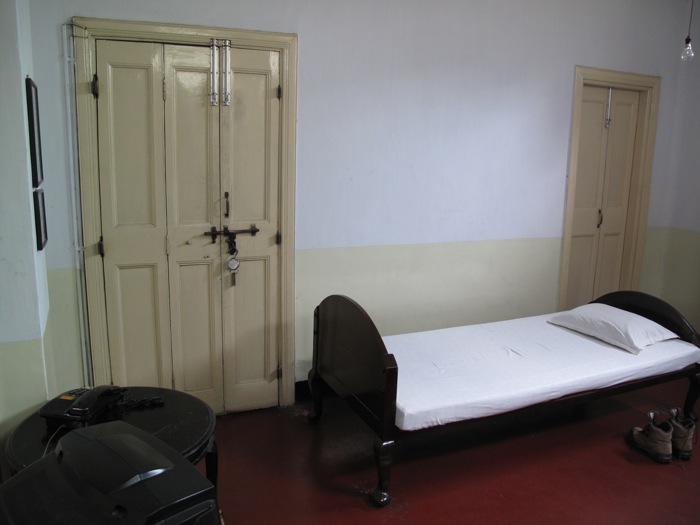
Yellow shutters and soot-crusted screens. In the bar, curtains, the warm beige of dim lightbulbs and eighteen ceiling fans on full; their whirring rush of air dulls the incessant honking outside on Ganesh Chandra Avenue. (Calcuttans simplify life by using the horn in lieu of brakes, clutch and turn signals). The dark wood-wainscotted walls of the Broadway Hotel saloon are made of primeval hardwoods no longer available at any price. Smoking is prohibited these days. A sign announces that it "is an offense,” but the tall walls are a suspicious dingy ochre, as if they had had the chance to collect smoke for many long-passed decades. This hotel does not have a faded grandeur; it has whatever it has always had, unchanged.


The waiters wear wrinkled burgundy Nehru smocks with black embroidered patches above their hearts, reading: Broadway Hotel. Oh, how I wish there remained such a place on Broadway! Squat red leatherette chairs crowd against brown formica tabletops buffed almost white in places; there is little left of the original faux-burl woodgrain pattern. Mildew specked mirrors along one wall double the already ample space, which has soaring ceilings. The soap at the men's handwashing station is dispensed from a swinging tin bottle that pivots on a mount, bolted to the wall above the sinks. If it ain't broke please Lord don't fix it.


When I alight from the elevator cage the children of the manager are laughing and howling in their adolescent Sikh turbans, playing narrow soccer on the polished red cement floor of the fourth floor corridor. Moments after I have dropped my bags on the single bed, the half-deflated miniature basketball is kicked through my still-open door. On purpose, I am certain. It rolls about the room, and within seconds the curious duo are peering through the curtain at the door, sticking their noses right into my room, demanding to know how tall I am. I've been here ten minutes, and I could live here forever.


 The hotel's website (they are not out of date) almost proudly announces that none of the rooms are air-conditioned. The bed, edged away from the wall, better to be under yet another churning ceiling fan, has no top sheet. This saves everyone time and bother. You would be no more likely to require a top sheet than to walk out into Calcutta wearing a sweater.

It is 11am. I stretch out under the helicopter downdraft, close my eyes, and lean into the single pillow. I have flown all night from Africa, with a 2am to 6am layover in Mumbai. I couldn't be more tired, but I am ecstatic to find myself in the most splendid ten dollar hotel in all of Asia.


5/05/2011

Somaliland Safari

More on this later, but the people of Somaliland would like you to know that they represent a politically distinct entity unaffiliated with the terrorists, warlords and pirates of Somalia. That this autonomous enclave on the northern side of the Horn of Africa remains unrecognized by any other government annoys them. Security, hospitality, and chai are all comparatively abundant. Travel, even independent travel, is possible here.

At the end of a recent film shoot in and around Hargeisa, I squeezed in an all-too-brief safari with wildlife guide extraordinaire Abdi Jama. Emerging from the Somali bush this morning, we drove directly to the airport, and I'm writing to you now from the wifi convenience of the very comfortable Ole Sereni Hotel in Nairobi. Here's a slideshow:

Saïd, packing the truck in front of the Ambassador Hotel, Hargeisa

Passing the Airport on the way out of the city. Camels occasionally wander onto the runway at inopportune moments.

Random obligatory shot of cute rural toddlers.

Obligatory shot of self in desert.

Big sky country.

Abdi Jama enjoys a Somali chai.

Minuscule mosque in teensy windswept village on the Tuuyo plains.

The end of the day on the Tuuyo plains.

Improvised rain cover.

Camp One.
Termites can be a problem.

But they make beautiful houses. No two alike.

Abdi Jama, stalking the Somali Lark on the Tuuyo plains.

The crew. Chief cook and bottle-washer Saïd, birder and bushman extraordinaire Abdi, and my personal security force, Mustafa.

4/30/2011

Going back to Vietnam

My story on the phenomenon of Vietnam War tourism and US veterans who return to visit the places they once fought ran yesterday in the Sueddeutsche Zeitung, although not in their online edition. Today is the anniversary of the Saigon airlift. Here's the pre-translation original:

On the telephone, Mr. Vu speaks English with a clipped, military precision, quickly dispensing with the logistics of the next day’s excursion. “Do you need to visit Khe San?” he asks. “No? Fine. Just to confirm: the driver will pick you at 10:15 in Hue and bring you here to Dong Ha, where you will collect me and drive up into the DMZ.” Mr. Vu sounds like the real deal, a veteran of the Vietnam war; it is almost like the planning of a tactical assault. Mr. Vu is one of the very best, but there are many people in and around the ancient Imperial City of Hue who do what he does. Vu is a DMZ tour guide who takes visitors and Vietnamese alike on customized trips through the many notorious locales dotted along the former border between North and South Vietnam.

Replica of the "Peace Bridge"

Demilitarized zone tourism is a thriving business in Hue, something that would be impossible if the wounds were still fresh. The savage conflict that unfolded here is quickly receding into the fog, not of war, but of distant memory. Overwhelmingly youthful, the population of Vietnam seems focused on the future and the country's bustling, Chinese-style economy, while America is deeply mired in the conflicts in Iraq and Afghanistan that have defined war in the present millennium. In the inevitable comparisons the lessons of Vietnam would seem to have been forgotten; for most, the war has become history. But not for the veterans who fought here.

Along the esplanade on the north bank of the Perfume River, near the gates of the famed Hue Citadel, street vendors hawk used dogtags, the steel identity badges all GIs wore around their necks, listing their name, blood type and religious affiliation. Apparently authentic, they are lined up on a low stone wall along with other knick-knacks: North Vietnamese medals, Soviet-style enameled communist friendship pins, and antique Chinese porcelain. Not far away, behind the ancient and imposing walls of the old city, stand rows of tanks and US artillery seized by the North in the conflict known only here as The American War. Dozens of agencies dotting the tourist quarter of the city offer tours to the DMZ. Options range from an inexpensive day in a bus full of other travelers to the kind of individual tailored experience Mr. Vu offers, on which former servicemen can seek out the particular places that were of personal significance to them forty and more years ago.

 Inside the Vinh Moc tunnels, where North Vietnamese lived underground on the edge of the DMZ in order to avoid American bombs. The network of burrows is now a showcase bit of propaganda intended to underline the resilience of the outgunned but ultimately victorious North.

Mr. Vu, it turns out, is 34 years old, born in 1976, the year after the Saigon airlift. He is extraordinarily knowledgeable. He knows which branches of the US forces served where, and when, and which regiments were involved in which conflicts. On the drive to the preposterously named “Peace Bridge,” across the Ben Hai River, Vu pulls out a binder full of maps and Life Magazine photographs showing the landscape as it appeared in the late 1960s. The tranquil but dreary rice paddies stretched out on either side of the 17th parallel appear in them as a cratered, lunar devastation, like a heavily polka-dotted carpet.

It is gray, and raining, and peasants are driving their water buffalo along the muddy banks above the paddies. There is almost nothing left to indicate that the DMZ was the scene of some of the war’s heaviest fighting. The southern half of Quang Tri province, below the Ben Hai, was the first area in the south to fall, and the area to the north, Mr. Vu says, was the most heavily bombed of all.

Replica of the battle-scarred and bullet-holed loudspeakers used by both sides to broadcast opposing ideologies across the Ben Hai River.

In many ways, this is a simulated experience. The Peace Bridge is a copy, right down to the guard booths at each end and the towering columns of gunmetal gray loudspeakers, non-working replicas of the ones which used to face-off, broadcasting competing propaganda across the river in an incessant, deafening battle of volume. All this was bombed to splinters; these reproductions have only been here for the last ten years or so, Mr. Vu says, to satisfy the tourist demand. Why, a visitor wonders, do so many people want to see the DMZ?

“Most of my clients,” he says, “are in their 40s and 50s. Khe San, Hamburger Hill, the DMZ, these places are familiar to them from books and movies.” DMZ tourism has gotten lots of free publicity from Hollywood. Nonetheless, the phenomenon began with Vietnam veterans in 1991, the moment the US eased travel restrictions that had prevented its citizens from visiting the country. “So many of them are my clients,” says Mr. Vu. He estimates that in 1999, when he began giving tours, 30% of those he guided had seen active duty in Vietnam, and still today at least one in ten are veterans.

Mr. Vu with artillery shells, carefully repainted with the identifying codes and letters of US ordnance of the period.

Rob Allerheiligen, who was a First Lieutenant in the US Marine Corps in 1969, at Monkey Mountain outside of Danang, wrote in an email that “I think I always thought I would come back some day.” He spent a day in 2010 with Mr. Vu. “Even though I had not been stationed at any of the sites we visited, I had friends who were, and I have read enough about Marine Operations…to know what I was looking at and to be impressed at what those Marines accomplished there.” He says he experienced a “funny feeling” landing at Danang almost 41 years to the day after he deployed. “There was a flutter in my stomach and an increase in my heartbeat.”

Glenn Prentice experienced the siege of Khe San on the notorious hill 881S as a forward artillery observer, one of only 17 out of 350 Marines there who was neither killed nor wounded. In 1995 he felt “overtaken by an overwhelming urge to go back to Vietnam,” and returned on his own to the hilltop scene of his youthful trauma; the siege began on his 19th birthday, in 1968. “You come back with guilt that you survived,” he says. But the sense of obligation he feels as a survivor seems not only to extend to his fellow American servicemen; after making friends with a North Vietnamese colonel who had fought at Khe San as his enemy, he collaborated on building a water treatment plant in a village near Hue, and since his unlikely friend's death he has helped the man's daughter with her college expenses. “I promised I would take care of his family,” Prentice says.

“When you have so many traumatic events, and when you are so young, they are basically permanently imprinted in you,” he says. “You need to go back, because at times it feels surreal.” He has now returned 14 times since his first revisit, and helps other veterans who aren't sure how, or whether, they can manage the trip. Their reactions “run the whole gamut,” he says. “Sadness, depression, relief.”

“They are very quiet, and don't really want to share,” says Mr. Vu, barreling back towards Hue in a minivan through the misty rice paddies of today's utterly transformed Vietnam. “They're very emotional. I don't know why.”


4/24/2011

New York Times solves Jamaica Bay National Wildlife Refuge Hindu Conundrum


A couple of years ago, after stumbling upon countless yards of cheap saffron and scarlet "silk," ruined, rotting offerings, washed-up floats and soggy bunting littering the pebbly beaches of eastern Queens, I blogged about the evident use of Jamaica Bay for an unspecified Hindu ritual. Finally, the New York Times explains. Broad Channel, apparently, is New York City's answer to the mighty Ganges.

4/16/2011

Cosmic Slop: The Gumbo Movie


The inaugural meeting of the Association for the Promulgation of Gumbo was, if the co-president may permit himself to say so, a resounding success. On Thursday night, St. John Frizell and I served two subtle variations on the theme of fried chicken and sausage gumbo in the boardroom at Cabinet Magazine, along with caruru, a Brazilian okra stew. Caruru is a ritual food of the Candomblé religion, often available in Brazil from Bahiana vendors who wear pristine white cotton finery to demonstrate their religious proclivities. It is essentially a gumbo, but one made with dried shrimps and ground peanuts, and it was included on the menu in order to demonstrate the connective culinary tissue (okra fiber) linking the far-flung corners of the African slave diaspora. Staggeringly decadent and delicious pies from Four and Twenty Blackbirds rounded out the meal, and the tummies of the guests.

At the meeting, during which vast quantities of gumbo was consumed by about twenty ravenous board members, we showed the following film. According to the filmmaker, the surface of the bubbling pot of gumbo serves as a metaphor for the creation of the world and everything in it.*

I'm not only the co-president of the Assoc., I'm also a client the secretary. The minutes of the meeting are in preparation and will be posted here shortly. For the moment, please enjoy this classic of kitchen cinema.


*From a Darwinian, rather than creationist, perspective.

APG® Okra graphic ©2011 Laura Harmon; used here by permission of the artist

4/13/2011

First loaf of the year


Impassioned bread-baking and relentless world travel seem close to incompatible. Even though I'm a purist whose bread only involves three ingredients--flour, water, and salt--I failed to find any opportunities to bake a few loaves while tramping about in the National Parks of Vietnam. Before leaving at the end of December, I had distributed samples of my sourdough starter to diverse friends, family and acquaintances in the hopes that some would survive until I returned. When I got back I had scarcely time to locate someone who hadn't killed it off (thanks, Mom!) before I departed for Haiti on a film shoot. So it wasn't until this week that I managed to fire up the oven.


Like the Sugarhill Gang said, I don't mean to brag and I don't mean to boast, but I like hot butter on my breakfast toast. Also, I like a crisp, nutty crust and an open spongy crumb, and it's just like riding a bike, apparently, because if I say so myself my first effort for 2011 is an unqualified winner. No yeast involved.


Technical details in the comments.

4/10/2011

New York Times almost writes a sensitive article about Vodou

Dan Bilefsky's effort at a cautious, politically correct and balanced article about New York area practitioners of vodou was reading better than I might usually expect on the subject from the New York Times, until I reached the last paragraph. After framing his story around a ceremony to celebrate computer engineer Jack Laroche's ritual marriage to the lwa Ezuli Frida, such weddings being a common mode of expressing allegiance and affiliation with a particular spirit, he concludes with the non-observation that Laroche "sees no contradiction between wielding an iPhone and marrying a voodoo bride." (After all, what would those pagan pin-pushers be doing with a mobile telephone? What if you were to spill goat's blood on it?)

You don't have to have been to journalism school to know that "sees no contradiction between" is a construction that does absolutely nothing except raise the spectre of just such a contradiction. Now go back to that sentence and replace "marrying a voodoo bride" with "keeping kosher" or "lining up in church to receive the holy communion." Would Bilefsky have included those sentences in articles about the resurgence of orthodoxy in Jewish youth, or the fascinating Sunday-morning antics of hedge-fund managers?

...

4/06/2011

The Social Life of Caged Birds, on PRI's "The World" UPDATED


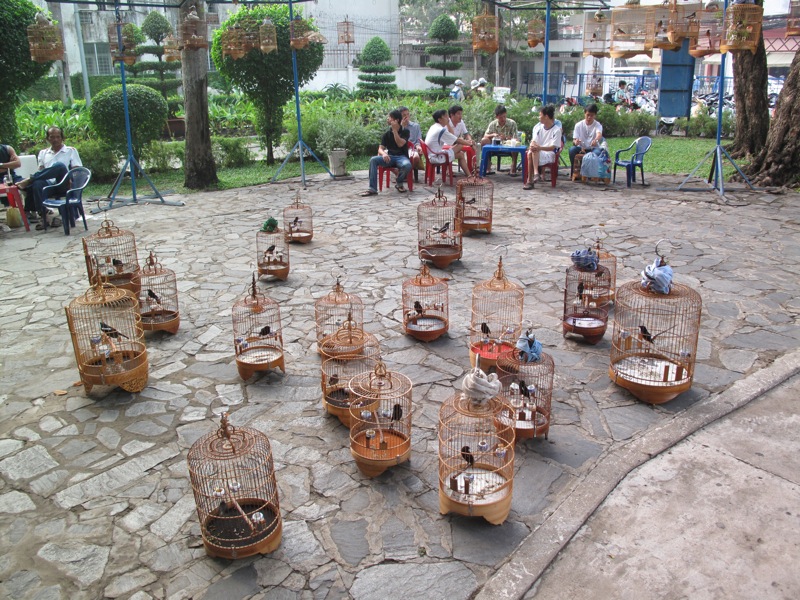
On weekend mornings at dawn, Saigonese songbird aficionados like to bring their pets to a café in the corner of one of District One's most popular parks, where they drink coffees and teas, and chat, perhaps about birds, perhaps not. Meanwhile the birds make friends among neighbors of their own kind, at least to the extent possible while trapped in their bamboo prisons. They also do their best to out-sing one another.


I realize this is rather short notice, but my "audio postcard" about these caged-bird fanciers in Ho Chi Minh City runs on PRI's "The World" today on your local NPR affiliate. In case you missed it, I'll post a link here later, the segment is now available online at The World's website, along with a groovy slideshow of my photographs.