9/13/2006

Would you rather be on the bottom or on the top?

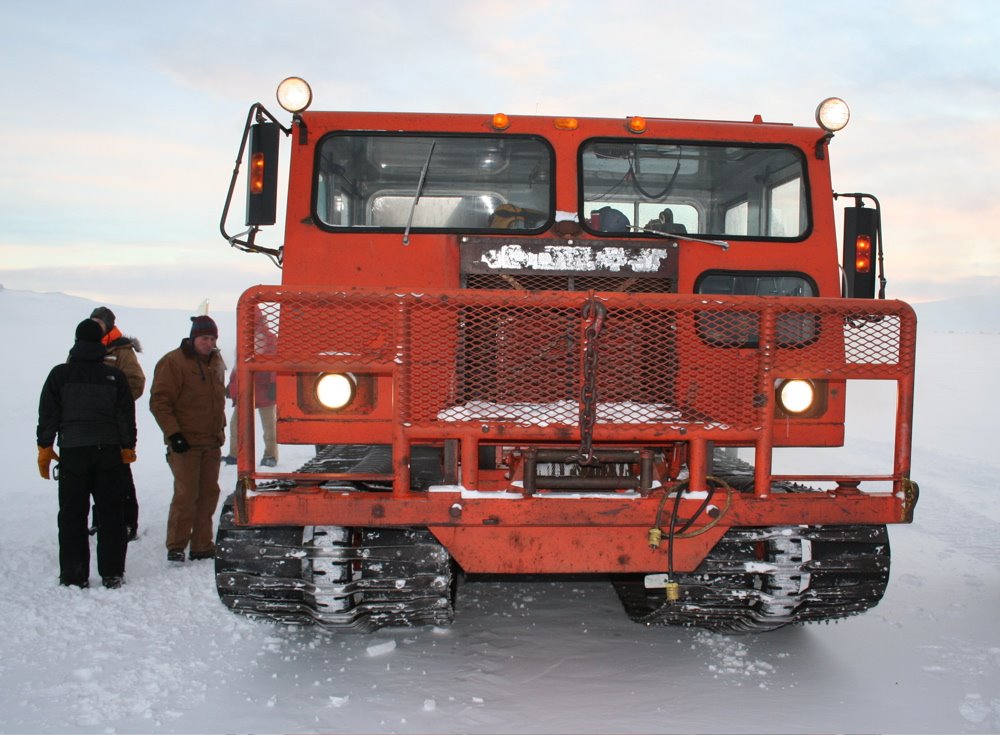
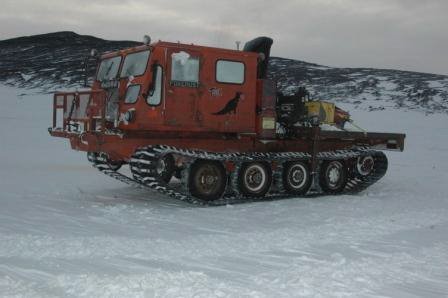
Nodwell, by Foremost, aka T-Rex


Will Brubaker successfully piloted T-Rex all the way back from Black Island despite 9 members of the party having established a betting pool with the stakes riding on just how many hours and minutes out it would be before T-Rex bit the dust. Talk about bad karma. (Us, not Will). He has an excellent post on his blog with lots of mechanical details and McMurdo vehicular history as well as his point of view on sleeping in the "Night Train" on the top bunk. For example, among other interesting things I didn't know, the name Pisten Bully comes from the french for ski-trail, piste, and has nothing to do with a piston, although that's what most of the rest of us boneheads were probably thinking.

"JinnyMae" Cat 950 at Black Island.
Two views from: Vehicles of McMurdo

And you thought it was crazy in Antarctica...

Just heard from my friend M... in Zimbabwe. When I visited about ten years ago the two of us had an incredible safari in Mana Pools National Park, sitting next to the Zambezi River eating biltong and Ramen noodles and watching wildlife for days. Shortly thereafter the crap totally hit the ventilator, but M... still manages to live there somehow.

M... writes:

A little slow on the net here. Just waiting for govt to pass the interception bill so they can read anyone’s mail. Was wondering if you were freezing your ass off or hanging from crumbling ice flows.
Still in Zim and if we had fewer power cuts and more fuel I would be able to make a more substantial contribution to the destruction of the ozone!
Its as loopy as ever here. Just had the Zimbabwe International Film Festival! The digital technology workshop would have been interesting if it hadn't been for the simultaneous defence force re-enactment of a helicopter battle. It was the Harare agricultural show but the only thing they had to show was a military display. Inflation running at about 1300% and the Reserve Bank just chopped 3 noughts off the currency. So whilst people were bringing in their old money to change – which you couldn’t as they hadn't printed enough or if you didn’t have a bank account you couldn’t change your money! – they then introduced a law saying it was illegal to carry more than a 100 million on you. (Black market rate 700,000 to the US$) So road blocks everywhere as the police proceeded to help themselves to mostly poor people and traders “illegal” cash as they attempted to get to the bank before it all got stolen. Now we have 1 dollar and 1 cent notes which they cant print enough of so there is never any change and they have managed to make the 10000 look like the 1000..well the numerically challenged like moi finds it difficult. Plus the 1 cent has a minus value as the paper it is printed on is worth more. And now the Minister of Finance who is fighting with the Governor of the Reserve Bank has said the 3 noughts will be back by Christmas. The governor, bless him, is now building a new home. A simple 40 room mansion, with a guest lodge, 5 swimming pools, a gym and a cinema. Not forgetting the helipad.
Just had a week in Mana..in a lodge! Did have to throw my chair at a hyena that came too close to my boervoors. One tourist was trampled to death by a mother elephant. Saw lion and wild dog. Went on game walks and lion tracking walks.A must on your next visit. And canoeing. My first and last time paddling upstream in a broken national parks canoe through endless pods of hippos and huge crocodiles. Happily I had the guide with the A-K. Some campers now have solar powered electric fences around their tents and cooler boxes to protect them from the monkeys and baboons. A matter of time before that doesn’t work.


M... included this photo as a reminder of places that have birds, and grass, and bamboo.Photo credit withheld to protect independent journalism in Zimbabwe

Thanks for the update and stay safe; we're thinking about you!

9/11/2006

All Present and Accounted For

We are safely back from Black Island after spending most of the day making the traverse in one Pisten Bully, accompanied by T-Rex. Keith, Dawn, Ants and Glenn stayed behind to continue work there, keeping the other two Bullies.

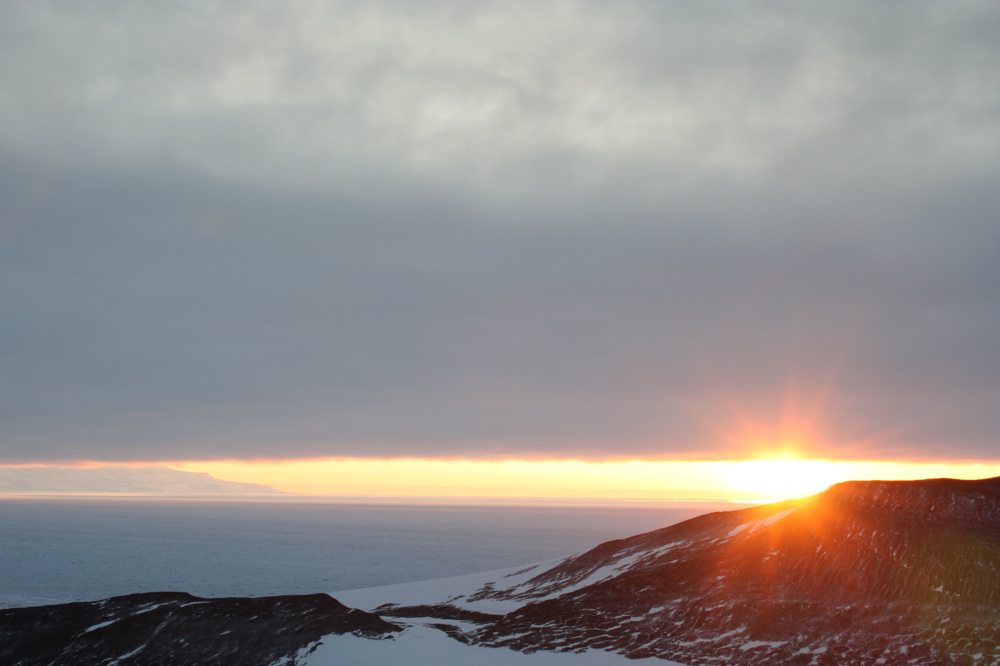
Sunrise from Black Island, this morning


Syl capturing the ambiente. I recorded sound for some of the exterior shots, but since we kept the Pisten Bullies running most of the day and most of Black Island's power is supplied by a diesel generator I finally went on strike and refused to stand around outside recording the hum of diesel motors to go with the spectacular and pristine images. (I have a "no dieseling" clause in my contract.)


When you see this you don't expect it to sound as if you are standing outside on level three at the Port Authority Bus Terminal, do you?


The rear view mirror of the Pisten Bully on the way back to McMurdo: Dude, I have bad news for you, Jerry's dead!


I've edited the rest of the photos from the trip into the existing entries I wrote while there, so that if you have already read those you may now go back and look at the pictures, and if you haven't they are now extra special and complete!

9/09/2006

Life in a windswept shack


Those disappointed by the creature comforts of the McMurdo station and the way of life it offers, one that might be called "bourgeois elementary school," with its hot lunches at prescribed times, its hallways postered with science projects and announcements of knitting circles, are people who feel strongly the disconnect between the hardships of the "golden age of exploration" and the insular and seemingly overprotective cocoon within which McMurdo envelops the contemporary Antarctic traveller.

Such people, of which I certainly am one, would do well to spend a night like last night in the "Night Train" at Black Island. Yes, last weekend we slept on the ice shelf on the coldest night of this year's Winfly, but just next door, in the adjacent tent, were Thai and Cece, mountaineers with twenty years of Himalayan, Andean, and Alaskan vertical ice climbing experience between them; their primary mandate for the evening was to be certain we didn't freeze, blow away or lose any fingers or toes. Although that was an exciting evening, it was instead last night, another sleepless night, that summoned for me the ghosts of the defunct greats of Antarctic exploration.Is there a building inspector around here?

I've already noted that the Night Train was so named because sleeping in it resembles a night's rest aboard a moving train. But if two nights ago I was reminded of the plodding pace and relaxed swaying of an Eastern European wagon-lits, last night was more like being in an open cattle car pulled by the Japanese bullet train.

As the winds picked up to seventy and eighty miles per hour towards bedtime, Mike, Sylvestre and I bundled up and stumbled down the hill towards home. My snorkle hood restricted my vision to one eye, stung by the impact of driven crystals of snow. If this description recalls my last blog entry, you are begining to understand some of the character of life on Black Island.I'm not sure what this does, but it was on a shelf in the battery room at Black Island; I'm hoping it will come in handy and help me avoid hackneyed, repetitive descriptions of the searing, biting, icy, chilling, sweeping, blustering, driving and otherwise brisk wind.

Inside, the Night Train was freezing cold. Not because the preway stove had gone out, but because the Night Train is a leaky sieve of a plywood shack, and the relentless onslaught of the wind had scrubbed every corner free of warmth. In the sleeping bag, on the metal bunk, the sensation was of being suspended in a wind tunnel in a balsawood coffin. Aside from the morning there was nothing to wait for except the inevitable moment when our fiber-board tomb would take flight, sail down the hill and splinter on the sea ice, the shards blowing onwards across to McMurdo, due North twenty miles. The constant shaking and shuddering was like those tense first moments of an enormous aircraft vibrating its way towards take-off, except that the sensation lasted for ten hours.

My feeling, from having seen it from the outside, is that the Discovery hut is of much sturdier construction. They don't make them like that anymore.

Not the Night Train: diesel tanks at sunset

9/08/2006

Reading: The Worst Journey in the World

Very nearly one hundred years ago R.F. Scott, E.A. Wilson and "Birdie" Bowers starved and then froze to death in their tent, on the "Great Barrier," permanent ice shelf on the way back from the South Pole. In "The Worst Journey in the World" Apsley Cherry-Garrard recounts the build-up to this catastrophe, drawing on Wilson's and Scott's diaries and letters to illustrate their suffering right down to the very bitter end. Although it is an exhaustive and well-written account, I had never quite grasped how it could be that the threesome, only some 11 miles shy of their next carefully layed depot of food, could have spent day after day in their pitched tent, waiting for a blizzard to pass before continuing along, all the while knowing they were at the point of death. Why, even in nasty weather, did they not continue and make a final attempt to reach the depot? I now understand.

After the long day yesterday, with eleven of us lounging in the single combination living room and kitchen, stuffing ourselves, snoozing, and reading, we enjoyed a communal DVD screening of "The World's Fastest Indian", a cute but forgettable New Zealand road movie in which Anthony Hopkins spends his life savings to travel to the United States and race his motorcycle at the Bonneville Salt Flats. Mike, one of the riggers, split his attention evenly between the film and the real-time wind speed readout feeding to the laptop by the telephone and VHF radio. He tells me there is a word in English for "going crazy from the wind," which I haven't googled yet, but put it in the comments if you know what it is.

The kitchen at Black Island is full of homey little touches to make you feel comfortable and help ease the difficult transition you may experience after arriving on a new continent.
Photo: courtesy of The Black Island Heritage Preservation Trust


There are three levels of weather here: Condition 3 is "normal" and in it prudent and standard outdoor activity is authorized. Condition 2 is defined by wind speeds between 45 and 55 knots, or temperatures below -75 C or visibility of less than one quarter mile. In Condition 2 nobody should leave central McMurdo base (or, in our case, the immediate environs of Black Island). People not in a building should immediately go to one. In Condition 1, defined by wind speeds greater than 55 knots, or temperatures below -100 C, or visibility less than 100 feet.Parked Bully in horizontal snow, about fifteen feet outside the door.

As we watched the film, and Mike watched the wind speed, it became pretty clear that even if nobody was announcing it (all eleven of us currently at Black Island were in the room watching the movie) we were technically in Condition 1. Under Condition 1 nothing moves. At McMurdo, you must remain wherever you find yourself when the Condition is announced. Were we to follow the law to the letter, the six of us sleeping down in the "Night Train" would instead need to curl up on the sofa together, or spread sleeping mats in the battery room. At the end of the film I checked the wind: 63mph, or exactly 55 knots, the cutoff between Condition 1 and 2. Moments later, a lull. The computer had the windspeed at 38mph. But by the time I got on Big Red and my neck gaiter, mittens and boots, the wind was once again ripping. I opted not to check the readout again, turned on my headlamp, and headed for the night train, seventy-five yards away. I took blowing snow full in the face at some 50 knots and stumbled towards the two parked Pisten Bullies some ten yards from the door. "Telephone" Keith kept an eye on me from the door. "I'll just sort of watch how you get along," he said. This morning he told me that as soon as I had passed the Pisten Bullies I was gone from sight. On the ground I could see some duct-work that I knew led about a third of the way down the hill to the Night Train, and marked the direction of the course. Reaching the end of it, I looked up. I thought I could see a building in front of me, but I wasn't sure. I was nearly blown over. I had little idea where I was going in the driving snow. Finally a broad pale shape loomed up in front of me and I pulled myself directly into the wind up onto the stairs. The door of the Night Train is an old, heavy, walk-in freezer door, and it opens out. I could barely open it, as the wind was pressing it closed, but I had managed the 75 yard traverse. I tugged the door open, slipped through, and let the wind slam it decisively behind me. That Scott, Bowers, and Wilson had remained lying in their bags, getting hungrier, colder and weaker, edging closer and closer to death, rather than pack up and attempt to continue the 8, or 11, or more, or less infinite miles onward to their next depot, through the blizzard, now made sense to me.

After a beautiful day today the wind is coming up again this evening, so we will see if we actually manage to get out of here tomorrow.

9/07/2006

This is Black Island Traverse, come in please...

Yesterday morning at about 9AM we set out across the permanent ice shelf in three Pisten Bullies, accompanied by T-Rex, a geriatric tank-like flatbed truck with treads instead of wheels. The Mighty T-Rex. from: Vehicles of McMurdo

"18,600 pounds of pure Joy." Photo: Will Brubaker


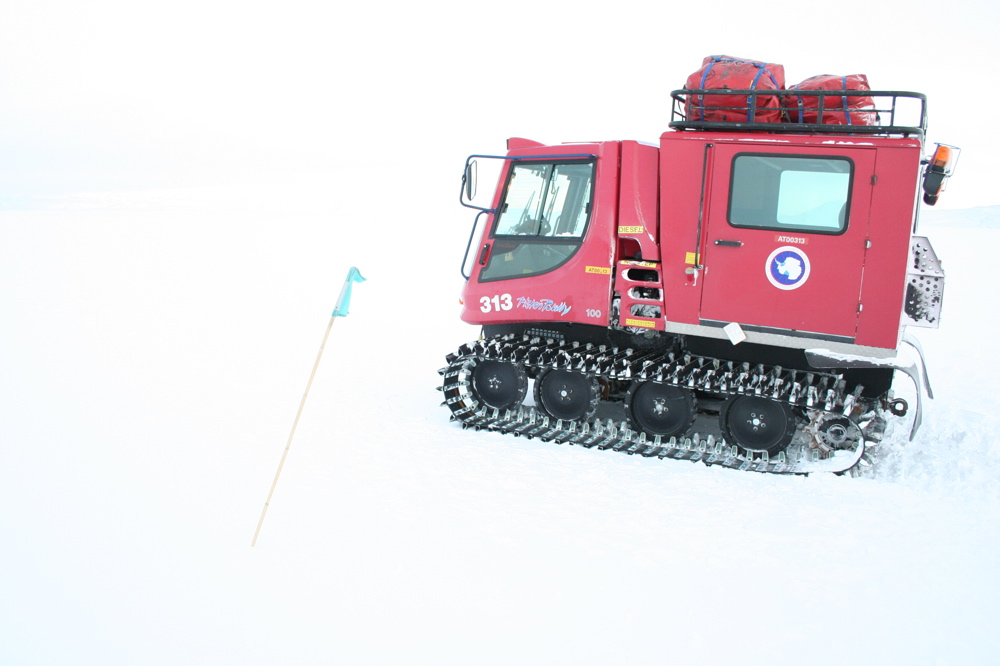
I can tell you that Piston Bully 313, since I drove it for the five-hour trip, has a top speed of 14 miles per hour on flat ice. Where's the snow? Where's the sky?
Pisten Bully 313 from: Vehicles of McMurdo


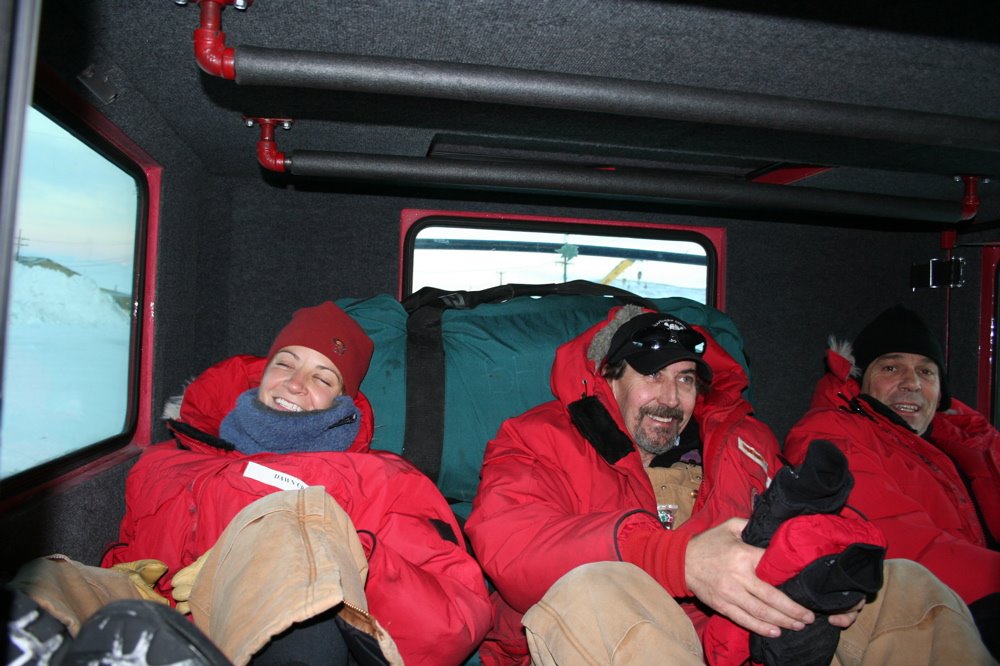
We identified our convoy to MacOps (McMurdo Operations) as the "Black Island Traverse" and scheduled hourly check-ins. The Pisten Bullies were crammed with gear: Survival bags, with food, sleeping bags, tents, stoves, and first aid kits; our own sleep kits; food for four nights; tool kits "on T-Rex;" bags of ECW gear, GPS units and radios. Dawn, Keith and Syl:
Dag, it's crowded in the back of this here Pisten Bully


The drive to Black Island is 56 miles on a roundabout route over the permanent ice shelf, but Black Island itself is only twenty miles as the crow flies from McMurdo station, across the sea-ice. "Sea-ice" defines that ice which normally melts every year and is at this time of year generally six to ten feet thick, while the "Permanent ice shelf" is thousands of feet thick and lasts "forever," at least until global warming really kicks in.


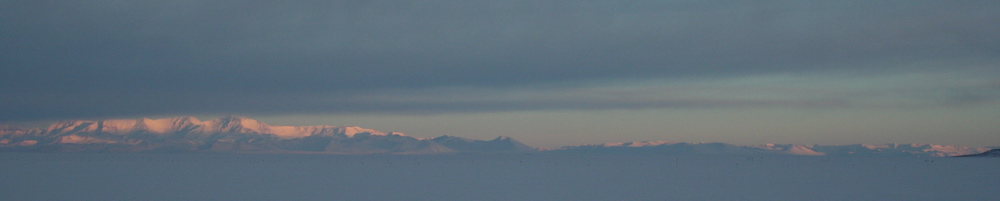
After waiting two days for the weather permitting, we have fabulous weather for the drive. The sun comes fully out, only to hover on the horizon all day, without ever moving up any further in the sky, and the Royal Society Mountain range is illuminated with a warm pink light. With the sun directly behind us, the Pisten Bully, spewing clouds of snow from its treads, makes a spectacular shadow on the snow in front of us. Imagine an enormous frog wearing a billowing wedding dress and you get an idea of the shadow which led us along the ice. Although a truly unique experience, I was reminded of driving through the Sahara, where one has no idea of the logic of the roadway; the fact that one is driving alongside regularly staked markings of bamboo instead of fifty yards to the right, or to the left, or a mile to the right, or to the left, seems not to matter (until one drives into a crevasse, hidden by drifting snow). The fine dust blowing off the vehicles and impeding visibility and the importance of maintaining the convoy also reminded me of the Algerian desert.


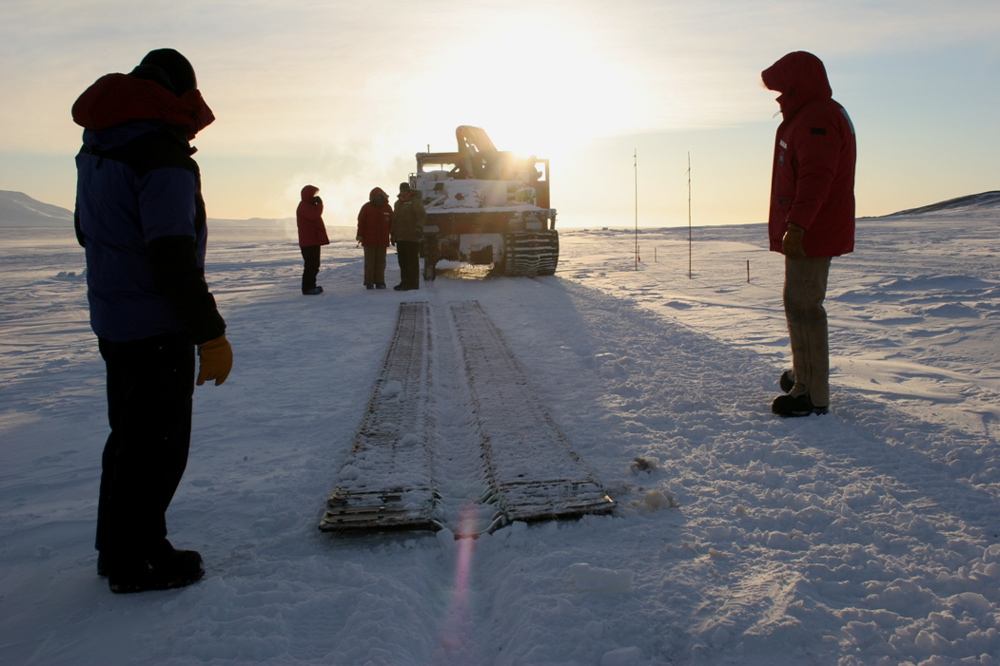
Four hours into the trip one of T-Rex's belts broke. A lattice of rubber plates held together with a spine of curved steel bars, it lay stretched out in the snow like an enormous snake skeleton. T-Rex looked far less military and rather tragically impotent with only one belt. Will and Dave, the boys from the heavy shop, used a Pisten Bully to wrangle the belt back into position, and Will backed T-Rex up and onto its own belt. We abandoned the scene, dividing into two groups, but learned later that after two and half hours of struggle in very cold conditions it was ultimately impossible to create enough slack to reconnect a shorter version of the belt.

Will takes care of T-Rex like it is his own child, and he was not amused when Ants named this photo the "Self Laying Track Vehicle"
photo: Anthony "Ants" Powell


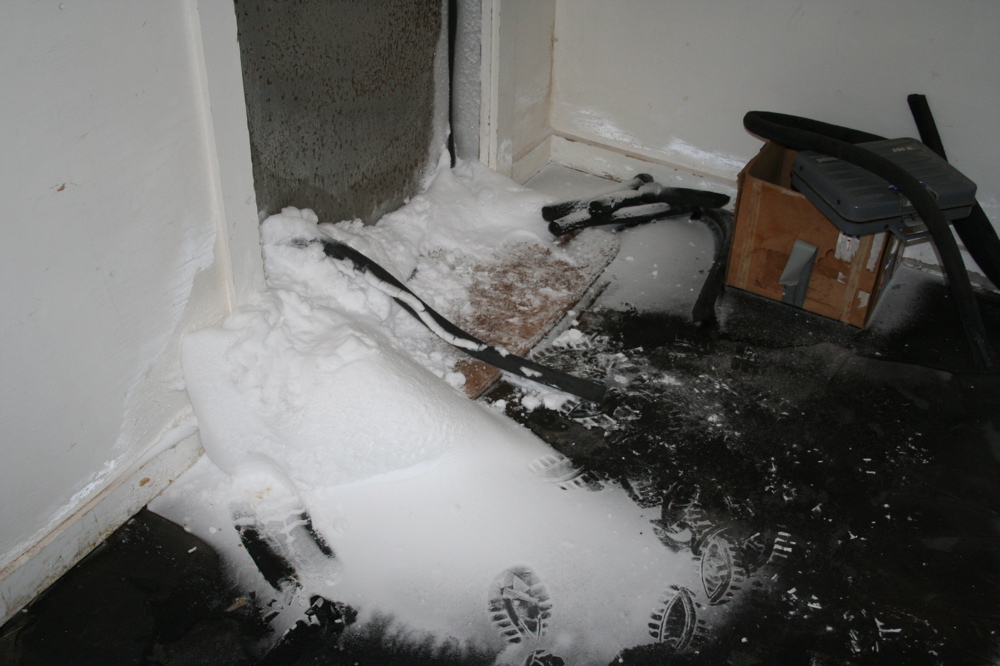
After arriving at Black Island we set to work shoveling snow out of the "Night Train," an eight man dormitory just down the hill from the main building, which is a combination of a kitchen, living room, food pantry, and rooms full of batteries and equipment for telecommunications and the storage of power from the windmills. Nobody had been to Black Island, or at least nobody had slept in the Night Train for the last three months, and it was full of snow in strange piles, on the sofa, on corners of mattresses, in a huge drift by the door. The snow here is so fine that like Saharan dust it works its way through even the tiniest holes. Even an invisible crack under the front door eventually allows in piles and piles of snow. Formations like stalactites hung from the ceiling in places where a tiny pinhole had allowed one granule at a time to enter. We removed many cubic yards of snow and then fired up the "preway," a diesel stove that soon had the place toasty, but dense with fog, like a sauna.Interior Snowdrift


After the arrival of the T-Rex party and fajitas and wine in the main building, we put on our Big Reds and made our way back down to the bunkroom, which is more or less a mobile home on stilts, with ancient, doubtless asbestos, floor tiles, and graffiti covering the walls with the wisdom of former visitors. i.e. "Australia is just like Black Island, except much, much, much, much better." In the course of the evening we came to understand why the bunkroom is called the Night Train. As the wind rose over the course of the night the entire building began to rock, creak, and whistle in the wind, as if we were in a couchette crossing eastern europe. By morning the laptop in the main living room giving constant windspeed readings indicated 40 knots, and by 2:30PM visibility was about 50 meters in horizontal blowing snow moving at 60-70 knots. No outdoor projects of any kind have been accomplished. We sit around the formica coffee table and read books, take turns on the computer and eat Dawn's chili, although beans and bunkhouse are universally declared a bad combination by the seasoned ice visitors. The wind direction holds firm out of 180 degrees due south, the source of all of Antarctica's nastiest weather.Rien a Foutre


I recorded spectacular wind noises in the hall and especially inside Black Island's ping-pong ball, a fifty foot in diameter Buckminister Fuller geodesic shell for a massive parabolic transmitter, connected to the main building by a series of hallways and refigerator doors. I remember as a child we had a large sheet of aluminum in the basement that when shaken or beaten made thunderous noises with infinite and ominous theatrical applications. The inside of the ping pong ball in seventy knot winds sounded much the same as that aluminum sheet, but magnified tremendously in scale. The constant rippling and pulsing of the huge triangular panels, stretched taught over aluminum triangular lattices, created an amazing wall of sound. The inside of the dome reminded me of the sets for Brazil

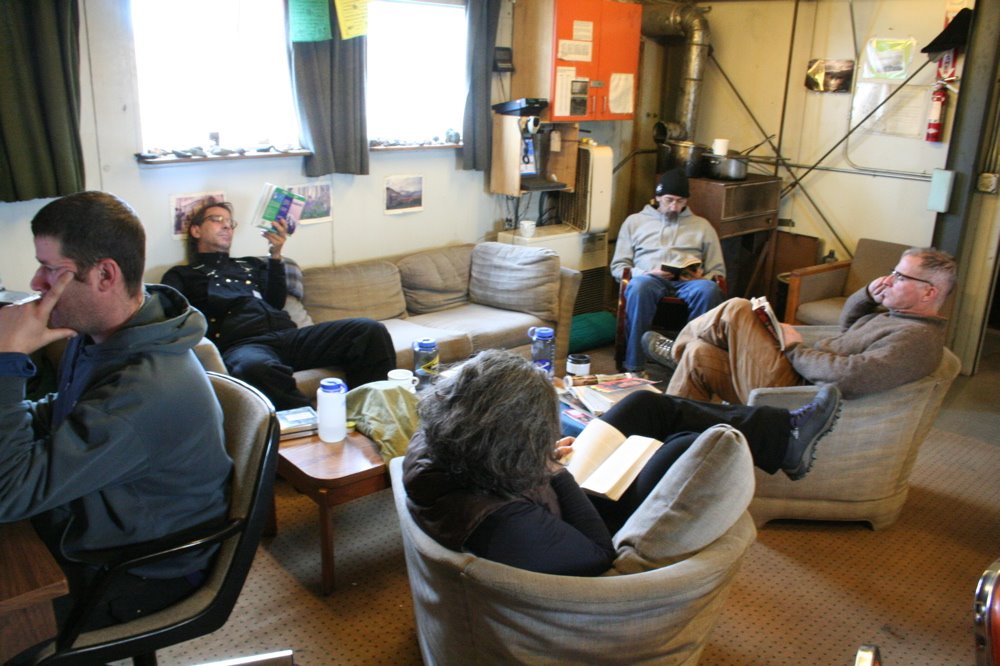
In the living room the wind rattles and sings mournfully in the chimney. Nonetheless the diesel stove heats the indoors to a sweltering 80 degrees F or so, which has a soporific effect on the room full of quiet readers. Only Will disappeared for the entire day, slaving over some beastly diesel engine or other, reemerging like a troglodyte from deep underground, slimy and coated with black grease, just in time to complain bitterly as he watched the rest of us gobbling the last crumbs from a pan of brownies. Otherwise only Dawn worked, cooking dinner and baking cookies. There is little to do but sit and snooze and eat, like a large family in a too-small vacation house sitting out a thunderstorm.
Parcheesi, anyone?

9/04/2006

Announcing the Vehicles of McMurdo photo essay

MacTown at dusk from the Hut Point Ridge trail


After struggling to get up at 5:45 and slathering on the layers until I felt like a walking ball of yarn, we met up at the office for the 7:15 departure to black island. After dragging my "sleep kit," two bags of ECW gear, sound package, and a pelican case full of backup sound gear out onto the loading dock I felt like a butterball turkey beginning to self-baste. Once everything was ready we all waddled over to the chow hall to meet the work crew that we hope to film fixing antennae and diesel generators at the Black Island facility. Most of them were there, but nobody had received final word that the trip was on. I wolfed down what must have been a two thousand calorie breakfast to fuel the engine for the long trip across the ice and about 7:18 the leader of the work gang ambled in shaking his head and said maybe tomorrow. We are debating whether to take ourselves off of the manifest.

The day before yesterday was our first official day off, a Sunday, and therefore everybody else's day off as well. I decided early that I would hike the Hut Point Ridge trail, one of the three recreational hikes currently open. Doing this requires filing an "efoot plan" online. It also requires a buddy. Faced with the immense social hurdle of corralling someone into going for a walk with me, followed by the administrative mountain of filling out a one page internet-based document, I quailed, and opted instead to bundle up and walk the road down to Hut Point, back to the "Discovery" hut. This is considered to be within the town limits, and therefore requires no notification or "buddy system." I walked up the hill at the end of the point and took the pictures of Vince's cross I posted last night, and then headed back to town, where I wandered about aimlessly and took a few pictures of the more exotic motorized conveyances to be found here, for the upcoming series Vehicles of McMurdo. As I was lingering by the Heavy Shop, taking pictures of a geriatric John Deere tractor, my man Deany appeared with a fivesome of happy campers, just setting out to walk the Hut Ridge Trail.

from: Vehicles of McMurdo

Deany is a capital fellow, what we might call in today's parlance an excellent dude, who we first met when he plonked himself down at our dining table and urged us to tell him a story. We stammered, as one does when unexpectedly prompted to entertain, whereupon he told us with great enthusiasm of the wonderful travels he had had following his last tour of duty on the ice. He had worked as a volunteer "woofer," working four hours a day on organic farms across New Zealand in return for room and board and then shipped out on a yacht delivery to Tonga. He noted that two years' experience working in a warehouse, rather than "my fifteen years of living off the grid in a tent" were what had qualified him for a job in Antarctica. I believe he works in supply, but I don't know, which is interesting in and of itself because many conversations here don't go much beyond the inevitable opener: "and where do you work?." He told us all this with an innocent enthusiasm and seemed to me to take an infectious delight in what the world has on offer; I liked him immediately.

At the top of the trail is the "ping-pong ball." It might not look like it, but this is used in the pursuit of science and has no military application today, nor will it have in the future.

The group had only moments earlier added Jane to their efoot plan, by calling the firehouse to add her details, but they urged me to join them as well. The fireman I spoke to was rather chagrined, particularly as I didn't know my own telephone number or room number (note to efoot plan web designer: ninety percent of the information required for the efoot plan should autofill once a valid community member name is added. Anything which autofills incorrectly would then be overwriteable by the user.), but eventually he wished me happy hiking, and, administratively qualified to hike the loop, I set out with Deany's band.


I knew, but hadn't quite internalized until this hike, that our little home, Ross Island, is essentially the product of Erebus. As we hiked up towards Arrival Heights, despite the blowing snow and the subzero windchill, I was reminded of hiking volcanoes in Guatemala. The entire landscape, in fact, is cinder and chunks of volcanic rock, much of it snowswept and buried in ice. It is a short but stunning hike that descends the ridge above the "Discovery" hut, following the curve of the coastline, with the endless frozen sheet of the McMurdo sound just off the edge of the trail. I have scoffed at the rules and regulations requiring check-out in order to take a two hour stroll, but once we reached the ridgetop I understood the necessity for having a radio and a buddy. Chilly, yet perfectly comfortable on the hike up the road, we piled on double thermopane goggles, balaclavas and snorkle hoods once we reached the ridge. The narrow trail had patches of fresh and treacherous snow, and a turned ankle up there, even though in plain view of McMurdo station, could have dire consequences for the solo walker. Instead of twisting our ankles, however, we went skating.

9/03/2006

And now a word from our sponsor

Mystical holy mist, or foggy camera lens? You be the judge. I'll go with the former. I'm hoping Santa Teresa of Avila is hiding around here somewhere.

If you peg out while on duty down here someone will hopefully put up a cross for you as well. This is


Vince's cross, with the "Discovery" hut below and McMurdo just visible on the hill behind.

Transmission rupted...

After packing up all my ECW gear, layering myself like a woolen Napolean (that's a Mille Feuilles to you, you gallic gadabout) and praying fervently for a restive gastro-intestinal tract on the seven hour Pisten Bully traverse to Black Island, I arrived at the office fifteen minutes before our meet time only to discover that because of 50-knot winds we are postponed at least 24 hours.... This post showcases one of the more bizarre structural constraints of the blog: that, unless one is a most faithful subscriber, everything is experienced in reverse chronological order.

Transmission interrupted...

I just got word that we will leave at dawn tomorrow morning with a seven man work crew, travelling by Pisten Bully convoy across McMurdo sound to open the facility at Black Island and do begining of season maintainance there. This requires seven kidney crunching hours of travel across the sea ice followed by a couple of days of filming in one hundred knot winds followed by seven more kidney crunching hours of return voyage, weather permitting. So don't expect to read anything new until at least Thursday, and if I don't make it back, give my record collection back to Andrian.

9/02/2006

In which we congratulate Mr. Nansen on his safe return

When last we checked in with Norwegian uber-explorer Fridtjof Nansen he had mercifully decided that he and Hjalmar Johansen had to turn back, or else face starvation. As they head south he writes in one diary entry after another of his disbelief that they remain encircled by pack ice and out of sight of land. They walk and camp on freezing slush, constantly impeded by open channels of water, yet unable to take the sea because these fissures lead nowhere, petering out into more solid ice, or funneling into narrow channels that will not permit travel by skin-boat. June 9th is typical: "we came across a number of lanes, and they were dificult to cross, with their complicated net-work of cracks and ridges in all directions. Some of them were broad and full of brash, which rendered it impossible to use the kayaks. In some places, however, the brash was pressed so tightly together that we could walk on it. But many journeys to and fro are nearly always necessary before any reasonable opportunity of advance is to be found." A month and two days later and not much has changed: "a monotonous life this on the whole...day after day, week after week, month after month...over ice which is sometimes a little better, sometimes a little worse...we do not know where we are, and we do not know when this will end...it is hard to go on hoping in such circumstances, but still we do so; though sometimes, perhaps, our hearts fail us when se see the ice lying before us like an impenetrable maze of ridges, lanes, brash, and huge blocks thrown together pell-mell.... There are moments when it seems impossible that any creature not possessed of wings can get farther, and one longingly follows the flight of a passing gull." (Farthest North pp. 316-317.)

Day after day they went on, from time to time killing their weakest dog, in order to feed the other dogs, so that their human share of the sledging burden became larger and larger. Nansen paints a vivid picture of the drudgery of the days, the endless slogging through knee-deep sludge and the horror and guilt he felt at killing their trusty canine companions. He talks less of the nights, which, after my one night of sleeping on the ice, I believe must have been even more dreadful. He and Johansen shared a reindeer-pelt sleeping bag, both to conserve on weight and to combine their body heat at rest, and it must have been sodden with perspiration and exhalation after the first night out, only to immediately freeze solid in the morning until the two crawled into it and shivered it back into comparative usefulness each evening. What boggles my mind is the thought that never in all their time did they have a chance to relax while warm. Only while trudging, shoveling, paddling or otherwise toiling would the two of them have been able to keep warm at all.

Antarctica, not the Arctic


Finally, at the end of July, they did sight land, but upon reaching it almost two weeks later they found a new set of problems. They had no idea where they were and found the area dotted with islands and rocky promontories which promoted the permanence of more clumps and fields of travel-inhibiting ice. In their kayaks they were attacked by walrus, from below, and at night polar bears pawed outside the tent. (Many of these they successfully shot for food, and eventually to sew together a new bear-skin sleeping bag). "Where we are is becoming more and more incomprehensible," he writes. The end of August at that latitude, of course, is not too early for the duo to become worried about the onset of the next winter. "Our situation was not an attractive one;" Nansen writes, with typical understatement, on about August 24th, "in front of us massive broken sea-ice close by land, and the gods alone know if it will open again this year; a good way behind us land which looked anything but inviting to spend the winter on, and our provender very much on the decline." Nansen does not write anything of significance again for months, recommencing his diary in earnest on December 6th, by which time they have shot and killed enough seal, bear and walrus to live on for the winter, and constructed a small stone house in which to live. His apologies are identical to those I have already heard from winterovers here, and his symptoms are now thought to have a medical cause, a diminishment of the thyroid's activity in extended periods of darkness.

"I had hoped to get so much done this winter--work up my observations and notes, and write some of the account of our journey" writes Nansen, (but Phil used almost the same words). "But very little was done. It was not only the poor, flickering light of the oil-lamp which hindered me, nor yet the uncomfortable position--either lying on one's back, or sitting up and fidgeting about on the hard stones, while the part of the body thus exposed to pressure ached; but altogether these surroundings did not predispose one to work. The brain worked dully, and I never felt inclined to write anything."

It was not until June 17th of the following year, farther south on the craggy coast, after having abandoned their winter shelter, that Nansen heard dogs barking somewhere inland. Their meeting later that day with Frederick Jackson and his British arctic expedition is comparable only to the encounter between Livingstone and Stanley. In its joy and improbability it far outshines it. In the purest documentary spirit their encounter was retroactively recaptured for posterity.

9/01/2006

I changed my mind, I want my records back


We certainly have no more concerns about being thought a bunch of pussies. Here at McMurdo, for the moment, we are halfway famous, as the insane people who went camping at the beginning of Winfly.

An icy awakening in the Scott tent: "Good morning, I'll have a tall latte, and some croissants."


According to Cece and Thai, who took us out on the permanent ice shelf to set up camp last night, this is the earliest in the season that "survival school" has ever been offered. Today at lunch, after we got back, complete strangers were coming up to me and saying things like "you sure chose a nice night for it," or "warming up yet?" and "glad to see you made it." Yesterday's temperatures were quite the most savage we have had since we arrived on the continent: by the time we went for an evening stroll to get our blood flowing before diving down into our sleeping bags, it was about forty below, the magical temperature that can be expressed in either F or C, since negative forty is where the two systems converge. In the late afternoon in a stiff wind from the southeast the wind chill was around -65 and was quite possibly worse out on the ice where we were setting up our Scott tents (some said "did you hear the windchill was down to minus 80 last night?" already expanding upon our legend). Cece and Thai have both guided mountaineering trips on Denali for years, met in Nepal and are the sorts of people who attack grizzly bears with their bare hands and dangle from ropes off the edges of glaciers and so forth, so we felt like we were in excellent company, but nobody remotely pretended to be warm. I had on three layers of long underwear, wool and then two layers of fleece, jeans, and insulated bib overalls. On top I was wearing about seventeen sweaters and "Big Red," as they refer to the monster parka which we were issued in Christchurch.
We drove out in a Pisten Bully and made camp on the ice. Getting the tents up was the major work for the day. These are similar to the tents Scott used; they are essentially tall, four-sided teepees with a large apron around the bottom.

"Snow mound camp", with the volcano Mt. Erebus in the background.

This we secured by piling snow all atop it and burying tent stakes in the snow. This snow, sitting above thousands of feet of ice, reminded me of the old cliche that Eskimos have dozens of different words for snow, because it is completely unlike anything I've called snow before. It has the moistureless consistency and weight of blocks of styrofoam, and breaks up into crispy slabs when you shovel it.


Hey, didn't I see you at the "Famous Polar Explorers" Costume Party?

Once I got in my bag for the night, sleeping in almost all of my clothes except the outermost layers, I actually kept pretty warm. In that kind of environment, however, I could do nothing but obsessively monitor every vagary in my energy output, anticipating a possible shortfall. When my beard froze up solid from the moisture generated by my exhaling I would pull Big Red over my face until I was claustrophobic and felt I was suffocating, and then I would peel back a tiny corner again to let some air flow in. With the three of us in the tent and mountains of gear it was beyond snug and every single action is difficult and requires violence. Sylvestre was wriggling around so much I was convinced his sleeping bag beside had been invaded by a horde of fire ants, but after forty-five minutes of tugging and thrashing I realized he was only trying to do up his zipper. I got no sleep to speak of, but my biggest problem was not the cold; I had unbelievable heartburn, the worst I think I have ever experienced, for which I can only blame the dehydrated "teriyaki chicken" in a bag that I ate for dinner. I'm rambling and desperately need a nap, but I'll add any exciting details later as they come to me....

Anne's wondering if this whole thing was such a great idea after all.

Winter Bamboo

Getting into the whole arctic / antarctic bamboo gestalt and in compliance with my strict policy that the only external submissions I will accept for this blog are photographs of bamboo, my parents sent this snap of their backyard taken in some long ago pre-global-warming New Jersey winter.... I hope the two of you have a wonderful trip to Scotland.

8/31/2006

And give Andrian my record collection

Here are a couple more images from yesterday, one of the local use of bamboo for "flagging" trails, and the other taken out the window of our office at Crary laboratory at dusk.


Tomorrow at 9AM we leave for our "survival training." Long ago in tropical Manhattan we decided to get this class out of the way as soon as possible after our arrival, since once trained we will be cleared to travel to many more localities. The training, also known as happy camper school ("because you are so happy to get back," as one wag put it) is supposed to include building an igloo and then spending the night in it, or in an adjacent tent. Or sleeping in a trench carved into the ice. The forecast calls for evening lows in the -25 F range, with wind chill down to -40. People to whom we have mentioned our upcoming camping trip, referred to as a "shakedown," have had two responses. Some said: "really? I didn't think they did that at this time of year." The others just began to laugh with the uniquely sinister edge of hysteria which identifies the winterover. If I don't make it back, tie me kangaroo down, sport.

8/30/2006

An Afternoon Excursion

This afternoon we drove out to Castle Rock to shoot some scenics. As soon as McMurdo Station was lost behind the first hill I felt a sense of relief. The community here, at least at this time of year, is so insular, and the opportunities to leave so infrequent, that after about ten days "on station" I already feel a bit imprisoned. Until today we had only been to Scott's Discovery hut, a few hundred meters away from the dorms. Our hope was that the sky would clear enough for us to actually see the sun; this is a big deal for winterovers, who haven't seen it since April. We hoped to get some pictures of it low in the sky and perhaps be able to illustrate the sense of euphoria that must come when it finally rises again. In the first photo I believe it is lurking somewhere there in the clouds.


We took a Pisten Bully along the Castle Rock loop, one of the flagged, authorized recreational tracks that Raytheon workers and other McMurdo community members can enjoy on their day off. (The typical Raytheon contract is six days times nine hours). Anne drove this absurd and humorous vehicle.


Castle Rock is a legendary landmark, used by Scott and Shackleton and most anyone who has every sailed or steamed deep down into McMurdo sound.


We scrambled up the slope to get some pictures of the frozen sound from the ridge above. Anne humped the tripod up the mountain because I have a "no-schlep" clause in my contract.


The scenery is pretty mind-blowing.


I loaded these photos in a little larger than usual so you should be able to click on them and get an enlargement...

8/29/2006

The Doctor Is In


Please give me a call on Extension 4XXX to schedule a convenient time for your mandatory ice probe.

photo: Sylvestre Guidi

Miaow...miaow...

Today we got up quite early and filmed a balloon launch. The "science group" we have been spending some time with fly helium balloons to take ozone readings and measure airborne particles. The balloons are made of .3mil plastic and are about thirty feet tall when inflated. A series of Rube Goldbergian devices, painted in multi-colored neon hues to facilitate later recovery, are suspended from the balloons in a chain; a GPS tracking device, an ozone data transmitter, the experiment which actually measures the ozone, a parachute. At the time the wind was only about five knots and the launch, although stressful, went off well. The balloon rose quickly into the black night sky and disappeared from view. As these balloons rise the helium within expands, finally bursting the balloon, at which point the parachute is meant to take over and ease the instrument back to the ground. This particular balloon made it about twenty five kilometers up before popping.In October, once the McMurdo helicopter pilots arrive, we will fly out and try to recover the remains of these experiments based on the last successfully received GPS coordinate transmission.

By mid-afternoon the conditions had turned quite nasty but we did some more filming outside nonetheless because we are men. Well, two of us are. It was minus seventeen degrees F and a fierce blow of about fifteen knots wind brought the windchill factor down to minus 37. We went out to film Phil training a couple of people on driving the Pickle, a relict forklift abandoned here by the Navy. After about forty minutes of wielding the boom in mighty brisk conditions I was certain that both of my thumbs would need to be removed and replaced, despite the chemical heat packs buried in my mittens. My wool balaclava had a chilly wet spot in the middle where I was exhaling, around which had formed an inflexible halo of ice. My beard and moustache were stiff and crackling and a sliver of exposed skin somewhere on my forehead seethed with pain. As soon as the pickle lesson was done we scampered back into the Crary laboratory, which houses our office. Total time outside was about one hour. I plugged in my 1200 watt hair dryer, toasted the balaclava dry and checked my email.

On March 14th, 1895 Fridtjof Nansen and Hjalmar Johansen abandoned their ship, the Fram somewhere in the frozen polar seas north of Siberia, and headed for the North Pole, either out of impatience or after some utterly unscientific determination that the icebound vessel would drift no closer. They took three sledges, thirty dogs, two bamboo kayaks, an odometer and a thermometer, some pemmican and some fish-meal. The low that night was minus forty-five degrees F and Nansen has nothing to say about how they experienced the wind chill factor in their thin silk tent. They had with them their wolfskin oversuits but didn't wear them because they were "too warm" and collected perspiration during the day, only to freeze solid at night. Nansen wore primarily numerous layers of woolens.
"I cannot deny that it is a long journey, and scarcely any one has ever more effectually burned his boats behind him," he wrote. "If we wished to turn back we have absolutely nothing to return to, not even a bare coast. It will be impossible to find the ship, and before us lies the great unknown. But there is only one road, and that lies straight ahead, right through, be it land or sea, be it smooth or rough, be it mere ice or and water. And I cannot but believe that we must get through, even if we should meet with the worst--viz. land and pack-ice."

Nansen's projections of how long the journey might take read like the purest conjecture of an extreme optimist. Within days of leaving the Fram the duo were butting up against enormous icey pressure ridges which required long detours. The canvas coverings of the kayaks, useless on the solid, endless ocean of ice, were tattered and holed from various accidents with sharp protruding ice. The temperature was often far colder than that which we experienced today on our brief foray outside. At night they shivered in reindeerskin sleeping bags for hours before these solid sheathes of ice thawed enough for them to get to sleep.

After convincing himself that they were making good progress northwards but this progress was being counteracted by a sudden and persistent southward drift of the ice on which they were traveling, Nansen finally came to his senses on April 8th and determined that for them to have any chance of returning to any kind of land they needed to turn back without reaching the pole, but having achieved "Farthest North." Summer was coming and the two men were in the middle of a frozen ocean that would shortly begin to thaw. They were, essentially, lost, since in the long brutal days of endlessly lugging their sledges over mountainous piles of shattered ice floes their watches had run down unwound and it was therefore impossible to take accurate navigational readings.

"Saturday, June 2nd [note that 8 WEEKS more of horrifying slogging have passed since the two turned back]. I could hardly have imagined that we should still be in the drift-ice without seeing land; but Fate wills otherwise, and she knows no mercy. The lane which stopped us yesterday did not close, but opened wider until there was a big sea to the west of us, and we were living on a floe in the midst of it without a passage across anywhere. So, at last, what we have so often been threatened with has come to pass: we must set to work and make our kayaks seaworthy."

Here at McMurdo I just finished my cafeteria meal of hot chicken "alfredo" along with some fresh lettuce, some of the last remaining from the last supply flight of Winfly. Afterwards I had some soft ice-cream with sprinkles. We bundle up in our three quarter length down coats to march the fifty yards from one heated building to another. I am about to go to bed, where I find my army-issue gray wool blanket a bit too warm. Compared to Fridtjof and Johansen and the rest of the Norwegian lads we will leave for now, still stranded on the ice, it is hard to conclude that we are anything more than a bunch of pussies.

8/27/2006

More Arctic Bamboo

I'm not sure where Fridtjof Nansen sourced his bamboo, but he had the foresight to bring enough with him on the Fram journey to build his kayaks out of. This suggests that he might have hatched in advance of even setting sail his insane plan to abandon the ice-bound Fram and forge over the sea ice to the North Pole by dog-sled (here the kayak frames are piled up on a sledge). Did he know all along? The upper kayak frame is a one-man boat, the other is for two people.


photo: The Nansen Photo Archive

A staggeringly cool dude named Craig whose website I have nosed around in for years and who is into bamboo and kayaks and more lays it all out for you in case you want to try building your own. I made a small one once and floated in a tiny pond in Puerto Rico but it was nothing I'd go to the Arctic in. I bequeathed it to Alex "el jibaro de la bachata" but sadly tree-rats moved in to his garage in El Alto de la Bandera and turned it into a nest before he had a chance to launch it.