9/25/2006

Reading: The Antarctic Diaries of Edward Wilson

Photo: M. Deany

Yesterday Deany and I went skiing on the Castle Rock trail. As was the case when Anne and I hiked up there a couple of weeks ago, we were met at the trailhead by a vicious headwind. It was full-on balaclava and goggles weather, with each of us peering into the face of the other to look for any slivers of exposed skin before setting out; frostbite was a real possibility. Neither of us said anything to the other until much later down the trail, but it turns out that as we were bundling up to get started we were both thinking "damn, what a stupid idea this is." As is usual with such ventures persistence is rewarded, and by the time we reached the first tomato (the emergency shelter) the wind was already slackening. It was blissful and quiet, with only the slide of the skis and the crunch of the poles audible in the air. The snow was hard and brittle so we weren't exactly kicking and gliding, but the skis beat trudging along on foot. Beyond Castle Rock conditions were much calmer, and we shushed our way down the side of the mountain with only a handful of spectacular and catastrophic spastic collapses between us. Tumbling on cross country skis down an icy hillside has the graceless, unnaturally angular quality of a shot heron falling out of the sky and plummeting to the ground. Deany managed to shatter one of his bamboo ski poles and had to finish out the trek using a bamboo flag as a replacement. This flapped over our heads all the way home, as if we were a very small parade.

It's a long walk for one run, but how many people have snowboarded from Castle Rock down to "the Great Ice Barrier"? Martin, thrashing.

The turn out of the steep slope down to the west of the rock opened the door to an immense vista of sea ice stretching endlessly to the south, towards the Pole. Here before us, had we stood on this spot some 104 years ago, on November 2nd, with binoculars, we might have seen Scott's party setting out on the "Southern Journey," of 1902. Accompanied by E. A. Wilson, biologist, artist and expedition doctor, and Wilson's close friend Lieutenant Ernest Shackleton, Scott aimed to reach farther south into the continent than any preceding expedition. Within days, in fact, they had pushed beyond the mark set by Carsten Borchgrevink some years earlier.

Wilson's diaries help illuminate the degree to which Scott was concerned with reaching record latitudes, and by extension, the Pole. "I am afraid this long southern journey is taking me right away away from my proper sphere of work to monotonous hard work on an icy desert for three months, where we shall see neither beast nor bird nor life of any sort nor land and nothing whatever to sketch," writes Wilson. Scott has just informed him that rather than do scientific research with Emperor Penguins he is to leave the relative pleasures of camp and ship and walk south. And then back north. For ninety days.

Erebus, smoking

As Deany and I could see when looking out from the slope behind Castle Rock, the southern journeymen had not even the prospect of encountering land to sustain them in their long uncomfortable slog towards the Pole. The icy winter slip for the ship Discovery, here at McMurdo, and the establishment of McMurdo as the US Antarctic Program base in the 1950s are both thanks to our being on the dividing line between the seasonal sea ice and the permanent ice shelf, which Scott's party referred to as "the Great Barrier." Immediately off the point, in front of the collection of pale green outbuildings that make up New Zealand's Scott Base, just a kilometer or so from our office as the skua flies, immense undulations of buckling ice mark the line. From the foothills of Erebus, where Deany and I were skiing, no land relieves the endless view across the permanent ice shelf to the south. Scott, Shackleton and Wilson sledged this way, butchering their weakest dogs to feed those that continued to pull weight. (It is notable that two of the major criticisms which continue to be used to diminish the accomplishment of Amundsen's stroll to the Pole are that he savagely killed his dogs off along the way and that he was single-mindedly focussed only on reaching that elusive spot on the end of the earth, to the exclusion of all science. Nothing in Wilson's account suggests that much about Scott's approach differed. In fact, the "failure" of Scott's dogs appears to have much to do with their being almost grotesquely overburdened, in contrast to Amundsen's.)

For sixty days the trio marched southwards, managing very little mileage, as the dogs could not cope with the overloaded sledges. The party ended up dividing the cargo, making two trips each day to move it all, walking three miles distance to cover each mile south, like a terrible and endless series of canoe portages. Eventually they did sight land, and even got close enough at the very end of the journey to some cliffs, from which they hoped to secure geologic samples of the rock. This proved impossible because of an enormous ice cliff, and finally, on New Year's Day, they turned back. We might describe them as returning empty-handed, but they were by now pulling their own sledges, and faced a full month of snow-blind twenty-four hour graylight ice-shelf trekking misery before they would stumble back into camp. Wilson's account of how he spent my birthday in 1903 is typical: "Turned out at 6AM to another hopelessly overcast day, with nothing to steer by or fix one's light-dazzled eyes on. After an hour's marching we found the steering so erratic that we camped and waited to see if it would clear. At 4PM there was enough break in the cloud ahead to steer by, so we had another breakfast and at 6PM started off again. We did nearly three hours and then camped as Shackle was feeling bad. Now it is nearly midnight and we have turned in. Outside one can see nothing at all, either in the sky or below it, all one uniform brilliant gray light without a break. One cannot see one's own footsteps in soft snow in this light, nor any of the inequalities that one stumbles over.... My eyes today have been very weak and painful."

What a contrast with our day yesterday staring out over the ice shelf from the hills of Ross Island! As we skied down the slope of Erebus onto the sea at the edge of the great barrier, we had brilliant blue sky overhead. Scarcely a breath of wind rustled the bamboo flags, and the snow was packed so solid that the edges of the skis left little trace. Deany and I peeled off our balaclavas, opened the vents on our technical parkas, and whizzed along, getting long smooth glides out of each ski-step. In the crisp subzero snow-pack each thrust of a ski-pole made a sound like the cry of a distant tern fishing over the ocean. "Man," said Deany, "we're skiing, in Antarctica!" At Scott base, the circuit complete, we unbound our skis and set off walking across the hill to McMurdo, warm and energized and looking forward to a good cup of tea.

"A nice cuppa Jasmine Green?" Photo: M. Deany

9/24/2006

Angela, you look hungry


Angela, two views from: Vehicles of McMurdo


Whut the fizzuck? from: Vehicles of McMurdo

If you know, we have a comments section and would love to hear from you.

9/23/2006

Just another day on the sea ice


Asked to discuss his sublime photographs of sea and sky, perfectly bisected by the horizon line, Hiroshi Sugimoto stated that one of his guiding concepts in creating his seascapes was a desire to photograph vistas that were in essence timeless. I'm not sure whether he ever came to Antarctic waters to take pictures of the sea while working on that project, but yesterday, as we travelled out onto the ice again for our official sea ice training, one needed do nothing more than walk a few steps forward past the inevitable line of bamboo flags in order to be plunged into one spectacular and chronologically infinite landscape after another.

We drilled holes to test the thickness of the ice, and filmed others drilling holes. We passed Inaccessible Island, too steep for the great explorers to have landed on; nobody else seems to have made so much as a mark since.


Those little black spots under the Barne Glacier are big fat Weddell seals

At the foot of the Barne Glacier a collection of enormous brown tubular sausages lounging on the ice constituted our first sighting of Weddell's Seal. Vast torpedoes of blubber, they rolled in the snow, occasionally lifting a languid flipper or a wedge-shaped tail. Years of birdwatching have taught me that committed efforts to watch wildlife always lead to the most spectacular natural settings on earth. Of all the places to choose, the seals were resting directly beneath the unearthly crystal-blue ice-cliffs of the Glacier. Science says they are there because the pressure cracks in the sea ice that radiate out from the glacier towards the outlying islands create access holes where it easy to pass from the water to the surface, but they seemed to me to have chosen the spot for its awesome surroundings.


Nonetheless the Barne Glacier has undoubtedly moved, travelled, broken, warped and calved far too much over the last eternity of millennia for the view to have been of any use to Sugimoto. Instead it was to the west, over an unbroken and untraveled sheet of sea-ice, that the vista, of only the narrowest slit of sunlit mountains, trapped between ice and low white sky, spoke of the infinite.

9/21/2006

Do you have any Dr. Pepper?

The storm has passed on in the night and as Sylvestre put it, "today we are making a documentary about shoveling." We've been here just over a month now and virtually all of the 397 people currently on station are aware that a documentary film crew is in their midst. People we haven't even met approach us in the hall by the coat racks or come up to us at dinner and give us hot tips. Last night a thoughtful guy named Lenny, from building 159, which houses all the support for airplane repair, stopped by our table to let us know that 159 was snowed in in a pretty serious way and that their department would soon be getting involved in some profound snow-moving operations. After he left Anne said, "look, now people are doing our location scouting for us." We went down there this morning and found that their front door was completely drifted in, save for a forearm sized patch of sky visible at the top left of the door. Because their door opens inwards they had already converted this wall of snow into the world's smallest refrigerator by carving out one rectangular Diet Pepsi-sized niche. As if one needs a refrigerator here for anything other than to stop things from freezing....


The rectangle bang in the middle of the doorway fits exactly one can of soda.


Sylvestre films the half-demolished fridge.

Pickup Trucks of McMurdo


Ford F-350. Three Views from: Vehicles of McMurdo

9/20/2006

Hokusai out the window Dept.

For the last thirty hours or so we have been hearing almost constantly that "they" are about to declare Condition One. During most of this time the weather state has officially remained at Condition Two, but the snow and wind is so thick that it is already quite exciting to walk the fifty yards from Crary Lab to the Galley, so the conversation about when the downgrade to Condition One will occur has become a constant. We discuss having pajama parties in Crary Lab and busting out our "sleep kits" and setting them up on the sofas upstairs and then realize it is still Condition Two and hurry off to eat something in the cafeteria.

Three Views out the office window

View of probable Condition Three

Unequivocal Condition Two

Possible Condition One

In other news antarcticiana always stands by its story; you will find no retractions here. However, I did receive an email informing me that it was irresponsible to have recently posted something to the effect that I could hardly wait to drive my own Pisten Bully out onto the ice and turn it off and lie on my back in blissful silence. The assiduous reader of this blog will already have picked up on the subtle yet persistent theme of the annoyance of idling engines, particularly as they impact my task of recording useable film sound. One can only hope that this thread, running as it does through various entries, has been appreciated for its humourous character. Just in case it has not, let me emphasize that I am in fact well aware that driving a motorized vehicle out into the middle of a frozen sea in subzero temperatures and turning it off in order to "let the engine cool down" or "record seagulls" is a recipe for, at the very best, a long and chilly afternoon spent waiting to be rescued by a posse of diesel mechanics. I am a wuss who is among other things almost pathologically uninterested in polar swimming, so rest assured that anything you have read to the contrary is, as they say, what passes for humour around here.

9/19/2006

Snow Day

Sea Ice Training cancelled because of the storm....


Currently Condition 2, but we are all waiting for it to go to Condition 1 and trying to decide which building to be stuck in...

The bottom of a glass of milk


At 8:07 this morning I was still in bed in my minuscule half of a dorm room. Around here that constitutes sleeping in, but we had scheduled a bunch more sit down interviews for today and the first one wasn't to be until around ten. I woke when the phone started ringing, an occasion so rare that I didn't even know the room had a phone in it until a few days ago. "The weather has shifted, plans have changed we're going out on the sea ice, and we have to be ready in twenty-five minutes." Anne, on the phone. "That's going to be hard," I said. "Goodbye." I managed to go from boxer shorts in bed to seven full layers of ECW (that's extreme cold weather to you, you indian summerer) in the office in about twelve minutes, but I wasn't very happy about it. We grabbed more bags of ECW gear, sound gear, camera, tripod, E Z rig, thermoses of hot liquids, water bottles, snacks, bag lunches, ice drills and bamboo flags and loaded up Pisten Bullies 313 and 315. The whole time I was thinking: this is a rude awakening.


In memory of Clyfford Still


It turned out to be an inauspicious start to a glorious day. I don't want to badmouth McMurdo too much, but it was just wonderful to get out of town again. The three of us, along with Cece and Thai, who also took us camping at forty below, and Dr. Regina Eisert, our local seal scientist, headed out to examine the route over the ice to Regina's future camp, where she will take endless blood and milk samples from calving Weddell seals in what passes for the summer around here.


A storm was threatening and the sky was low and uniformly gray, but visibility was good and we could see a band of sunny mountains along the horizon line, a sliver trapped between blank white sea ice and cold gray sky. From time to time the wind came up and the view deteriorated. In the blowing snow there was no separation between sky, ground, air, or even windshield. Thai described this condition as "driving around the bottom of a glass of milk," or "being inside the ping pong ball." From time to time we stopped and drilled and flagged, leaving a trail of flapping banners on bamboo stakes to mark the route.

Two big Bull inna one pen

Following a pressure fault in the ice, we looked for a place to pass over the crack. By drilling a series of holes and measuring the depth of the ice Cece and Thai determined not only that we could not cross, but that a Pisten Bully would quite likely plunge through into the Ross Sea; in places there was less than a meter of ice, and at one point my foot went through a shell of snow down to my thigh before my foot came to rest on the thinner layer of ice covering the crack. Seal scat and blood on the snow indicated the presence of seals, and the presence of holes through into the water below, but with the water temperature a balmy negative one or two C Regina said she was sure that the beasts would stay under the ice, and indeed we didn't see any.

"Screw you, buddy." Cece performs an extraction--that's three meters of ice probe, son

We drove on and soon found a bridge, where another long series of bored holes showed the ice to be at least two meters thick. After drilling a few holes I lay on my back on the ice and looked up into the massive ceiling of clouds and felt a kind of euphoria. Anne and Sylvestre were filming some distant landscapes from the wind-shelter of the Pisten Bully. Since Cece refused to let us turn the vehicles off in case they wouldn't start again I elected once again not to record the sound of the engines as the soundtrack for the spectacular mountain scenery and instead just lay on the ice feeling wonderful and watching snow blow past. I don't know why I was enjoying myself so much but something was going on and I was blissfully content.

The black spots are Cece and Thai, drilling in the void


Tomorrow we are going out again for our official "sea-ice training" and I was so happy out there that I was tempted to ask them just to leave me out there until then. Once we have completed our sea-ice course we will be able to drive out onto the sea ice ourselves and take our chances turning off our own damn Pisten Bully. Of course then I'll actually have to work and not lie around like a seal.

The rear view mirror inside the ping-pong ball, and a bamboo flag floating in a bowl of milk...

9/16/2006

The brilliance of the Finns


We took today off after filming ten interviews yesterday in our "interrogation room." At this point, on a free day, I am all for seizing every opportunity to get out of McMurdo. Anne agreed, and joined me on a hike to Castle Rock, one of the few trails currently open for recreational walking, two people minimum. Upon checking out with the firehouse they informed us that the weather was looking ominous and recommended that rather than do the entire seven-mile loop we ought rather to turn back at the rock and make it a shorter round trip. It was clear and bright and cold and windy and when we reached the top of the road that climbs up behind the "Heavy Shop" something that looked rather like a potential storm was sitting out on the horizon, and we suddenly had at least thirty knots of wind right in our faces. It was pretty slow going, uphill and into the headwind, and there were moments when we were setting our goals pretty low, as in trying to get up the enthusiasm to reach the next bamboo flag, twenty yards further. Finally we reached the first survival hut, called the Apple, or the Tomato, and tucked inside to break out our thermos and have a cup of tea. The Apple has two cots with frost encrusted sleeping bags, a cook stove, a medical kit, emergency food, and a fold out table for pouring the tea.


Our friend Mike the rigger and his girlfriend were once caught in a vicious storm and had to spend the night in the predecessor to the Apple; even though it is only a couple of miles back to McMurdo if the weather gets nasty and visibility goes to nothing it sometimes does happen that it is better to just sit tight out there.

We returned via the Hut Ridge Loop trail, which I hiked last weekend with Deany. It was completely different today than last time, when it was overcast and blowing snow. Today the wind threatened to push us off the ridge and down onto the frozen sea far below, but we were in bright sunshine and it was a spectacular walk down to the "Discovery" hut.


Back in time for a hot lunch I took further advantage of the posh comforts that you dwellers of the milder latitudes can't possibly imagine we have down here. I went to building 209 and had a sauna. Hello!!? Why is it that nobody mentioned the saunas in any of the 300 briefings we attended? Rectifying this oversight should be made a major priority. You can get scalded in one of those. Please, briefly brief us on the appropriate brevity. If Deany hadn't told me about the saunas I think I would have spent most of my time here assuming that they were something only to be had at the South Pole. Thankfully, despite the omission, I emerged unscathed. I'm actually very good at saunas. Lie on warm teak planks butt naked. Sweat like a beast. Lather, Rinse, Repeat. Let's face it, the Finns are a bunch of geniuses.

9/14/2006

Thrilling and Fascinating!

We're going to be inside for most of the day interviewing McMurdoites about what brought them down here to iceville. We've set up an interview booth in the rock polishing room down the hall. Matt O promptly made a label for the door, which now reads "Interrogation Room." Since in the context of my sound recording career recording some sit down interviews against a plain backdrop makes for rather an adventure-free, sameish day, it may be a good time to give a quick technical rundown on how we are doing the shoot. I've had some requests for an outline of how things are working out in the extreme cold from other filmmakers, but the rest of you may find this dull. In fact, you may be bored to death. Should you actually expire from boredom, please remember me in your will; I'm a non-union freelancer and have no retirement plan to speak of.

So far our biggest problem has been the demise of one of our Canon cameras. We had two XLH1s but camera "B" has already bitten the dust. This apparently had absolutely nothing to do with the cold, but resulted from the extreme dryness here, which results in the generation of enormous amounts of static electricity. We pad about the carpeted floors of the Crary labs in our 100% wool long underwear and it is no surprise that we are constantly zapping ourselves on doorknobs and metal shelves. One of these zaps seems to have fried a board on the Canon.

Otherwise the most significant issue comes from changing environments; bringing a camera in from the cold results in immediate lens fog. It can take a good half an hour or forty-five minutes for the condensation to diminish. To combat this we are exclusively using a Sony F900 HD camera outdoors and using the Canons inside. Taking the Sony out of doors is never a problem, but once we come back in it has to sit and sweat until it gets back to indoor temperatures. If your rush right back outside the condensate freezes to the lens, and, presumably, the heads and everything else.

Unfortunately I don't have the luxury of building up two complete sound packages, so I have to put up with the condensation. I don't have a foggy lens I have to look through, but on coming in from the cold my Sound Devices 442 mixer and Sound Devices 744T hard disc recorder immediately get a covering of hoar frost on them, which then melts as the devices warm up, leaving the electronics sweaty and moist. So far this hasn't resulted in any catastrophes but I imagine some of the potential problems could be cumulative, so I try to avoid this whenever possible, by leaving the gear in a colder indoor corner when I come in, for instance.

Boom shadow: bane of sound persons everywhere.

We have porta-brace polar bags for the camera and my sound package which are meant to hold in some of the heat the machines generate. The sound gear gets mighty cold, but probably remains some degrees warmer than the outdoor ambient temperature. The 744T records on a spinning hard disc and also on Compact Flash cards, which are said to work better at extreme low temperatures because they require no moving parts. So far I haven't had any issues with the hard disc but from the first day I have always fired it and the mixer up indoors so that it goes out into the cold already spinning the disc. We are recording double-system with 29.97 non drop free run time of day SMPTE time code and rejamming the camera to the 744T every time we change batteries. (I know, I lost some of you just then). This alleviates my paranoia about the wireless link between me and Sylvestre; often I can't even see inside the sound bag to reassure myself that my wireless transmitter is functioning properly. Yesterday on the ice runway we went through about 3 Lithium 9 Volt batteries in two hours; indoors they would last for at least 8 hours each. Generally I have had good results extending battery life by packing the transmitter's pouch with disposable iron-filing-based Grabber MyCoal Heat Treat Hand Warmers, but yesterday nothing seemed to be working and it wasn't exceptionally cold, so I'm a bit confused.

Except for wireless transmitters we are exclusively using the Anton Bauer Dionic 90 battery for all cameras and sound equipment. I had two Anton Bauer "gold mounts" wired to gutted Hawk Woods boxes by the Professional Sound Co. in New York so that I can power the whole mess from these incredible batteries. Sylvestre put some in a freezer at -30 for a few days in Montreal, took them out, and found they had only lost about 5% of their charge, possibly not much more than they would have lost in three days of sitting around at room temperature. They are rechargeable Lithium Ions and so far have performed fabulously; I only change the one battery it takes to power all my stuff about once every two days. This is going to really help us when we are in the field camp as we will only very occasionally have to run a diesel generator to power the battery chargers.

Whether the rest of our fiddly little things will continue to work when we are camped out and the equipment never really has a chance to get warm is still an open question.

Snow Job

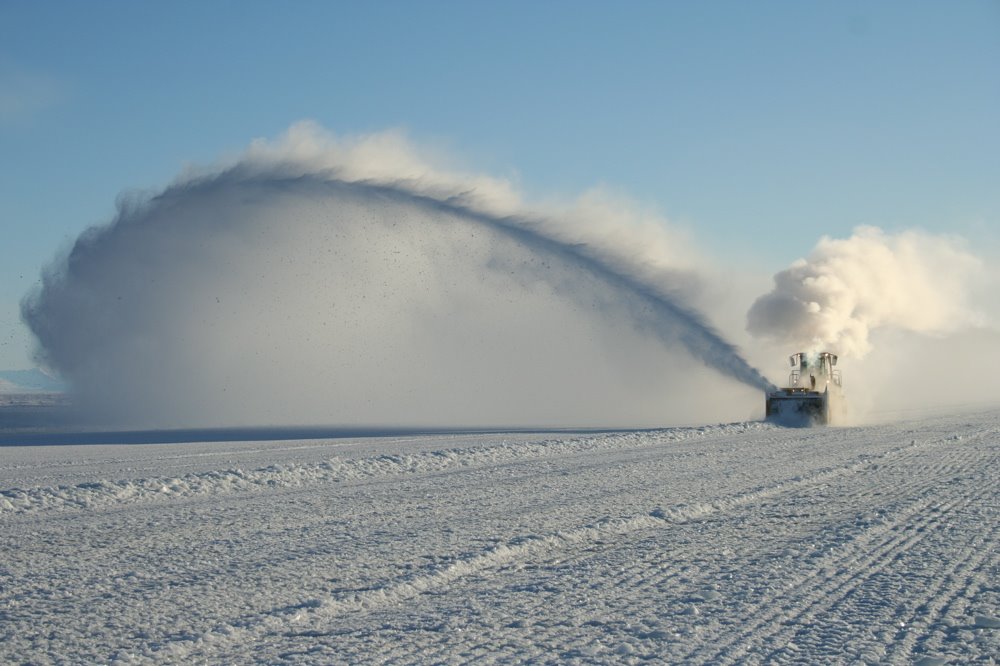
A dozen massive vehicles by Caterpillar, dieseling while their drivers catch lunch. Don't they know I'm trying to record sound over here? Meanwhile Mt. Erebus attempts to out-diesel them in the background.

We spent today on the "Sea Ice Runway," which is under construction in anticipation of the fast approaching summer. Known here as "mainbody," summer officially starts with the arrival of the first flight on October 3rd. Everyone commenting on this says we are really lucky to be here for winfly because mainbody is hectic, there are lines for food at the cafeteria, and the place is just generally overrun with mooks and beakers. In other words we have already become a junior league version of the winterovers, who groused and sulked when our flight arrived and they were forced to endure us running about gabbling and oohing and aahing, healthy, fresh-faced and suntanned. Still three weeks away, we already resent the imminent arrival of a bunch of johnny-come-latelies who are, we're sure, certain to be intolerable and disgustingly enthusiastic about something or other when, for God's sake, they don't even know what darkness is. Could you hold on a second? I think I lost a contact lens...

The Sea Ice Runway is a hive of activity. Graders, snowblowers, and surveyors are making it safe for planes to land on the six-foot thick ice. Once it is up and running, or open for landing, airplanes will be flopping down just a few hundred meters from our office window, so while I've been complaining that we have yet to film a shot without some kind of motor dieseling somewhere in the background, I suppose I should count my blessings, as I have only jet engines to look forward to. It has been blissful so far, since not a single aircraft of any variety has ever passed overhead, but apparently there will be over 300 flights in the course of the coming season. This seems a staggering number in support of a few science projects, but as I learned on board the USS Nimitz last fall, military pilots don't log any flight hours by sitting on the ground. The runway preparation machinery is awesome, and includes many future contenders for the Vehicles of McMurdo photo essay, with snowblowers that on my sidewalk on Coffey Street, would probably suck up, chew, and spit out my entire termite-ridden shack of a house along with the snow. Comparing them to your average snowblower is rather like comparing Niagara Falls to a garden hose; these blowers fling grapefruit and basketball sized chunks of solid ice dozens of yards. Before driving out there we were told that last year a pickup truck was largely destroyed and its driver gravely injured when he made the mistake of turning along the runway towards the business end of one of these beasts.

An orgy of diesel fumes and projectile snow...