Twitching, you need to understand, is not a symptom of some dread disease, or a nervous mannerism. To twitch is to list, to tick, to cross off, as in a species of bird, once seen. Twitchers are those birdwatchers at what we might call the hardcore end of the birding spectrum, those maniacal and fanatical amateur ornithologists driven by a desperate impulse not entirely distinct from collecting passport stamps or records or turquoise enamel cookware. Ever in seek of the new, these are not people who sit about watching their favorite garden birds visit the backyard feeder. No. Twitchers flit around their state, nation, continent or globe in search of novelty, rarity, and most importantly, another X on the checklist. They have "life lists" which catalog the entirety of their successful sightings in the absurd world of competitive birding. I would never participate in anything so crass, not to mention demeaning to the birds themselves. But that's easy for me to say, because my list is longer than yours.
In Australia, at least, my list is most definitely not longer than Sean Dooley's. A lifelong birder and freelance comedy writer caught "between jobs," Dooley, in 2002, squandered his inheritance attempting to break the Australian "big year" record. He sought, in other words, to see in one calendar year more species of birds within the political boundaries of what we call Oz than anyone before him. In fact he hoped to far exceed the long-establish record of 638; he was aiming for a full 700. If you think this is an obscure goal allow me to assure you that in the United States it is not uncommon to encounter birders who keep county lists, not only in their home state, but in the neighboring ones. What's more, they keep cumulative lists for a particular month in a particular county. And monthly state lists. And lower 48-states lists. And lists of their lists. I don't have any of these. What do you think I am? Some kind of bird geek? I do admit to having a "Five-Borough" list and a "Red Hook" list, but purely for my own amusement. And if you had seen Red-throated loon in the industrial wastelands of the Erie basin, swimming just in front of the Sunset Park Home Depot, you would start a Red Hook list too, I know you would. Not to mention I had Wilson's warbler in my back yard on Coffey St. and needed somewhere appropriate to write that down for posterity's sake. But this isn't about me, it's about Dooley.
I don't want to offend anybody, since over the years I've been given as gifts everything from academic works on feather structure in
accipiters to sappy reminiscences of lives spent "birding around the old Vermont homestead," but I could care less about books about the habits of birds, how to feed baby birds, what birds some other person saw, what makes birding "fun", why birds can fly and so on. I don't want to stay home and read about other mooks who love birds, I want to go out in the woods and see new ones. Unless it is a field guide, which will help me identify birds in Madagascar, and therefore allow me to add them to my list, I don't care. So a book like
The Big Twitch is normally not something you will find me enjoying.
But in fact, I
loved it.
As far as I can tell from the birders I've met here and there around the globe in my travels so far, Sean Dooley is the only other "birdo" out there besides me who understands why the rest of the world thinks we are insane. And thinks birding is funny but still birds. "To bird" having become in our world a verb. Most hardcore birders you meet out in the field say things like "I was going to fly home to be at my wife's side as she delivered our first child, but I hadn't managed to see Scarlet Macaw in time to get back, so I stuck around the malarial swamps of Guatemala for a few more days. But we're planning on having more children." Should you give the merest hint that you find this suggestive of misplaced priorities, such people invariably go all huffy on you, retreating between the covers of their field guide and refusing to talk about which trail it was exactly that they saw Atherton's scrubwren on that morning. But not Dooley. He thinks it is all hilarious and embarrassing, but inescapable, because he has got the disease. In
The Big Twitch, he drives thousands of kilometers through the outback madly ticking off species and eating nothing but stale meat pies, only to arrive, exhausted and road weary, at some god-forsaken internet cafe where he logs on and discovers that some mega-rarity has been sighted thousands of kilometers back across the county, whereupon without stopping for so much as a coffee he rushes to the airport and flies off to fail to see it. Then he laughs about it and starts over. Meanwhile his total is steadily rising, along with the suspense.
I don't want to spoil the ending of this ornithological cliffhanger, but Dooley gets his 700. His 700th bird for the year was a tiny, brightly colored sparrow-like bird known as a Blue-faced parrot finch. Notoriously difficult to pin down, nomadic and wily, parrot finches feed in long grass in clearings in rainforests. One would imagine that they would be doing well, given how much rainforest is being cleared around the world, but parrot-finches are declining. They are very particular and like only tiny clearings in very good, pristine forests. When I was in the Philippines, working on a film about Imelda Marcos, I remember reading about a filipino parrot finch with habits even less-well-known than those of the Blue-faced. It hadn't been reliably seen in years, and even to go to the district where it might conceivably occur meant risking kidnapping at the hands of Maoist separatist guerillas. I didn't try to see it. Dooley saw his Blue-faced on Mt. Lewis in northern Queensland, which has comparatively few guerillas, and as I am in the neighborhood I thought I would stop by and visit the site, being that it is now obviously of immense historical significance. I also hoped to see Tooth-billed and Golden bowerbirds, Mountain thornbill, Gray-headed robin, Bower's shrike-thrush, the aforementioned Atherton's scrubwren, Chowchilla, and Fernwren, these being the crucial species to "get" here, as they all live only in a small area of mountainous coastal rainforest in this enormous state. They are known collectively as the "wet tropical endemics."
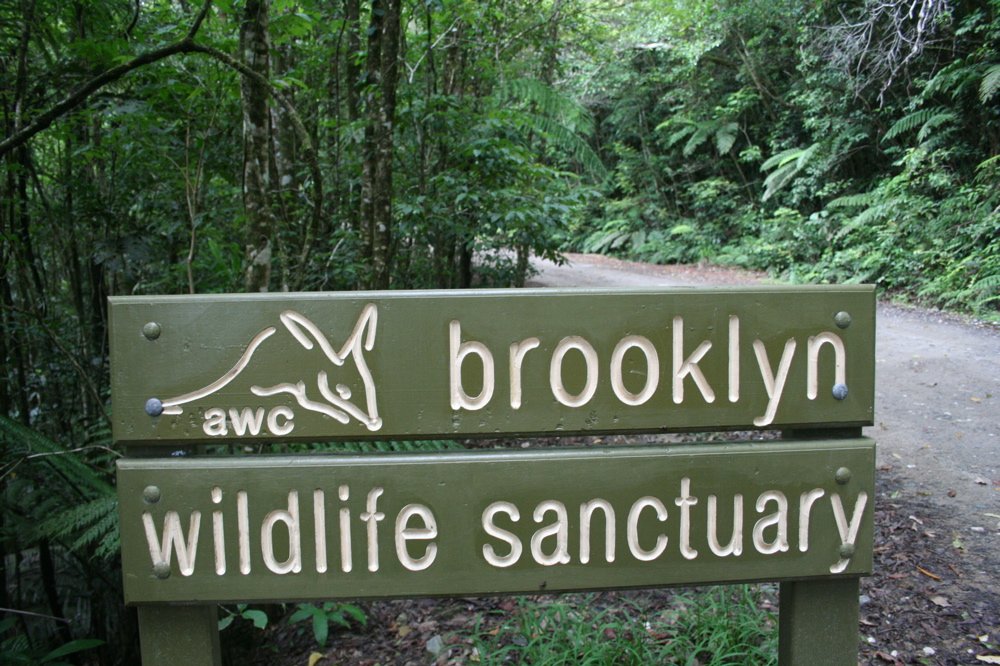
 The entrance to the Mt. Lewis refuge. If only we had tropical rainforest like this in my Brooklyn!
The bird is known to hang out at one particular clearing in the forest, near the summit of Mt. Lewis, a couple of hours north of Cairns, which was the answer we were looking for in the quiz in the previous blog entry. Dooley claims to have been particularly excited to see the parrot-finch not only because it was to be number 700, but because he had failed to find the unreliable little beast on previous occasions. It was, therefore, a "life bird" as well as a "year bird." With one week left in the year, he wrote:
"Over fifteen years I'd made the pilgrimage to Mount Lewis on five separate occasions. Each one had seen me return with an empty space on the checklist. Others had been seeing them recently at the famous clearing but there had only been one or two and they had been very difficult to get onto.
"I rose before dawn on the morning of Christmas Eve, determined that this time it would be different.... Bleary eyed I drove up the mountain and parked the car at the concrete causeway where a party of Red-browed finches were feeding. The parrot-finches will supposedly forage with the Red-broweds, but not this time.... I tremulously walked the rest of the way to the clearing. Again there were more Red-broweds, again no Blue-faced."
My God, Dooley, put me out of my misery, I can't stand the tension."After a couple of minutes I thought I saw something a bit bigger fly down to the base of the grass. I could see one stalk of grass waving about far more wildly than the ones the red-browed finches were perched on. This had to be it. Slowly the bird on the grass stem moved up towards the waving seed-head. Like a fisherman who can tell by the strength of the tug on the line that he's got something good, I knew this was the business. Suddenly the bird popped into view. Plump, bright green body, blue face, red rump: a Blue-faced parrot finch, bird number 700."
Trying to have this experience for myself (this is about me, not about Dooley), I drove after dawn up the slick clay road, through spectacular tropical Australian rainforest, watching the odometer tick off the tenths. The critical clearing is 11.6 kilometers up the mountain from the main road, as any fool who can Google should know. Probably 90% of the birders on the world circuit who have the parrot-finch on their list have seen it in this exact spot. Not me. I saw it well before there, at about the 8 kilometer mark, when an explosion of small birds burst out of a minuscule patch of roadside grasses. Does that make mine better than yours? Directly in front of me, before I had so much as gotten out of the car, a blue-faced parrot finch perched on the branch of a bush overhanging the road. Even through the rental car windscreen I could appreciate the brilliant grassy green body, crimson, pointed, parrot-like tail and the cobalt blue, almost Yves Klein head. The parrot finch is quite a little number. I jammed the car into park, turned it off, and eased the door open gently, while rooting around on the seat next to me for the binoculars, never taking my eyes off the bird. I slipped out and got a bead on it through the bins. Slowly I approached, flushing more birds, which whirred up into the bushes and peered around. Suddenly I was surrounded by parrot-finches, a pestilential plague of them. It made me wish I had brought a squash racquet, to swat my way through. There were four in all.
The legendary Blue-faced parrot finch, Dooley's-number-700, was literally my first bird of the day. When I arrived at the actual, reknowned clearing, I saw two more. At my leisure, relaxing, not rushed. They hung about, as if they enjoyed me watching them. They were virtually nibbling at my shoelaces. (What I'm doing right now, according to Dooley's useful and farcical "glossowary" of ozzie twitching terms, is
gripping you off: "Not as grubby as it sounds, but still an unpleasant experience. When one birder teases another after having seen a bird the other one hasn't.") My day started on that high note and just kept getting better. I know, I know, you desperately want to know about the Chowchilla. Yes, I saw it (2684). And Atherton's scrubwren. And all the others. And King parrot. And Bridled honeyeater. Etc. You didn't. I did. You shoulda been there.
Sorry, I got a little carried away there.One of the best moments of the day was watching two Red-browed finches mating. Out of nowhere a pair flew in and landed just inches apart on a horizontal exposed twig at the edge of the world-famous clearing. In his conical bill, the male was clutching the tip of a blade of grass, which he extended into the air in an arching bouquet. He then hopped a series of vertical hops, waving the seed-head indeed. Each hop brought him closer to the female, who was at the very least receptive enough to have joined him on the branch to begin with. I'm fairly certain she knew what was up. With a final wave of the seeds and a last hop he leapt aboard the passive female. Flustering and ruffling, humping and wriggling, he discarded his blade of grass in mid-coitus, which is to say about two seconds into the proceedings, as if to demonstrate that he no longer needed his prop. I suspect that in the Red-browed finch world, the bit of grass symbolizes the man's willingness to set up house, to nest and to nurture alongside his mate. Somewhere in there I'm sure lurks a life lesson waiting to be learned, I'm just not sure what it is. But I'm going to try out the building materials courtship trick next time I'm in Sunset Park at the Home Depot. Look for me holding a 4X8 piece of sheetrock over my head and hopping up and down.
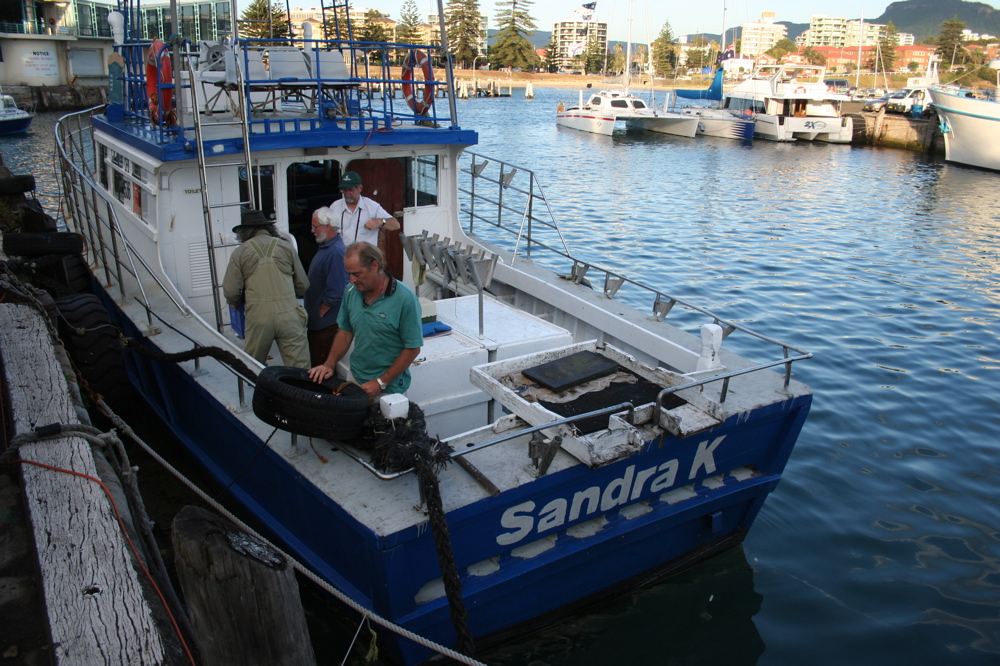 The Sandra K. at the wharf. Everyone from Phoebe Snetsinger to Sean Dooley has headed out for a gut-churning sea voyage on board this modest vessel.
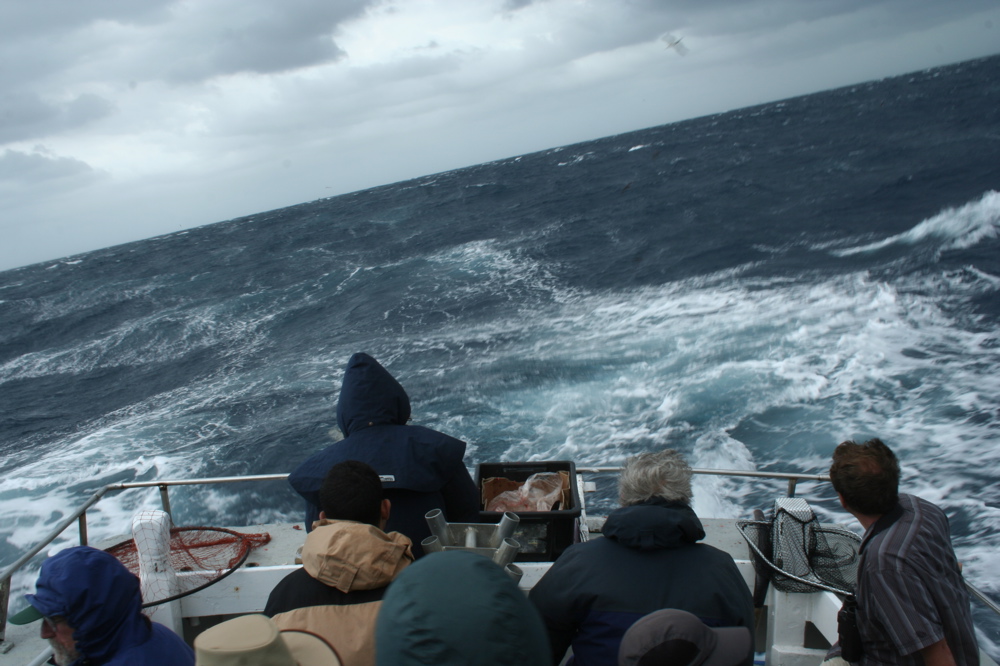
 Puttering through the harbor, a boat full of birdos, all eagerly scanning the waves for the first bird of the day.
 "The sun's coming up, like a big bald head."
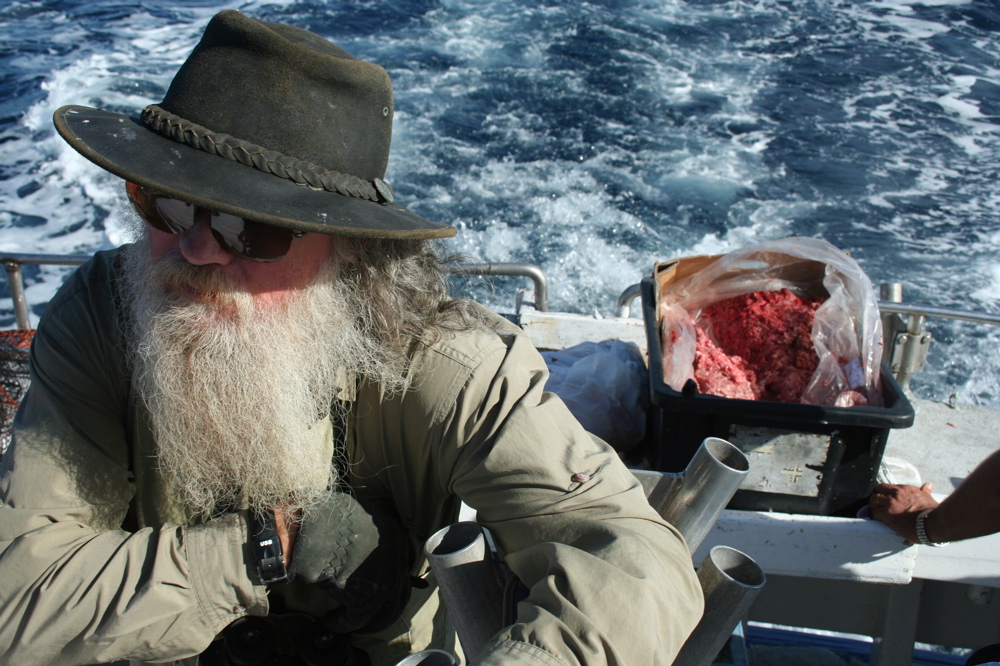 The former drummer for ZZ Top, now retired to a relaxing life as the resident chum-master on board the Sandra K.
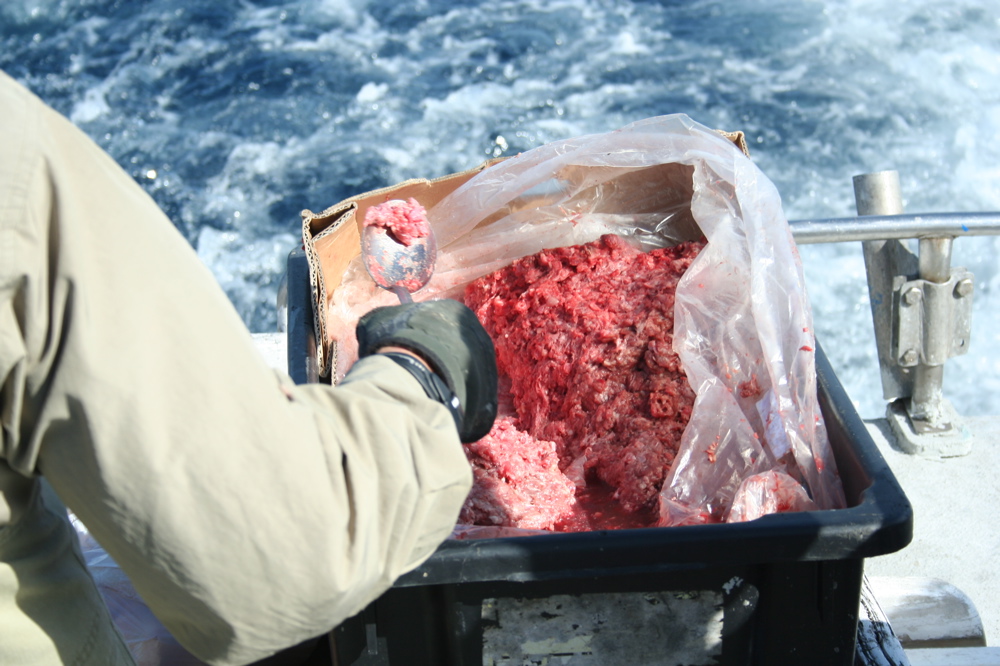 Mmmmmm. Delicious. Nothing like the sight of a tub full of ground raw chicken to help ease that queasy feeling bubbling up from the small intestine. Is that spoonful for me?
 Soon a mass of Wedge-tailed shearwaters began to gather, gobbling chicken offal and trailing behind the boat.
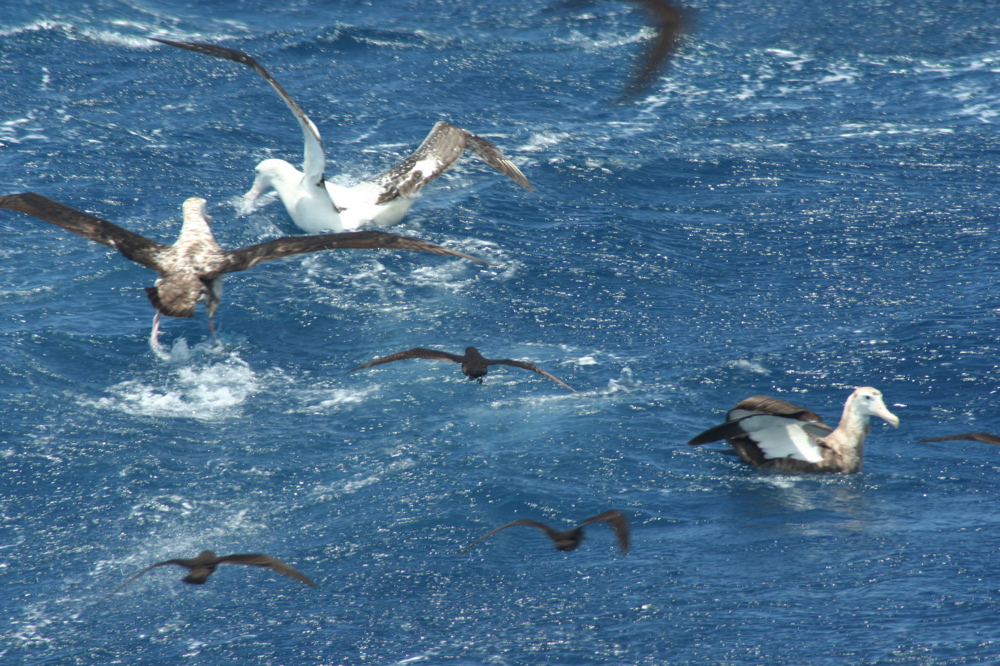 The big boys, three Wandering albatross, join the party as we near the continental shelf.
 Netting shearwaters for banding; something like capturing butterflies, except bigger, and with feathers.
 It's a bit like fishing.
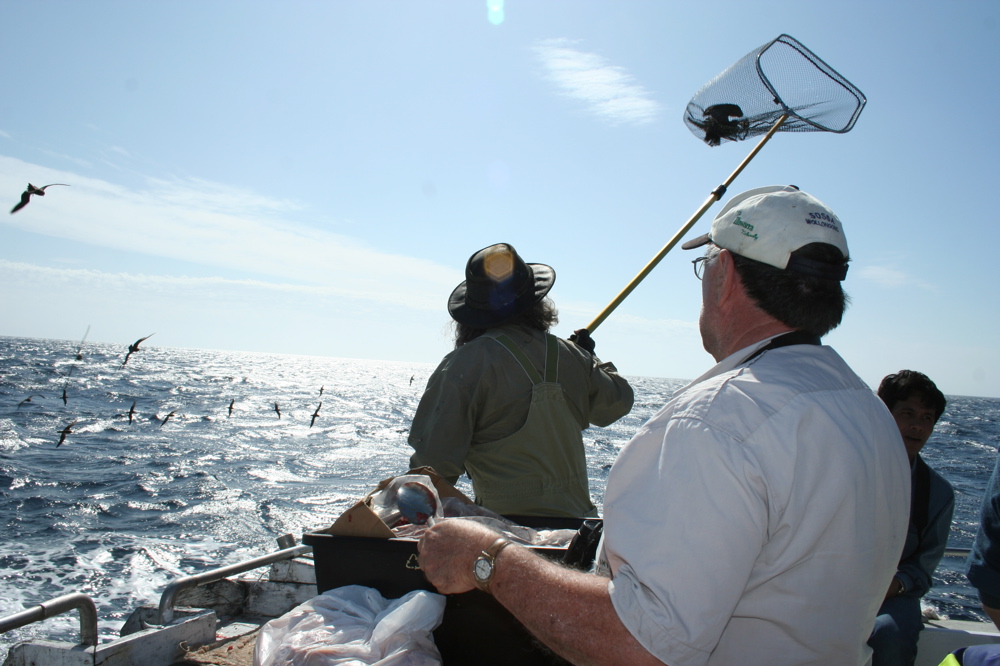 Got one!
 Bird banding.
 Scraggly shearwater, banded. Tag and release.