Showing posts with label racing. Show all posts

5/15/2012

A Day at the Races, Part Two

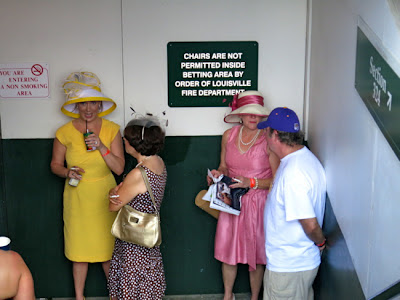
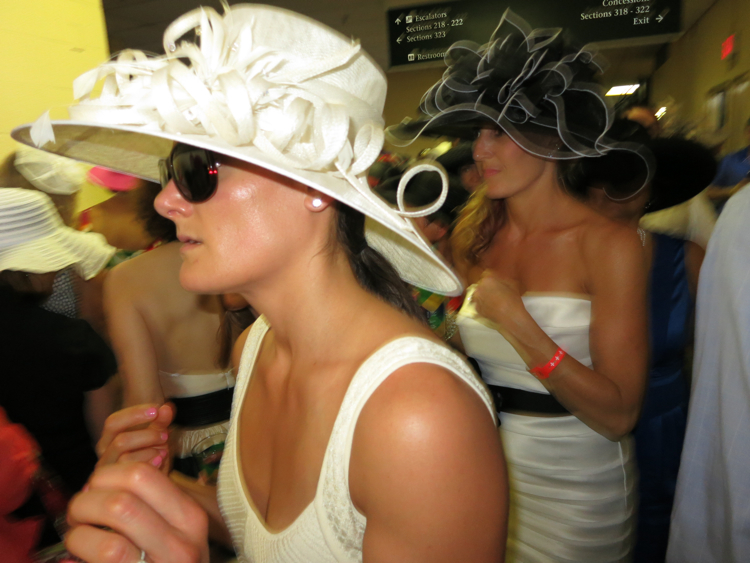
As I noted below my last post, the Kentucky Derby, perhaps not an easy way to make money, is nonetheless money in the bank for any aspiring street photographer. The hats, the alcohol and the fevered viewing of the horses compile into countless revelatory and unguarded moments. Here's a second series from a weekend in Louisville:


9/29/2011

Me and Eddy (Updated)

A few weeks back, superstar portrait photographer and honorary* member of the Brooklyn Pinarello User's Group, Wolfgang Wesener, dropped me an email with a hot tip. The greatest cyclist in the history of the sport was shortly to venture out from his lair in Belgium on a rare visit to New York.

Known for obvious reasons as "the cannibal," Eddy Merckx won the Tour de France five times, a total since eclipsed, but in his era he dominated the sport more completely than any rider before or since. He held the one-hour record and triumphed in innumerable classics, including the savage Paris-Roubaix, which he won three times. He is a legend, at the top of any list of the most famous Belgians in history. There is a subway station in Brussels named after him. The man walks the streets of Flanders like a living god.


Did I want to come along and drink free beer and meet the monster-legend? Certainly! The event was a press-tivity celebrating the fifty years of Bicycling Magazine, held incongruously at the Classic Car Club on lower Hudson St. To accommodate the guests, the Car Club had emptied their showroom onto the surrounding streets; the sidewalks outside were strewn with Aston Martins and Porsches.

Inside, they had wine, and cheese, and some of the latest carbon-fiber bicycles manufactured under the Merckx imprimatur. While these feather-weight ugly ducklings are all the rage, it should be pointed out that Merckx himself rode in an era when men were men and bikes were made of steel.


The event logo is inspired: a view of Eddy's posterior, with the man looking back at you over his shoulder. It's a reminder to the many, feebler, one-time followers that the best they could manage was to approach the back end of greatness.

I was focused on the cheese platter, but Wesener had an ulterior motive. He hoped to convince Merckx, or Merckx's people, or Merckx's patrons at Bicycling, to schedule a sitting for a portrait. While I gobbled canapés and helped myself to pair after pair of the complimentary bicycling socks on offer at the door, Wolfgang schmoozed. He has photographed flamboyant denizens of the Manhattan nightlife demi-monde of the 1980s, patrician vintners of the grape-clad hills of Tuscany, and innumerable superstars of the crank and cog, the stage and screen. A few choice names of former subjects, a list varied gently depending on the context, are enough to serve as an impressive resumé. Within moments he was back, breathless. Merckx was due to fly back to Belgium early the next morning, but at the end of the party he might spare a few minutes. There was only one problem. Wesener hadn't anticipated being able to photograph at the very event. All his gear was 30 blocks north, in his apartment. Would I consent to stick around and keep an eye on Merckx, while he went to collect it? I looked around cautiously, trying to ascertain whether they were still serving hors d'oeuvres. "Sure," I said, spying a tray of saté'd chicken skewers, "Why not?"

Baron Merckx and Wolfgang Wesener discuss the finer points of cycling strategy.

And so, without quite intending to do so, I had volunteered to be a photographic assistant for the evening. A short round-trip taxicab later Wesener returned, and I was helping set up lights, run power cords and sit for test portraits. Suddenly, it felt like a day at the office. It was all remarkably like preparing to film an interview, when the sound person is invariably asked to sit in the "hot seat" and give the cameraman something to focus on. As if we don't have our own work to do.

"The Cannibal," graciously autographing.

The installation complete, the evening became a waiting game. There is a certain amount of suspense to these affairs, for despite the lavish promises of the minions, the possibility always exists that the celebrity subject will feel overwhelmed by the end of the evening, put upon, hungry for the fine dinner he has been promised. Imperious or petulant, the coddled star may simply announce that he or she has had quite enough of signing cocktail napkins and making banal cocktail chitchat with the teeming masses. Then with a rush the handlers converge, and the whole posse swishes out the door and into the waiting limo and are gone, leaving you forlornly toying with dials on your now impotent, subjectless camera.

But Mr. Merckx is a gentleman. He endured for much of his life the searing burn of lactic acid in his oxygen-starved muscles as he demolished the cycling opposition; such men are not daunted by the social indignities of arranged public appearances. He came and took his seat. I held the reflector. Wesener snapped away, burning quickly through a couple of rolls of film. Film, real film. With just an exposure or two left to go he urged me insert myself into the frame, for a souvenir moment with Eddy.

A few days later, the film developed, Wesener called.
"You're very lucky, Mr. Fleming."
"Why is that?"
"The best picture of Eddy is the one with you in it!"

The next week, a print arrived in the mail.


For those of you who are unaware of it, my name, Fleming, was one widely given to impoverished Belgians (the Flemish) who fled Flanders and emigrated to Ireland seeking greener pastures, possibly as early as the 11th century. "Oh, here comes another boat-load of Flemings," the Irish would remark, when on slow days they enjoyed going down to the harbor to watch the ships unload. As this image makes clear, the passing centuries have done nothing to erase the winning, world-dominating DNA of we flatlanders. The shared intensity of gaze, the identical noses, the parallel angles, the commitment to victory at all costs. Me and Eddy.

Final image courtesy of WoWe


*Manhattan residents are only eligible to be "honorary" members. 


UPDATE 10/3/2011:

Wesener is not just some dilettante on a Pinarello. While my rides around Prospect Park this summer have been mainly about lowering my cholesterol and getting regular aerobic exercise, WW was in serious training for L'Eroica, the Tuscan cycling marathon held yesterday in the wine country of Chianti. (This explains, perhaps, why on our rides together I was desperately trying to hang on to his rear wheel). Today, in an email, he's written a sort of haikuish summary of the savage ride, much of it held on the unpaved roads that wind through the hills of Tuscany:


it was dark when we started and dark
when we finished
i did the 205 km (details later)
the dirt roads (50% of the race)
were hell (and nearly destroyed me)
it's so exhausting that after a while
you aren't aware of the incredibly
beautiful landscape anymore.


Eh, Congratulations, Paisan!

3/21/2010

Red Hook Criterium

 
There's a notorious race on the pro cycling tour, the Paris-Roubaix, which adds additional insult and danger to the already brutal demands of world-class bike racing. Known as l'enfer du Nord, the race is a savage, kidney-jangling, off-road torture chamber run over as many remaining stretches of cobblestoned road as the organizers can fit into the route. The trophy is a chunk of paving-stone. 

Taking a page from this storied event is the organizer of the Red Hook Criterium, a race of which I was entirely unaware until yesterday afternoon when I spotted a patron at the fabulous Fort Defiance, sporting cycling shoes and a shirt advertising it, emblazoned "March 20th, 2010." I imagined he was relaxing over a cocktail after having just raced. Not in fact. The event was to be held later in the evening, at 11PM. 

After enjoying a first barbecue of the season in the local community garden, we wandered on down towards the water to have a look. Nocturnal bike races are few and far between. Beard St. was clogged with cycling aficionados. There were many dozens of people, I suspect, who had never set foot in Red Hook before, but illicit sporting activity is always a powerful draw. The Red Hook Criterium is unsanctioned. It's a guerilla race ridden on brakeless, fixed-gear cycles originally created for use only on dedicated cycling tracks. Unfortunately these bikes, popular for decades with messengers and hipsters, have now become an entire cyclery subculture unto themselves. This is why a woman at the corner of Beard and Richards streets, part of a crowd trying to prevent a bus driver from continuing his scheduled route, was screaming "they don't have any brakes!"

I'm all in favor of guerilla actions, especially bike-related ones like the monthly Critical Mass rides, which are essentially joyous political manifestations that draw attention to the desperate lack of cycling infrastructure in our city. But the Red Hook Criterium is not one of those. Also, "it ain’t no hipster show,” founder-organizer David Trimble told Velo News. “The first two winners have gone on to pro contracts." This is a high-speed, top-level amateur criterium, which is a particular type of short-course cycle race. In contrast to a road race, which goes from point A to point B (Paris to Roubaix, for instance), a criterium is made of multiple laps of a tight loop, usually about a mile or three, which is repeated over and over again, in this case 16 times.

This is a race, it seems to me, trapped between its gangster, outsider ethos, its growing popularity, and the very real demands of providing a safe riding environment for the racers and  large crowds of cheering spectators. The dilemma is evident. It is hard to imagine that the city would ever officially permit a nocturnal cobblestone criterium. The police are on twitter, just like you, so they were aware of the race, and they cruised by a few times, apparently deciding to choose their battles and let this one happen unimpeded. But this is quite literally an accident waiting to happen.

In his Velo News story, Daniel McMahon managed to convince me that, if he has ever set foot in Red Hook before, it must have been at least ten years ago. "The race takes place in a derelict part of the city," he wrote, "a postindustrial area a stone’s throw from the waterfront, where at night it’s decidedly empty of people." That romantic description was more or less accurate until the Fairway opened at the end of Van Brunt St. and the IKEA opened on Beard street. The race organizers must know about the IKEA, since they put the finish line of their race at the entrance to its parking lot. Thanks to that big-box store, the stretch of Beard making up the southern flank of the racecourse is now also the terminal leg of the B-61 bus route. The B-77 bus route has also diverted to Beard St. to bring in shoppers, and runs along it in both directions. As for being decidedly empty of people, that might have been true had there not been a bike race....

During the Red Hook Criterium, a fast and short race which probably took the winner about 25 or 26 minutes to complete at speeds between 25 and 30 miles per hour, no fewer than four bus drivers had to be begged, wheedled and cajoled to pause and prolong the Saturday-night completion of their duty, which is to provide low-cost, highly energy-efficient transportation to New Yorkers. (Naturally, the bus never seems to run this frequently when I want to take it, let alone at eleven PM on a Saturday night, but  I was there, and I counted four).

Part of the problem is the nature of the criterium format. Another was an unevenly matched field. With a repeating loop of only three-quarters of a mile, it took only three or four laps before the gang of racers was entirely exploded. There was no tight pack, whipping around the course en masse, with long pauses in the action. Instead there were riders widely spread around the entire loop of the course, with the result that the hapless volunteer flagmen could never find the time safely to allow the buses to go through on their route. (This could have been greatly helped had anyone who was "lapped" --overtaken by a full rotation of the race leaders--been immediately forced to stop riding, but as far as I could tell that wasn't happening). Surrounded by people, with the roads blocked by pedestrians, the buses were huge and inert; even when an opportunity to move presented itself, it was impossible to get people out of the way fast enough. More than once a bus finally began to move, only to roll right into the path of more riders careening around the corner. At risk of sounding like a premature curmudgeon or a sandbox supervisor, this is going to be great fun, right up until someone gets hurt.


Night of the zombie shoppers at the "derelict" and "post-industrial" finish line.

9/23/2007

Twelfth in a field of nine

Having on two recent weekends been off to the races, albeit automotive ones, and gone sailing aboard Anthony Chase’s yacht, Salomé, it seemed high time to combine the two pursuits, and so last weekend Anne, Anthony, Evan and I headed back to Mamaroneck for an ostensibly casual Orienta Yacht Club club race. The prediction was for winds up to twenty-five knots, gusting thirty, a terrifying and pessimistic prediction, for I cannot remember ever sailing in such near-gale conditions. Salomé, a tender, whippy boat, is much better known as a light wind performer, a vessel that will sail effortlessly down the Long Island Sound on a balmy breath of breeze when others are reduced to firing up their ghastly diesel engines to move through the water at all.

The friendly flotilla

All around us in the harbor was a flurry of activity as competing captains busied about their decks, fired up their engines and began heading out the channel that leads to the sound. Joining the convoy we left the harbor behind us and wasted no time getting the sails up, reefing down one, as there was already quite a blow and the forecast called for increasing winds. We were chagrined to see that many in the field were flying kevlar sails, high-performance, ultra-lightweight rigid canvas made from the same space-age material as bulletproof vests.

Kevlar, Schmevlar

With an hour or so to spare before the one-o’clock gun we tacked back and forth, practiced a controlled gibe and worked on our maneuvers. Proper positioning at the start is critical; it is not, of course a standing start, and ideally one should find oneself sailing full speed towards the line at just the moment the starting gun sounds. If crossing early it is necessary to come around again, a devastating self-inflicted handicap. As the moment approached we found ourselves jockeying in a clump of some five boats, all needing to get around and downwind to get across. While others tacked, Evan masterfully called for a controlled gibe. Suddenly we were through; first out of the starting blocks, or, perhaps, second.

Feel the froth coursing off of our stern, suckas

Running before the wind we had the illusion that the conditions were not so bold; the windspeed of course was masked by the direction of our travel. The larger boats, with their grotesquely expensive sails, began to pass us, but, being lighter and shorter, we felt our first place position secure, as the boats are ranked and handicapped, and only the much bigger boats were out ahead of us. We even fended off an attack from the Patagonia, who tried to slip past downwind of us, only to find us thieving her wind before charging off ahead.

Captain Chase surveys the scene as Evan steers and Anne soaks up some rays and the Patagonia renews her challenge

It was upon rounding the first marker that we first felt the fury of the wind. On a “close reach” with the sails pulled taut, the deck promptly canted over at an alarming angle, until the starboard toe-rail was well in the water. We were humming and throbbing along. Anne and I clambered up and sat with our legs dangling out off the port rail, Antarctica veterans relegated to little more than ballast. The first mishap was a near broach, as Salomé proved too flighty to weather a massive gust that took her and turned her right up into the wind until it seemed we were pointing nearly back towards the harbor and our mooring.

Uhhh; how did all your dudez get ahead?

Things were to go from bad to worse. Inexplicably, once back on course, there seemed to be rather more boats abaft than adraft, or however it is that sailors put these things. Nobody was behind us any more, save a sort of antique wooden showpiece collector's item kind of a vessel, a blue-hulled tub that might once have danced friskily along the waves during the period between the great wars, but was now somewhat long in the tooth. The wind was furious. We eased the sails, then trimmed them, to little avail. From the second mark we were forced to beat upwind, and our fate was sealed by an inopportune tack which had us on a straight collision course for a grotesque party vessel fast at anchor, its decks crawling with recreational fishermen. Tacking again to avoid this unpleasantness, we watched the competition recede onto the distant horizon. We considered inventing a pressing engagement somewhere out East, an overlooked barbecue, perhaps, requiring our immediate presence in the Hamptons. Instead, valiant in completion if not in victory, we pulled finally across the line and headed for the calm waters of Mamaroneck harbor to eat crow along with the celebratory post-race pizza.