Showing posts with label red hook. Show all posts

7/03/2013

Mulberries for Ruby (with apologies to Robert McCloskey)


On a recent trip to Greece, to visit what might best be described as a sustainable techno-hippie commune, I was astonished, again, by the number of olives growing everywhere. Every curve, every rise of the land, every back yard and neglected plot held stands of the trees, their distinctive gray-green leaves swaying in the Aegean breeze. I asked one of the cofounders of the Telaithrion Project if each and every one of the thousands of oliviers that I had seen from the car window had a putative owner. "Absolutely," he said. "But it is cheaper for the people to go to the store and buy olive oil than to bother harvesting and pressing their own, so many people in this village just let us help ourselves to their olives."

When I got back to Red Hook I described this vision of thousands of unharvested olive groves to my dear friend Erika. Both of us were somewhat horrified by the thought of all those splendid olives falling down to the ground and going to waste. We're accustomed to paying twenty dollars for a liter of fine oil at Caputo's or carefully tasting the $6.99 per pound selection of olives at the bar at Fairway. What paradise to have your own olive tree in your own backyard, we mused, without even taking into account the climate that comes with one! I told Erika that the folks at Telaithrion aren't certain exactly how much of their diet comes from foraging, but that they think it might be as much as 20%. When I had arrived, in their front yard, there were bedsheets spread on the ground beneath two mulberry trees, to collect the fruit.

"Now when you start talking about mulberries," said Erika, "I guess I kind of get it. We have a giant tree up in Rockland County, and I admit we don't do a very good job of harvesting the fruit." It's easy to fantasize about other people's fruit trees, but when it's in your own backyard it's harder to make it happen. In New York City? Who has the time?


Actually, Ruby and I do. My peripatetic freelance existence makes for some intense work when I'm on, but when the calendar is empty I bake bread, make preserves and lounge about the house with my seven-month-old daughter to my heart's content. Inspired by the greeks, and without so much as asking Ruby if she wanted to participate in my jammy schemes, I plonked her in her stroller and we headed out into the wilds of Red Hook in search of mulberry trees. (There are no olives.)

Like wild animals, mulberry trees leave tell-tale sign. Looking down the block from the corner the rich dark berries may be invisible on the tree amongst the green leaves, but the swollen, dark fruits scattering the sidewalk are a dead giveaway. 

Low-hanging fruit: An early June mulberry branch, brimming with berries. I can't tell you where, or I would have to kill you.

Above, a typical presentation; an unruly tree has long ago breached the confines of its owner's yard, shading the entire sidewalk with its fruit-laden boughs. Perhaps because they are smudged and smeared by passing pedestrians, who tend to collect a seedy, gooey purple paste on the soles of their shoes, mulberries are not on the New York City Parks Department list of officially sanctioned trees. Although there may be exceptions, the eager forager must therefore typically go in search of the overhanging branches of trees planted on private property. Although nobody has ever come out of their house and accosted me for stealing their berries, this possibility does give urban mulberry gathering an added frisson, the thrill of the trespass. My sense that Ruby's irrepressible grin would help take the edge off any such potentially unpleasant encounters was just another reason to bring her along.


Ruby enjoys the shade of a mulberry tree. Note the dense scattering of fallen fruit on the sidewalk behind her.
Ruby slumbers, while daddy harvests.

Ruby dozily guards the slowly filling mulberry pot with her stroller.

Here an aggressive mulberry has forced its branches through a chain-link fence, soiling the sidewalk with its sugary offerings.

A few days shy of ripe. (I picked the ripe ones before taking this photograph.)

Mulberries come in two varieties, purple, and white. In Red Hook, at least, trees with purple fruit far outnumber those with white fruit, but I did find a few of the latter variety, which are mixed in, above. I believe them to be sweeter, and more highly prized, but perhaps I just think that because they are more scarce.

A healthy bowlful, on the kitchen counter.

The same berries, after macerating overnight in two cups of sugar. Some people skim off the foam before they begin cooking down the jam, but I don't bother.

A case of half pints. I would estimate it took approximately 20 cups of berries to make these, and approximately two-and-a-half mulberry-picking man-hours.

An extra half jar, for immediate use.

TECHNICAL NOTES:

Most recipes for mulberry jam call for an obscene amount of sugar, as much as one cup per cup of berries. That's not mulberry jam, that's mulberry-flavored simple syrup. The problem is that even with low-sugar pectin, mulberry jam won't set very well unless the pectin reacts with a lot of very hot sugar. For me this isn't a problem; I don't care if the jam is runny. You are most likely going to be spooning this over vanilla ice-cream anyway. I used about three cups of sugar for every 8 cups of berries.

You need:

8 cups of berries
3 cups of sugar
1/2 cup of fresh or bottled lemon juice (you want this for the acid, not the flavor, so bottled is fine, and perhaps more consistent).

Ball Jars (about six half pints)

Wash your berries really well; they are, after all, urban berries, subject to soot and exhaust and I know some of them fell on the sidewalk when you were collecting them. Some nerdlins try to remove the tiny green stems. Really? They are very, very small, and I can't see them having a deleterious effect on the final flavor.

Mix the berries and the sugar in a bowl, then gently crush some of the berries with a potato masher or the back of a large spoon, to release some of the juice. Cover and refrigerate overnight. While the berries are macerating, get a good night's sleep.

Clean and then sterilize your ball jars in a boiling water bath. Put your jar lids to soak in the hot water once the jars are ready.

Put the contents of your berry bowl into a saucepan and bring it to a gentle boil over medium flame. Stir while simmering for a minute or five. (If you want to go the pectin route in hopes of firm and spreadable jam, follow the direction that came with your pectin and add the appropriate quantity now--probably a lot more sugar will be required....) Stir your lemon juice in well and turn off the heat.

Pour your jam into the jars, preferably with a canning funnel, and set the lids. Tighten your jar bands finger tight and process the jars in a boiling water bath (fully submerged) for ten minutes.

Spoon over vanilla ice-cream and enjoy.


6/09/2013

You dropped a bomb on me.

My father, who grew up in rural Arkansas, where the amusements were limited, has a favorite saying he pulls out and dusts off whenever offered an allegedly thrilling social opportunity, or in response to expressions of boredom by his many children or grandchildren: "Wanna go down to the warehouse and watch the Sears truck unload?"

He is staying with us for the weekend, and today we pulled ourselves out of the Sunday morning bed with enthusiasm, for the great Governor's Island Building explosion of 2013 was scheduled for 7:36 AM sharp. Living only steps from the tip of Red Hook's Valentino pier, with a full frontal view of the building in question just across the waters of the Buttermilk Channel, we made our way down to harbor's edge with only minutes to spare. Somewhere, this event must have been advertised on the "social media," for there was a small but expectant crowd. Soon, dull booms issued from the island, and with well-engineered self-control, the building collapsed in a wave.

8/29/2012

Gun Control


Is seven a wave? Red Hook is all atwitter. It's impossible to walk down the street without having a conversation about the rash of gun crime that has made the neighborhood itchy in recent weeks. Seven incidents of on-the-street stickup is without a doubt statistically significant number. No shots have been fired, but having looked down the barrel of a gun a few years ago (in another country) I would certainly prefer to be mugged with a knife. Keep your eyes open, friends and neighbors.

So far, the worst thing about this pattern of anti-social behavior for me personally is how it showcases my inclination to profile. When you hear that a sixteen-year-old black young man pulled out a gun at noon-thirty on a sunny day, it makes it really difficult not to look askance at each-and-every sixteenish-looking young black male when you pass him in the street. This is how the police do their loathsome stop-and-frisk business all day long, and I can't bear them for it, and now I see a reflection of myself in their mirrored sunglasses. I don't like any of it one bit.

Photo: Stolen from facebook (no gun used), taken, I think, by Karin Weiner

2/29/2012

Top Secret Mission


On Superbowl Sunday a man sidled up to me and said: "Headed for Liberia, huh? How would you feel about taking over, you know, a small package for me?" We had only met that evening, at a party during the first half. It was now deep into the second, and over halftime both of us had changed venues, independently moving from one Red Hook bowl party to the next. It was hard not to think that he was following me around, trying to enlist me in some nefarious scheme. Between us was a sea of guacamole, and mountainous bags of chips, all destined to be neglected, for we were only minutes from the end of the fourth quarter. Some people nearby who had overheard this exchange looked at us strangely. "A package?"

                Exhibit A

"You know what I'm talking about," he said. "Take some along with you. I like to think of them as my children, going out into the world and spreading far and wide." Curiouser and curiouser. Then I understood. The man was the artist, Beriah Wall; I've written about him, but I had never laid eyes on him before. He's the guy responsible for manufacturing and distributing small coinlike clay lozenges that can turn up anywhere: in a flowerpot, on the stoop, atop a fencepost, on the welcome mat. A mass distribution of free art, a decades-long project. Wall had been handing them out at the party, shaking hands with fellow guests and pressing a clay coin into their palm. "This is for you."

                            B

I said that I would be pleased, no, more than that, proud, to carry a collection of Beriah Walls across the Atlantic; this is just the sort of pointless activity that makes life meaningful. Then I went back to grazing on the corn chips and thought nothing more about it.

                             C

Two days later, in a frenzy of packing and tidying, I went out the front door and down the stoop to take out a bag of trash. There, in the corner of the diminutive top landing, was half a sandwich baggie brimming with contraband disks. They had arrived at just the perfect time to go into my luggage. At Kennedy Airport, for the first time in living memory, nobody asked me if I had accepted any parcels from unknown persons. It seemed a good omen for the mission.

                               D

In Monrovia, the Liberian customs agent eyed us warily, for we had 19 pieces of luggage, mostly tactical duffle bags and vast black plastic impact-resistant suitcases filled with documentary film gear. I kept my secret bundle to myself and hoped we would not be too closely scrutinized. How to explain several dozen coin-shaped circles of fired clay, bearing messages like "Us / They," "Frog / Boil" "Sober / Somber"? I was pretty sure they weren't illegal, but looking at this particular import from the perspective of an African bureaucrat I was also confident they were inexplicable. However, they don't call the local enlisted production personnel on film shoots "fixers" for nothing, and in no time we were waltzing through the nothing-to-declare zone with our four mountainous luggage carts.

                    E

As I made my way into Liberia, a memory came to me, of a long ago New Year's eve. In 1985 I was in Paris, and after a much too long and much too festive champagne-soaked evening, some friends and I decided that the proper way to begin the year would be to drive drunk to Versailles and witness the dawn departure of the sober maniacs of the Paris-Dakar auto rally, the hell-for-leather trans-Saharan car and truck race. At the time, I was caught up in the romance and urban chic of graffiti, and as we wandered amongst the impressive monster trucks, their every surface plastered with corporate automotive advertizing, I surreptitiously added my own logo to more than one, drunkenly and gleefully imagining my signature bouncing over the rocky terrain all the way to Senegal. Beriah Wall's clay coins share something of the graffitist's ethos. They are the artist's mark on the world. They disperse on unpredictable and unchartable journeys, they make a web, an enveloping network of declarations of their creator's existence. I took a few in my pocket each morning as we headed out to film, placing them here and there in our daily travels. I hope whoever found them got as much amusement, bemusement and abstract, fleeting pleasure as I experienced, when I first came across one in the bed of my truck in Brooklyn.

 
                F1


                          F2
 
                             G

Partial list of collaborations:

A The illicit baggy on the nightstand in my Monrovia hotel room.

B A Beriah Wall on a retaining wall, at the International Rescue Committee HQ, Monrovia.

C "Us / They" on a garden shed with gang and Manchester Football Club graffiti, somewhere in the hood.

D  At the African Methodist Episcopal University.

E  At a palm oil wholesale dealership at Redlight market.

F1 At city hall, interior.

F2 At city hall, exterior.

G Left as a tip upon departure, in my hotel room safe.

12/29/2011

Will work for rum


Some forty-eight hours ago, a cry for help went out from Daric Schlesselman to the members of the Van Brunt Stillhouse facebook page. Schlesselman is my neighbor, three houses and a vacant lot to the west of me, and he recently launched a new alcoholic business venture. His rum distillery is another neighbor of mine, three blocks and several vacant lots to the east, and I had been eager to stop in for a visit for some time, just to watch the sweet nectar drip out of the alembic.

"Time to start the rum!" He wrote. "As a few of you know, I had to buy sugar in 20 oz. bags this time around. I know. I'm insane. Who knew that sugar is seasonal? I would love some help cutting open all the bags for the first batch. I'm offering a bottle of rum to anyone who comes and helps open sugar...."

His message captures the essence of what it is that I love about my neighborhood. New York City is not a place where people typically stop next door to borrow an onion, an egg, or a couple of inches of ginger, but I do this sort of thing all the time. Red Hook is a village unto itself, hidden away in a remote corner of Brooklyn, surrounded on two and a half sides by water. Although the population seems almost to have tripled in recent years, and I see many new and unfamiliar faces in the streets, it retains the kind of casually intimate public life and community self-awareness described by Jane Jacobs in The Death and Life of Great American Cities as essential to any thriving neighborhood. Despite her analysis, these are today rare commodities.

I'm proud and happy to live in a place where my neighbors are comfortable sending out the Brooklyn artisanal locavore version of an invitation to an Amish barn-raising. For this to work, however, one has not only to think it's a lovely idea, but also to participate. So, yesterday morning, after a couple of pots of tea, I clipped the box-cutter my father had conveniently given me for Christmas onto my belt, and headed down the block.

"She was only a bootlegger's daughter, but he loved her still."

"
Denise and Tim, unbaggin'

In Haitian kréyol they say "men anpil, chay pa lou," a classic aphorism of communal labor that plausibly originated with slaves cutting sugar cane. Meaning: "with lots of people, the burden is light," or, "many hands make light work." Daric had slightly pessimistically written "depending on work flow and number of hands, I'll be there into the evening [i]f you'd like to help but can't come until later...." I arrived about ten-thirty and was home an hour later, five hundred pounds of organic, unrefined sugar having been liberated from its packaging. When that bottle of rum shows up on my doorstep I just know those few drops of neighborhood sweat that went into it are going to make it taste that much sweeter.

We gathered around the vat, knives flashing. Derek Dominy (center) proposed that we form a union, but we were finished work before we had even had time to have our first meeting.


The merry crew, after licking their fingers and rinsing their blades.

 Daric and his wife, Sarah Ludington, checking the plumbing. The sugar is dissolved into a slurry and then put into a holding tank much like a wine cuve, where rare Guadeloupian yeasts will hasten it on its journey rumward.


Stirring the sweetness. This would go great with pancakes.

12/09/2011

The Art just Keeps on Coming

A year ago, I blogged about the artist Beriah Wall, who has a refreshingly anti-capitalist approach to art distribution: he gives his away. Yesterday, as I was leaving the house in the evening to attend the opening of the long-awaited Kara Hamilton show at Salon 94 Freemans, I found on my stoop the latest example of free art from the always timely Wall. Call it a token of the times.


Verse: See a banker...

Obverse: Smack a banker OWS

(Although Hamilton makes her objects not out of clay but of precious metals and wonderous found objects from the natural world, I believe there may be significant overlap between her work and Wall's when it comes to critiquing conventional notions of the value, worth and price of art objects. About which more soon, perhaps.)

8/27/2011

Waiting for Irene on Saturday, 1PM


This morning you could feel her for the first time, the air thick, wet, gray and heavy. Gone was the surreal, disconnected feeling attending yesterday's balmy blue skies and glorious regiments of perfect white clouds. Hurricane? Yesterday calamity seemed impossible, although there was not a single parking spot to be had at Lowe's, and the checkout lines at the Pathmark supermarket snaked back into aisles denuded of pasta. The sheets of plywood screwed down tight over the doors and windows intensify the silence of the streets. It rains from time to time with quick, fierce downbursts that quickly fade into a drippy calm, as if we are already feeling a kind of cyclonic, circular churning of the oblong Irene, still 400 miles away. Down the block, I hear the whine of circular saws.

8/25/2011

Waiting for Irene

The homestead is in Zone "A", which describes the lowcountry areas of the city most vulnerable to flooding. I would estimate that the floor of my basement is within inches of mean high tide. Another way of putting this would be to describe Irene as payback for the dozens of times over the last 9 years that I have gleefully described my house as being within a couple of blocks walk of New York harbor. One does not have to go downhill more than a few inches to take that stroll. Currently buying guns, bottled water and canoes. Don't forget us out here in the swamps, FEMA.

6/16/2011

The Greening of Brooklyn

The heartwarming sight of a truck fulla landscape, crossing the Gowanus Canal today on Hamilton Ave.


Photo: courtesy Laura Harmon

12/27/2010

Snowpocalypse

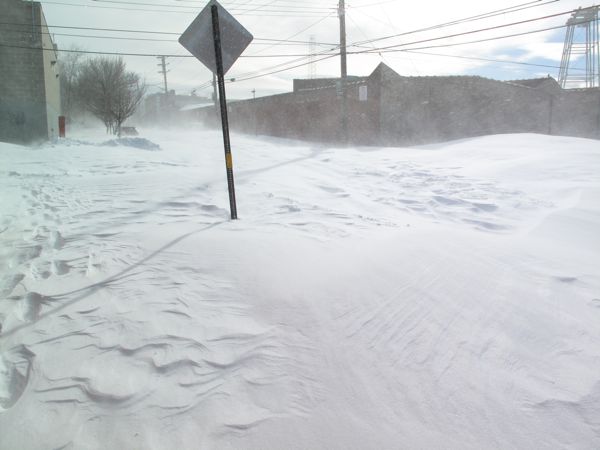
I was all ready to start posting about the strange joys of celebrating Christmas on the west coast of Florida, including the epic head to head battle that went down at Christmas dinner between a pre-stuffed vegan Tofurkey and a Hawaiian-style, 1950s kitsch brown-sugar basted ham, complete with pineapple ringlets. Then the phone rang with the news that yesterday's flight, the homeward leg from Dulles to Newark, had been canceled.

On Christmas evening my family and I were blissfully walking on St. Petersberg beach, watching pelicans diving into the azure Gulf of Mexico; the next morning I battled my way back to Red Hook, flying via Chicago to Philly and then training, subwaying, and bussing my way back to the 'nabe. Just in time to wake up to this: