Showing posts with label biodynamic farming. Show all posts

11/04/2010

Preparations 503 and 506

At risk of offending the fine folks who invited me to their shit-shoveling festival a few weeks back in the Loire valley, as recounted a couple of posts ago, I want to revisit the subject of biodynamic farming, because I'm now feeling I let those promoting the agricultural theories of Rudolph Steiner off a little too easily. It's easy to do so, and I think I know why. Because the goals of biodynamic farmers are so closely aligned with the natural wine, organic, fresh and local, and slow food movements, the more kooky elements that go into biodynamics have never emerged as a favored target of secular humanists. With all the evil in the world, why bother going after the possibly self-deluding biodynamic farmer? Furthermore, there seems to me to be little doubt that Steiner was prescient in comprehending the ravages of what would become industrial agriculture, and biodynamics is broadly concerned with soil health and sustainability, more than sixty years before that term became the overused mantra of the green movement. Why risk the perception that you are opposed to a thriving ecosystem, healthy eating, and happy animals by attacking biodynamics?

I wrote in that previous post that biodynamics "typically goes well beyond the basic prescriptions for organic farming." This is essentially true, but only if we are talking about the kind of co-opted organic farming decried by Michael Pollan, in which giant, industrial farms produce "organic" products on vast monocrop farms in order to exploit the marketing value of the term. And that wasn't what I meant: "organic" used to mean, to me, small, thoughtful pesticide-free farming of diverse plantings in a varied and complete ecosystem. Compared with this sort of agriculture, the ways in which biodynamics "goes well beyond...organic" seem upon further reflection to be limited to the mystical and the magical, namely the bizarre Steinerian preparations 500 through 508. The question then becomes: are the results of the biodynamic method superior to the results from any other less dogmatic approach to artisanal, pesticide and chemical-fertilizer-free farming? Are biodynamic farms superior in any way to other farms farmed by farmers deeply invested in soil health, the environment, and tasty eating?

 Preparation 506, in which Dandelion flowers are blanched and then packed into the peritoneum of a cow. This tiny bundle is then buried over the winter before being used as a sort of homeopathic additive to compost.


There are plenty of believers eager to point out that scientific evidence exists for the superiority of biodynamics. Some basic googling will bring up a host of such claims, but nothing I waded through went one simple step further and told you what that evidence is, or, heaven forfend, actually linked to a study demonstrating the point. If you want to enter deeper in this debate, take a look at Biodynamics is a Hoax, in which Napa vintner Stuart Smith pulls absolutely no punches under the subheading "Someone has to speak up."

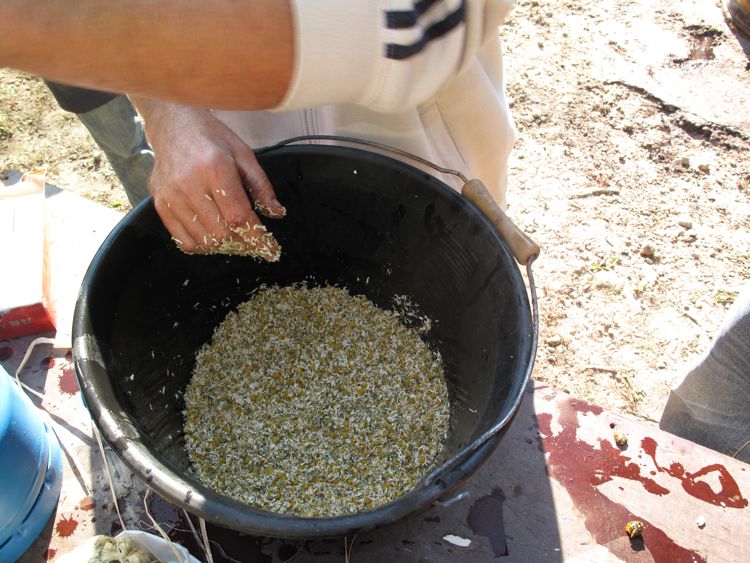
 Chamomile flowers awaiting deployment in Preparation 503.

The moistened flowers are pushed through a funnel, stuffing for a length of cow intestine. 

 The finished product, a chamomile sausage. It's very attractive, but the problem is that I can't find anyone who can explain why adding this to your spring compost will "reactivate" the soil...

There is, sadly, a more cynical perspective from which to consider the success of biodynamics, at least in the wine world. Thierry Puzelat, with whom I spent most of October learning how to make wine, is a very good example of the kind of conscientious farmer who cares deeply about his land and vines and produces excellent plonk without subscribing to the strange prescriptions of Mr. Steiner. He has no quarrel with biodynamic farming, and buys plenty of grapes from friends like Bruno Allion who follow the Steiner line, but his own attitude is "show me the evidence." He told me that it is remarkable how often groups come in to the Puzelat cellars for a tasting and ask him "are these grapes produced in biodynamie?" This before so much as taking a sniff of the first glass. In other words, biodynamics has become so trendy that for some the Demeter stamp of approval is more important to their drinking experience, or their self-perception of what sort of wine drinkers they are, than what the wine actually tastes like. While I have yet to meet a biodynamic farmer who I felt was insincere or concerned with anything more than creating the best possible farm environment, in the face of fetishizing like this I'd be very surprised if there aren't some vintners out there who are burying horns full of manure just because they think they will turn to gold.

After the preparation of the magical packets, we dug a hole in the ground and lined it with old slate roofing tiles, in order to avoid cutting open the parcels with a shovel in the spring dig. I have a similar attraction/skepticism for the rituals of Haitian vodoun, which also often involve the meticulous preparation and burial of small parcels, known as wanga

 The burial.


10/24/2010

Poop Horn (Suspension of Disbelief)

One of the more exotic episodes in my recent visit to the Loire valley was a day spent assisting in the creation of some of the semi-mystical preparations used in Biodynamic farming. Practitioners of the Biodynamic method view earth, cosmos, farm, crop and land from a holistic perspective. The health of each, and therefore our own, such farmers argue, are indissolubly linked. A field that is endlessly fertilized with powerful nitrates and sprayed with pesticides in order to maximize annual yields across a monocrop topography is a field that is ailing and poisoned. In this world view, the way most farmers use their land, and the way most of our food is produced, is deeply wrong; the equivalent for a human would be something like an endless repetition of Morgan Spurlock's experiment in Super Size Me, when he eats nothing but McDonald's products for an entire month.


Biodynamics, based on the teachings of Austrian philosopher-shaman Rudolph Steiner, typically goes well beyond the basic prescriptions for organic farming, and it embodies many similar ideas about environmental and soil health. As a general practice, I find it deeply appealing. Bruno Allion's farm and vineyard near Thesee, in the Loire valley, which I visited last week, looks the way a farm ought to look. There is dirt and mud, weeds and trees and grass. There are flowers and bees and ladybugs, and a happy pig in a comfortably big pen. It looks nothing like the vast and sterile monocrop lots on which America's corn and beef is produced.

 Looking over the horns

But what to do when the general appeal of a philosophy promoting a loving stewardship of the land seems diminished by peculiar prescriptions that seem odd, irrational and altogether divorced from the scientific method? This, for me, is the conundrum of Biodynamics. Take, for example, the "cornerstone of the Biodynamic method," Steiner's preparation 500, or cow's horn manure. The basic recipe is simple, if creative. In the fall, fill empty cow's horns with cow shit, bury them underground for the winter, and then dig them up in the spring. Although I'm certain cow dung is a high quality all-natural fertilizer, and cow's horns make perfectly good vessels in which to mature or compost the manure, it now starts to get weird.

 That's the, uh, substance, with which we will shortly begin to fill the horns.

One horn's worth of the fermented dung, generally about 80 grams of the stuff, is mixed into a suspension with 20 liters of rainwater by stirring it in a whirlpool vortex for a full hour. It is then whisked or sprayed over the fields. One horn is used to treat about one hectare of land (roughly 2.5 acres).  Not to bore you, but I did the math, and that comes out to 0.00074 grams of poop per square foot. If you've ever done cocaine, you'll understand this to be a minuscule quantity unworthy of your attention, a speck of fallen dust so small as to be all but invisible. You may also recognize from your long nights crouched over the mirror the way in which the ritual of preparation dominates the event; the horns must be buried in a specific way, and the stirring activity should alternate from clockwise to counterclockwise, perhaps "attracting cosmic influences into the liquid." The spritzing of the fields appears in photographs to be not unlike the splashing of holy water from a Catholic font. Biodynamicists describe the use of Steiner's preparations as a kind of soil homeopathy, and there doesn't seem to be any more scientific proof of its efficacy than there is for most homeopathic medicine. Just like homeopathy, I'd love to believe it works, but it sure does stretch the imagination.

What are we doing? We're making pâté de poop a la corne, you dipshit. I promise I filled some horns up myself, between photographs. (That's my main man Amane Hagiwara on the left. Within a few years I expect that you'll be seeing his name on a wine label or two. If you do, I suggest you buy the bottles).

 Locked and loaded, and ready for burial.

Bruno Allion has a beautiful farm, and he grows some serious grapes. I know, because I spent my first three days in the Loire valley harvesting them.

Looking wistfully into the pit. You gotta believe...


Next week join us for Biodynamic Preparation #503, cow intestine stuffed with macerated chamomile flowers. No, I'm not kidding.

8/04/2010

Scoville Units

While I was eagerly awaiting my brother's wedding last weekend, I wandered out of my hotel to find a quality deep-south farmer's market set up right in the main street of Greenville, South Carolina. Everywhere one goes in the United States it becomes more clear that foodyism is a pervasive and persistent national phenomenon, and not just the passing fancy of an urban coterie of organic-obsessed hipsters. People care deeply about what they eat, and how it's grown, and more and more of them want to grow it themselves. Attraction to the slow-food philosophy cuts across racial, class and regional lines.


To my eye, one of the star booths in Greenville belonged to a guy who sells nothing but peppers. Unless I heard him wrong, he cultivates 126 varieties. He told me he "grows some other stuff, but only for eating at home, it doesn't make it this far." This producer-enthusiast had a couple of dozen small baskets spread out on a table in front of him, each containing a different variety of pepper, and he was able to describe them one by one with the sort of vocabulary I generally associate with wine tastings. Such and such a pepper had "floral notes," another was citrusy, this next one, more precisely, lemony. Two for a dollar, but I only paid for four; it was the end of the morning and my new friend, pleased to be confronted with another pepper fan, threw in a couple of extra pairings.


I asked if he had any "ají amarillo," the yellow pepper that is a critical ingredient in Peruvian cuisine. He said he wasn't sure exactly which one I meant; he grows at least five ajíes from Peru.

Purple cayenne, two of my free bonus gifts for the morning. I'll get back to you after I've tried them.

4/20/2008

A Weekend with the Locavorians


Touring about the idyllic Berkshires in southwest Massachusetts, especially in the company of Alejandro DeOnis, one quickly comes to the conclusion that the movement we've all been hearing so much about, based in part on the prolific writings of Wendell Berry, and involving a mixture of getting back to the land and consuming locally, is starting to have the traction of a good four-wheel-drive pickup truck. I've always thought of the Berkshires as a summer playground for affluent urban summer weekenders, but a recent visit focussed on what the permanent residents of these soft, rolling mountains are up to gave a quite different impression.


Nestled between the palatial vacation estates and the old-money getaways are numerous farms where patches of mature, diverse forest butt up against open rolling pasture and temporarily fenced fields. Here chickens, guinea hens, pigs, goats and cattle take turns munching and manuring, enriching soils that later this spring will be planted with a wide and tasty array of heirloom vegetables. Many of you are probably thinking: "What's the big deal? Sounds to me like a description of a farm." But that's only because our childhood vision of a quack-quack here and a moo-moo there dies hard; the modern consumer has been carefully shielded from the true image of what the places where their food is produced actually look like. The Iowa of today, for instance, is consumed by corn. One crop, one vast acreage, one big conglomerizing agribusiness concern. Farms in California grow hundreds of acres of bland, identical, difficult to bruise tomatoes engineered to arrive in your supermarket intact and flavorless, twelve months out of the year. Like the old colonies, disastrously monocropped with exactly one export, like Cuban sugar, Honduran bananas, or Bahian cacao, American agriculture has in recent decades headed inexorably down the path indicated by profits and the economies of scale necessary to maintain them. Diversity today means having more than one genetically modified strain of corn planted on your land, not the Old MacDonald paradigm of dozens of different tasty animals gabbling about together beside beds of all sorts of vegetables, herbs and fruits ripening in the same bed.


Alejandro, inspired, in large part, he told me, by reading Michael Pollan's The Omnivore's Dilemma, about which I have previously written, abandoned Brooklyn with his affianced, Chase, to head for the hills. Soon his emails were full of stories of assisting at difficult calvings and receiving payment in meat for his participation in slaughtering a cow. This isn't about vegetarianism, organics, or even really opting out of the rat race. Call it a culinary lifestyle experiment, essentially based on the logic that life will be better and more healthy if you are in a position to supervise and participate in the birthing, growing, killing, nurturing, harvesting and preparation of your own diet.

Lord of the Harem, master of all in his domain

At the Moon in the Pond Farm we were welcomed by Dominic the farmer and urged to take an entirely unsupervised stroll around the property, a patchwork of fields and forest. Contrast this hospitality and conscious transparency with the categorical stonewalling of those public relations specialists who routinely deny the media access to factory farms, and actually refused to let Michael Pollan's observe the slaughtering of his own cow, a head of beef he owned fair and square, having purchased it as a calf. Dominic uses a highly flexible and portable lattice of solar-powered electrical fences to rotate his animals--cattle, goats, pigs, chickens, sheep--through the land, depositing nutrients, clearing brush and clipping the grass so it constantly rejuvenates. Liking the look of the animals and their obvious contentment in their happy surroundings, I loaded up a cooler with goat, lamb and beef stew meat, a goat shoulder and some home-made chorizo. Dominic has an enormous new walk-in freezer and very reasonable prices for meats raised with so much care and love.

If they look this regal and healthy, you can bet they will taste delicious. These beauties were guarding the farmhouse at the North Plain Farm, where the animals literally seemed to be running the show. Talk about free range! The yard was awash with inquisitive, pecking chickens, and pigs rooted for lost kernels of grain in the mud just beside the driveway. Much of the meat produced here goes to the most discerning New York chefs, cooks who really care what they are putting on the table. I can't afford to eat in those restaurants, but I could afford to buy my own chickens, which went into the cooler with the rest of my haul.

When paying for my meat at the Moon in the Pond Farm, I saw a strange banknote in the change jar, and asked what visitors, from what distant foreign land, had dropped off the unknown currency. It turned out to be a berkshare, the locally issued and accepted alternative to the no-longer-so-mighty Federally issued greenback. Local merchants, banks and farms can opt to accept these non-dollars, putting their money where their mouth is, as it were, in this literally local economy. The Berkshares feature local heroes, like DuBois, Melville and Rockwell. Given their uselessness in Brooklyn, I was forced to accept my change in dollars,but I felt sheepish about it. Promising to return with a list of orders from hungry Red Hookian neighbors, we rolled back down the Taconic towards the Big Apple.

12/23/2007

Reading: The Omnivore's Dilemma by Michael Pollan and My Life in France by Julia Child


Something is wrong with our diet, and two months of delighting in the outdoor markets of Paris have only served to focus my attention on the problem. Tomatoes that actually have flavor; herbs that haven't travelled hundreds of miles since being picked and therefore remain fresh in their paper bags until well past the next market day; vegetables firm and local; chickens of all different sorts and costs, priced quite clearly in relation to the amount of love and care that has been spent on raising them; these are only a few of the things to be seen on the street here that are quite different from the typical American food shopping experience. Begin to consider the relationships between the sellers and producers of this "produce" and the contrasts are amplified. And the French are still complaining that their way of life is being destroyed. In Morocco, they say, the tomatoes still really taste like tomatoes.


In two quite different books, one an indictment of contemporary American agrobusiness, the other a memoir summoning up misty, romantic reminiscences of a budding cook's first initiation into the finest sort of gastronomic Parisian life, we are forced to think about what we are eating. Julia Child's cholesterolfest is the chronicle of her life in the 7th arrondissement, of meals and wines and sauces first tasted, and of how she came to co-author another book, Mastering the Art of French Cooking, which was a runaway hit in the United States of the 1960s and launched Child's career as a TV star. In it are to be found the seeds of both America's ongoing culinary revolution and the extraordinary success of cooking as televised entertainment. Pollan's book is organized around the conceit of three meals he prepares at the end of three food chains he identifies: industrial, organic, and hunter-gatherer. Actually, there are four meals, because he discovers that what we know of today as organic has been all but co-opted by industry, so he eats one "industrial-organic" meal and one that we might call "beyond organic." But it is much less a book about eating than it is about the implications of the food we eat; Pollan is concerned with the moral, social, political, and environmental costs of most every bite we put into our mouths.

At the beginning of My Life in France Julia and her husband Paul, who met in Asia working for the precursor to the CIA, move to Paris on a USIS propaganda contract. Child eats sole meuniere and tastes poulet de bresse and she is hooked; before long she is biting into lark pies, roasting capercaillies and hares and doubtless swallowing ortolans whole. The Childs bring an American insatiability to the cuisine they find in Paris, and she points out several times that the key to eating in the land of butter and cream, of lard and cheese, is portion control. No seconds, no snacks. Meanwhile she is endlessly in the kitchen refining recipes that call for vats of these delicious fats. Refining and tasting. She and Paul diet, even at one point--gasp-- cutting out alcohol. There is never the slightest moral quandary raised by their charmed Parisian lifestyle, merely an endless search for the very best ingredients and preparations.


Pollan's investigation of what ends up on your plate is a more of a look at the ingredients that go into the ingredients. Unless you pay a lot of attention to what you eat, in America today much of what you eat is processed corn. Cattle are fed on it, although they never evolved to eat grain; so much for steak. So are chicken when they aren't eating much grosser stuff. Sodas are sweetened with it; these days sugar cane is an exotic tropical delicacy. In fact anything that is sweetened at all, and these days that is virtually every processed food product available, is sweetened with corn syrup. The ballooning of America, our grotesque epidemic of national obesity, Pollan dates to the sudden corporate switch from sugar to corn syrup in the late 1970s. Corn, it turns out, is disastrous for cows, for the environment, and for our health. Nonetheless, thanks to a downward-spiraling and self-reinforcing combination of government subsidies and agricultural exigencies we now have a beef industry that produces most of our meat pretty much out of sight of a blade of grass, cattle's natural food. He buys a cow, watches it eat corn, and then is refused entry to the slaughterhouse where it is killed and butchered.

"The industrialization--and brutalization--of animals in America," he writes, "is a relatively new, evitable, and local phenomenon: No other country raises and slaughters its food animals quite as intensively or as brutally as we do. No other people in history has lived at quite so great a remove from the animals they eat. Were the walls of our meat industry to become transparent, literally or even figuratively, we would not long continue to raise, kill, and eat animals the way we do." But because we consumers both want our food cheap and want to eat it without relating our meal to the death of a fellow mammal, we are complicit in the sorry turn of events that has brought us to where we are today: acres of densely-packed beef standing ankle-deep in their own waste for most of their lives, gobbling corn mixed liberally with antibiotics. Mmmm. Yummy. We're in denial about why our food is inexpensive, but to come out of that denial we will have to face certain unpleasant realities. For instance, hamburgers and steaks once had faces.


Pollan, horrified, flees the feedlots of the midwest for the huge produce farms of California, and even temporarily attempts vegetarianism. But his history of the organic vegetable industry makes it clear that what was once a hippy idea about goodness has become little more than a marketing term. Vast conglomerates now grow organic produce, and about the only good thing Pollan has to say about it is that the fields are fertilized naturally, preventing the runoff of poisonous chemicals. A head of fuel-guzzling salad is still trucked or flown across the continent before it reaches my Red Hook Fairway, the pickers are still underpaid and exploited and the flavor of a tomato is, well, scarcely Moroccan.


He goes next to Polyface Farm in Virginia, where a guy who sounds to me like a prime candidate for a MacArthur genius award, Joel Salatin, runs a complete, diverse, holistic eco-system sort of an operation. Chickens roam outside, fertilizing grass which the cattle bite back to just the right length, inspiring the blades to heroic efforts of regrowth. The animals are fat and happy and tasty. There are acres of rotating vegetable crops. It is all very Old MacDonald and nothing at all to do with McDonald's. Customers are able to choose their own live chickens and even encouraged to watch them being killed. (A few years ago I did sound on a cooking show. On one episode we visited a northwestern New Jersey farm rather along the lines of Salatin's. The show's hostess, Rosemary, ooed and aahed over a pair of truly spectacular hens that our host, the farmer, had killed in preparation for our visit and hung on the shed to bleed out. They were splendid, and Rosemary proposed a scene in which he and she would talk through the recipes for the evening meal while plucking the chickens. This was vetoed, promptly but with regrets, by the field producer, who said that chickens being plucked had zero chance of actually making it onto television. It was a powerful illustration of the absurdity of our American relationship to our food, and the media's role in reinforcing the dysfunction.)


Although Salatin's farm is not quite 100% self-sufficient, the aspiration of a farm like his poses a direct threat to the very fundament of capitalism. The closed, ecological system, every plant and animal in balance, is great for growing food, but it means the death of growth in the business sense of the word. As Pollan points out, no fertilizer is purchased from industrial agribusiness; inputs are few, and the goal is for them to dwindle to none. The farm has the potential to produce a certain number of eggs and chickens, but to try and have more stresses the land and throws the system out of balance. Although it is a constantly changing dynamic interplay of a wide variety of edible life, economically, an operation like this is static.

Salatin is little concerned with the "organic" moniker. Instead, and far more important than any notion of organic farming, are the ideals of transparency and local production that his operation embodies. Paying two dollars a pound more for a vegetable at a Whole Foods does almost nothing to change the environmental and ethical dynamics of American food consumption. We love the convenience of driving to the supermarket to buy our pristine shrink-wrapped cuts of meat, our buffed, glowing pressure-washed vegetables, but to really change anything we need to be riding our bikes to the farmers market. How far has your radish traveled? And what was the name of the chicken you had for dinner last night? (Or at the very least, what did the building it was raised in look like?) The concerned consumer should hope to know the answers to these questions. The many social benefits of this buy local and buy fresh strategy would have been, for Julia Child, primarily culinary benefits, but the beauty of it is that the two go hand in hand. Buying from Joel Salatin, if you have the luck to live just down the road from him, isn't only the best thing you can do for the planet, it will also get you the most tasty meal you can hope to prepare.

12/22/2007

Why, chickens in America would consider that luxurious!

Christmas shoppers over at food palaces Harrod's and Selfridge's in London are stranded without a steady supply of quail to serve for the holidays after the League Against Cruel Sports released this footage of inhumane conditions at a game "farm" in Lancashire.

Their gloomy surveillance footage of denuded, almost featherless birds, stumbling insensate about their tiny cages amongst the corpses of their brethren, marinating in their own feces, was uploaded by the Guardian UK with the label "Warning: viewers may find the following footage disturbing."