Showing posts with label food. Show all posts

4/11/2014

Not just another night at WD50

I had a crazy start to the week. My friend WoWe asked me if I wanted to join him and see what might dribble out the end of my pen while he photographed a gang of international culinary superstars spending 72 hours in New York to prepare for an all-star tribute dinner for Wylie Dufresne. Okay, I said, sounds like fun. Here's one of many possible dispatches:

3 Dufresne dishes, with his famous "Shrimp noodles" on the right.

Last Tuesday afternoon on Clinton Street in Manhattan's Lower East Side, chef Wylie Dufresne's molecular gastronomy restaurant WD50 appeared to be closed. The sun streaming over the tenements made the windows glow a dull, mottled brown: they had been blocked out from the inside with lengths of butcher's paper, as if the place was under renovation. Inside, however, the kitchen was a hive of activity, full to bursting with an astonishing gathering of some thirty head chefs from the best restaurants around the globe. Apples were being cored and mousses were being frothed. Magnus Nilsson of Sweden's Fäviken and Agata Felluga of Jour de Fête in Strasbourg were hip to hip, braiding shallot shoots into little nests of “Longevity” brand noodles, purchased in nearby Chinatown. René Redzepi of Noma, ranked #2 on the influential World's 50 Best Restaurants list, was sampling a variety of hot chile infusions with Ben Shewry of Melbourne, Australia's Attica (#21). Iñaki Aizpitarte (#17) and Kobe Desramaults (#72--the “50 Best” actually has 100 restaurants on it) were piping caviar-laced chicken liver parfait into those cored apples.

Wylie Dufresne was not present. In the basement, event producer Alexandra Swenden had assembled a team that was madly editing video footage to be tweeted and uploaded later in the evening. Out in the dining room, seemingly immune to all the stresses of the kitchen, the impresario Andrea Petrini had only one concern: with hours to go until dinner would be served, could this giant international secret possibly be kept from the pioneering chef whose restaurant they had all occupied?


Agata Felluga, Blaine Wetzel, Virgilio Martínez, Fulvio Pierangelini, Claude Bosi, Daniel Burns, Ben Shewry, René Redzepi, Alex Atala, Rosio Sanchez, Ana Ros, Rodolfo Guzman, Karime Lopez, Magnus Nilsson, Danny Bowien, Daniel Patterson and Gabrielle Hamilton are just the people in this photograph I got to meet and chat with and even interview over the three days of Gelinaz! preparations. Daniel Boulud is in there, too, but I didn't really get to talk to him. I did meet him, at Frankie's Spuntino on Monday night. He walked up while I was talking to Frankie Falcinelli and when Frank introduced us he said “do I know you? I don't think I know you.” I don't think he intended to be rude, I imagine he was just wondering if I was some Gelinaz! chef he hadn't met yet, but I never quite recovered enough to ask him to talk to me later. David Chang and I had plans, but apparently he started running the kitchen at WD50 to get things back on schedule Tuesday night and so he eluded my interviewing stamina. That's why I'm only an accomplished home cook, not a chef. All the other people who aren't named: I hope to meet you another time and I don't mean you any disrespect.

This surprise dinner for one of their own was the most recent in a series of undefinable culinary events presented by Gelinaz!, a loose collection of chefs that is part think-tank, part spectacle and part gathering together of friends who like to cook. Petrini, a longtime food journalist and talent scout, is the co-founder and the cement that binds them together, much like the transglutaminase “meat glue” that Dufresne uses to make his infamous shrimp noodles. Coincidentally, this is likely the actual dish immortalized in the recent premiere of HBO's Silicon Valley as “liquid shrimp.”

Gelinaz! started in 2005 “as a joke,” Petrini told me. His good friend, chef Fulvio Pierangelini “was known world-wide for being a pain in the ass, always complaining that people were stealing his ideas and his recipes. So I proposed that he go onstage with a bunch of other chefs who were re-imagining his dish and we would do away with copyright forever.” Perhaps the only thing all subsequent Gelinaz! events have had in common is this core idea of many chefs concocting their own versions of a specific dish. At a June, 2013 event in Ghent, Belgium, diners were served twenty interpretations of an 1861 Cauderlier recipe for chicken in pig's feet jelly.

We live in an era uniquely obsessed with food and its preparation. Cookbooks, now almost invariably tied to a particular chef and restaurant, are one of the few thriving areas in “old” publishing, despite the mind-boggling number of recipes and preparations available on the web. As evidenced by HBO name-checking Wylie Dufresne, high cuisine is pop culture, and an art-form. Last night's dinner is as worthy of conversation and serious discussion as the latest Wes Anderson film or that recent museum show that just opened. “We live in difficult times,” Petrini explained to me as I was trying desperately to dodge hot saucepans and scurrying sous-chefs. “Food is something that can reassure us”. The old standard of excellence in food was the Guide Michelin, which, Petrini says, “judged food by the criteria of the upper classes.” The idea was that a regular family would save its money to go to a great restaurant, perhaps once or twice a year. Today, that seems absurd. “For young people,” Petrini says, “food is everywhere.”

On the web, we have instant access to menus and photographs from the most far-flung of the world's temples to eating. Places like Nilsson's Fäviken, in a remote corner of rural central Sweden, would likely never have become must-eat destinations without the information era. But meticulously prepared food is not a commodity that can be ordered from Amazon. The global promise of the internet has also brought a great uprooting which with food has had the paradoxical effect of making us desperate to regain a sense of place, a sense of craft. We want access to unique ingredients and preparations that in the past might have remained unknown. Craft in general, and food in particular, is an antidote to the emptiness of consumer culture, and to the mass production and anonymity that are the less welcome side effects of the information technology explosion. Food grounds us, and an innovative, memorable meal is something everyone can aspire to create. It is no coincidence that so many of the World's 50 Best chefs here, many assisted along their way to stardom by Petrini's significant influence as its french chairman, are foragers, cooks who make it a point of pride to use ingredients so fresh and so local that they are often found growing only in the immediate surroundings of the restaurant. Places like Noma and Attica turn the winemaking notion of terroir into a guiding culinary principal.


Monsieurs Wylie and Andrea

Petrini is modest, with a profound sense of humor he expresses daily in his wry smile and his choice of wardrobe. At WD50 he was wearing a pale lemon-colored flannel shirt trimmed all the way around at the bottom with a row of dangling white lace balls that looked as if they might have been stolen from your grandmother's lampshade. “I'm not trying to influence anything,” he said, but chef after chef commented that they first met Petrini because he came to eat at their restaurant when it was still comparatively unknown. Rodolfo Guzman struggled for five years to keep open his restaurant Boragó, in Santiago de Chile. Then he was named #8 on the Latin American 50 Best list. “Overnight, we were booked one month in advance,” he explained to me, while picking through his arsenal of endemic Patagonian murtilla berries. “It was like a gift. It's why I am here.” Redzepi remembers meeting Petrini at Noma only a few months after he had opened: “That's why he knows everybody, because he discovered everybody.”
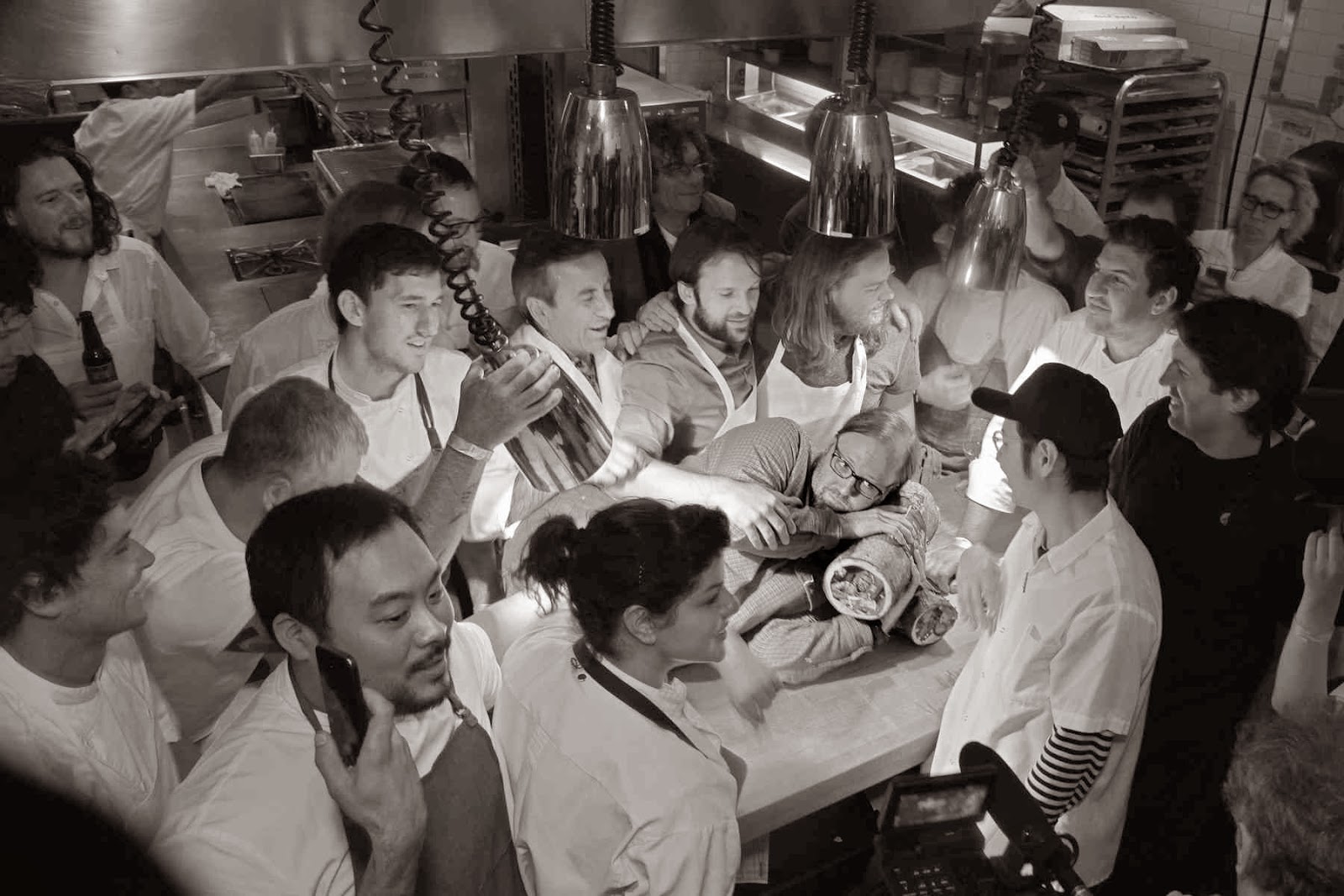
The chefs gather around unwitting host / roastee / honoree Wylie Dufresne, stretched out on his own work table.

At WD50, time was running short. The sun had set, and Dufresne was due to walk through the doors at 7:30 PM, lured to the restaurant on his day off by bogus reports of a refrigeration catastrophe. The ten-course meal--what Petrini called “remixes” of three of Dufresne's signature dishes, including the shrimp noodles—was as ready as it could be. Seventy non-paying guests—each chef had invited two—were hushed into silence in the dark dining room. In the kitchen behind, the lights dimmed; the only sound to be heard was the roar of the range hoods. Thirty of the world's best cooks had worked seamlessly together preparing for this moment, their egos apparently left at home. Now they crouched in the gloom in their colleague's kitchen. Precisely on time, Dufresne entered. In the middle of his own dining room he was greeted with a wide-screen television playing videotaped greetings from one chef after another. “Where are they?” he murmured in the dark, “where are they?” Suddenly, the lights went on, and there they were, hugging him, and serving him reimaginations of his own food. At once the world seemed smaller, friendlier, and a whole lot more delicious.


Alex Atala, Wylie Dufresne and René Redzepi

All photographs courtesy WoWe

Update: I don't want to jinx anything, as it hasn't run yet, but this story has now been acquired by the Suddeutsche Zeitung. If you want your own story, be in touch, as I have many more. 

Another Update: A gently longer version of this story will run in the Suddeutsche Zeitung Feuilleton tomorrow, April 19th, with more images by WoWe.

2/24/2013

Kimchi Jjigae Creole


Lately I have been making my own kimchi. Laden with raw garlic and vegetables, naturally fermented and entirely additive free, this spicy Korean condiment is said to be one of the healthiest foods on earth.   Properly made, kimchi is a living creature, a bubbling, blistering Far-East version of sauerkraut, a simple, humble cabbage brewing in its own juices. The thing lives, its flavor constantly altering as desirable bacteria munch and soften the once-crispy vegetables into submission. Nonetheless, I had always thought of it as a substance to be dabbed sparingly around the edges of other dishes, like hot sauce, or mustard.  This despite the fact that it is very easy to make vast vats of the stuff. In Korean markets in Flushing it is sold in quarts and half-gallons and even gallon tubs, and since it is a live ferment in continuous transformation, its shelf-life is not infinite (or even near-infinite, like hot sauce and mustard and ketchup). Connoisseurs believe kimchi peaks after ten days to two weeks, and that month-old kimchi will soon push what is essentially an ongoing process of decomposition into unpleasantly sour and funky realms. I determined, therefore, that I have been thinking about kimchi in the wrong light. It is not meant simply to accompany, to drizzle or augment. At least in Korea, it is to be munched with abandon, spooned up by the tubful, spread in thick slabs. If not, what to do with tremendous volumes of it?

I remember a perhaps apocryphal story, told to me before I really knew what kimchi was, about the abundance of garlic in Korean cuisine (in which kimchi is arguably the primary vector for garlic-delivery). A British ambassador to Korea, back in London at the end of his tour of duty, attended the opera. There, seated in his tuxedo on the ruby and gold-brocade chairs, watching the performance unfold, he discovered that he and his elegant wife had become pariahs. The stodgy Britains seated within their orbit were, despite the embarrassment of it all, getting up and abandoning the theater. So strongly did the diplomatic couple reek, with the garlic of dozens of Korean state dinners positively leaching out of their pores, that the other patrons departed well before the fat lady sang.


Gradually, I am becoming less obsessed with ethnic culinary authenticity, but one still wants to know if one's kimchi would fly in Incheon. I consulted with some Korean-Americans of my acquaintance. Sohui Kim, chef, neighbor and co-founder of the always excellent Good Fork restaurant (she does a killer steak with kimchi rice) declared it delicious and tasty, if rather too sweet. A few days later, tasting the same batch, the artist Nancy Hwang also questioned the sweet edge to my kimchi*. Then she said: "have you made kimchi tig-eye yet?"
"Kimchi what?" I sputtered.
"Oh that's one of the best things about making kimchi," she said. "You wait until it is almost too funky too eat, and then cook it down, usually with pork. It's the best."

When cooked, kimchi takes on an almost lurid, orange hue

When I typed in "tig-eye," Google corrected me, and I learned the Korean word for stew: Jjigae. Kimchi Jjigae, specifically, is the cure for those large, late-stage volumes of kimchi, which, like bread starter, gets more and more sour the longer it ferments. An indefinable moment arrivess when the stuff just gets too damn funky, the sourness oppressive. It is then time to make kimchi stew.

Due to how ridiculously delicious this is, this pot of kimchi jjigae was almost completely consumed before I remembered to photograph it It's a good thing there's anything left in the bottom of the pan.

There are many kimchi jjigae recipes online, with various added proteins, ranging from pork bellies to silken tofu. Some include both. I didn't have any tofu on hand, but I was recently returned from New Orleans, with an armful of smoky, cajun pork products. I chopped a wrinkled slab of tasso and a couple of onions and sauteed them until the onions were browning around the edges and the tasso had darkened and began offgassing tantalizing smokehouse aromas. Then I chopped about three brimming cups worth of three-week old kimchi and stirred it in. At this point, the Jjigae is all but finished. Just add water** sufficient to make your dish have a nice, soupy-stewy consistency, bring to a simmer and let bubble for five to twenty minutes. Serve with rice.

Looking down the barrel of kimchi oblivion. To the very bottom of a half-gallon jar. It's clearly time to make more.

*I've been experimenting, and none too scientifically. I have a vague recollection of adding a dollop of gochujang to the brine in this batch. Gochujang is basically hot pepper paste sweetened with corn syrup, and I've since been informed that adding it to your kimchi is highly unorthodox and would certainly result in that notably inauthentic sweetness.

**You can also add my new favorite substance, and word, gookmool, which are the intense kimchi juices that collect as a slurry at the bottom of the kimchi jar.

1/17/2013

Not really awesome.

 In the gloom of a January evening near Wall Street, dim golden arches are suspended above a brilliantly illuminated poster advertising McDonald's McRib sandwich.


Is it just me, or does this promotional campaign for the McRib sandwich imply that at other times, and in other sandwiches, the pork hasn't been real, (but rather unreal)? Is anyone else detecting an implicit: "Now, with real meat...!"? Perhaps it's the retro, 1950's font, suggesting that we have finally arrived back in some fictitious but glorious past when actual pork was used in confecting the mighty McRib. I'm certain I'm making too much of it, but my, oh my does that sandwich look revolting, oozing its glistening brown sauce out onto a Fulton streetcorner.

4/01/2012

¡Vete p'al Carajo!

A place to gas up, in more ways than one.

According to a Wikipedia article entitled "Spanish Profanity," the literal meaning of the word carajo is "crow's nest," as in the lookout at the top of the mast on an old schooner. This was news to me, and I rather suspect it would be for many speakers of the language. Much more frequently, throughout the great Iberian diaspora, carajo is an insult, a "swear." Its strength and implication varies across the vastness and diversity of latin america, with usages that include approximate equivalents of "oh, sh*t!!" and "go to hell!" Indeed, upon looking for, and then entering the Miami restaurant named "El Carajo," one is apt to exclaim "What the f*ck!?"


Although the owners of the El Carajo combination tapas bar, wine cave and British Petroleum gasoline filling station franchise pay homage to the nautical in their signage--their logo is a flag flying above a masthead roost tilted aslant by a Caribbean breeze--one imagines that they fully embrace the word's many meanings. It takes not a little sense of humor to open a full-on faux-Spanish cava in the back of a generic convenience store. Here the bewildered, walking in to prepay their gasoline, are likely to find, just beyond the cash register and the standard gas-station amenities, a group of men seated on stools around a table, pouring and sampling a selection of Iberian wines, each with half-a-dozen semi-used crystal glasses spread out before him.


 Not unexpected in your average gasoline station convenience store.

Rather less expected, in an adjacent aisle: this extensive selection of fermented grapes.

 Unexpected to the point of unique? The Spanish taverna dining room, complete with fake brick arches.

 Where some gas stations might have a hot nacho cheese dispensing machine or a slurpy gun, El Carajo presents this selection of fine Iberian cakes and pastries, behind curved glass.

Flan with your fill-up?


 From tortilla Española to black Angus sirloin, to go!

 The most unprepossessing façade.


 Never fear, El Carajo also carries the usual "convenience" selection of emergency cosmetics, candy bars, and sodas, like these emery boards. KD's fetching pink and green ensemble is by Mossimo for Tarjay.

 (17th and South Dixie Highway, and if you don't know, now you know....)

That's how we roll. ¡Vete p'al Carajo!

1/19/2012

Time to Make the Cookies! UPDATED


Although I was showered with gifts yesterday on my birthday, the best present I received came last weekend when I fulfilled a Christmas promise to my niece, a budding baking aficionado, and invited her out to Brooklyn to make cookies and bake bread. This was just about the most fun I can remember having in months. First we traipsed around Fairway hand-in-hand, collecting ingredients. Then dough was kneaded, peanut butter, butter and assorted shades of brown sugar were creamed together. Bits of batter plopped onto the floor, swelling loaves were spritzed with a waterjet to generate steam. We formed blobs of insanely delicious mixture into golf-balls and tined them with forks. The kitchen filled with delicious smells. We tasted the results. So much better than any amusement park!


Photo: courtesy Ashley Singer

01/31/2012 UPDATE:
 Just found, the cutest shopping list in the history of shopping.

1/09/2012

Making too much of Gumbo


Although it was not an event officially sanctioned by the Association for the Promulgation of Gumbo, dinner at my house last night owed a lot to the founding spirit of that organization. Call it the fraternity of consumption. Never having invited twenty people to dine at once before, I was typically concerned that there wouldn't be enough food. While at this point I pretty much grasp what dinner for eight should look like when laid out on the chopping board, were two and half pounds of okra, two chickens, and my last few sticks of Laplace, Louisiana andouille going to be enough for the gathering hordes? The affirmative RSVP rate was running at about 96%.


Not to worry. Despite my protestations that I had everything under control, "although a bottle of wine would be welcome, if you feel like bringing one," everyone bought food, and dessert, and wine, and I probably could have fed forty.


Just one little corner of the groaning board. Wild rice with a trio of mushroom species bundled up in lotus leaf, by Ordoubadi. With friends who bring platters like this to your gumbo social, you can almost get away with not even bothering to cook at all, and just blaming the lack of gumbo on a last minute scorched roux accident. But I'm ahead of myself. "First," as it says at the beginning of hundreds of Louisiana recipes, "you make a roux."


Roux, along with okra, is one of the defining, character-bestowing ingredients in gumbo. White flour, slow-fried in bubbling oil, must be whisked constantly to avoid it carbonizing and infecting your gumbo with the acrid taste of arson. Donald Link, of the brilliant Cochon Restaurant, in New Orleans, whose gumbo recipe I was following, writes that "the process of making roux can be hypnotic.... Watching the oil and flour mixture slowly change color and begin to take on its unique aroma gives you plenty of time to be alone with your thoughts."


Indeed, with the narcotic swirling of the whisk, I began almost to hallucinate. The surface of  bubbling roux has the quality of primeval swamp, as if, ultimately, life may emerge from it, the product of some wondrous accident of science and heat. The world and my thoughts, reflected in this toasting caramel lake, put me in mind of that film school classic, Jean-Luc Godard's cosmos as experienced in the swirling bubbles on the surface of a cup of coffee. It's from "2 ou 3 Choses que je Sais d'elle," and while sort of fun, it is almost staggering in its pretentiousness:


It is now time to admit the artistic debt the Association for the Promulgation of Gumbo owes to Godard in its own cinematic debut from early 2011, even if our version is perhaps too minimalist to reach the same heights of pretension:


Almost ready: one wants the roux, says Link, to be the color of a dark copper penny.

Lots of stock.


Perhaps the defining moment in the preparation of gumbo is the addition of the so-called Holy Trinity, along with abundant cajun seasonings, to the lava-like roux. This mixture of equal parts finely chopped onions, celery, and peppers is an obvious manifestation of Louisiana's French culinary heritage, for the Holy Trinity is essentially a mirepoix, with the peppers substituting for carrots. Once this flavor-base is added to the stock, the only remaining question is what sort of gumbo the dish will become. Will it be foot of pork or pile of crawdad? Back of crab or eye of newt? Just about anything can go in there, because no matter what you do next, now it's unquestionably a gumbo.


This one was andouille and chicken, cooked until the chicken was shedding off the bones into string. Last to go in is the okra, a symbol of fertility and virility thanks to many attributes, from its proud, firm shape to its womb-like interior cavity, bursting with seed and slime. Okra likely originates from Africa and was brought to the new world for or by slaves to grow and eat, and Cubans call the vegetable quimbombo, a word almost identical to various West African Bantu names for okra. Gombo, ngombo, gumbo, okra is synonymous with the dish.


The (mostly) Manhattan contingent, the Brooklyn locals having (mostly) wandered home in a gumbo-induced stupor by this point. This and the first photo courtesy of WoWe.


That is the bottom of the kettle you see there. Malheuresement le gumbo est terminé.

9/14/2011

Deep in the Heart of Bavarian Staten Island

Three weeks ago or so, when Irene was just a hot breeze swirling around the Bahamas, Laura and I had an overlapping free weekday. Usually, we would head straight for Jamaica Bay National Wildlife Refuge, to see lots of birds amidst not so many people as on a weekend. This year, however, the unseasonable torrents of August rain and an administrative / budgetary snafu have left the East Pond, where the water level is normally manipulated to maximize its attractiveness to migrating waders, far too full for any self-respecting shorebird to pause there. "What do you say we explore the oyster-baron mansions of Staten Island?" proposed Laura.

"The what?" The murky, industrial waterfront surrounding Staten Island includes graveyards of rusting tugboats, miles of petroleum storage tanks and semi-submerged, expired ferries. But one hundred and more years ago, these now dubious waters teemed with oysters, and great fortunes were made harvesting them and serving them in the oyster bars of Manhattan and beyond. What's more, Laura informed me, a few of the grand residences of the oyster oligarchs might still be standing along Staten Island's northwest shore, enjoying a harborfront view of Manhattan.

It now costs $13 to cross the Verrazano Narrows Bridge, which is close enough to the ticket price at MOMA that we were determined to savor every moment on the "borough of parks."


The nouveau-riche have always been fond of reviving the Greeks, and apparently the oyster magnates were no different. Now abandoned, the front yard wooly and overgrown, this titan is just waiting for a little bit of love and elbow-grease. One suspects it comes with a fascinating midden of oyster shells somewhere out back.


The wrought iron-fences, the closest one can approach, are more art nouveau than nouveau riche. They're very nice, and I'm frankly surprised no enterprising recycler-looters have never made off with them.


Right next door, there is no house left at all, only competing wrought iron gates complete with the presumed initials of an oyster magnate in the style of a champagne bottle label, demonstrating a certain consistency in the dominant Staten Island aesthetic over the years.


We followed the shore south and west, around the channel of the Arthur kill. There seemed to be no further evidence of the splendid oyster epoch. Suddenly we stumbled into a corner of Bavaria, not far from New Jersey, and providentially just in time for lunch. Almost across the street from a shady and overgrown graveyard filled with headstones of first generation immigrants from the old country, we found Killmeyer's.


Except for the ATM sign and the slot-mounted air-conditioner one would swear one was in any of countless villages in the surrounds of Munich.


We made for the tented biergarten in the back yard, empty of people on this weekday noon, but crowded with plastic Wal-mart patio furniture. A dirndled waitress, somewhat surprised to see us, soon brought us the list of spezialitäten. A blackboard on the wall listed an impressive array of deutsche brews. Traitors to the south, we ordered refreshing tankards of Gaffel Kolsch, a beer so delicious that it inspires in me the hope of one day visiting Cologne.


Latkes, and spaetzle mit wienerschnitzel. The latter seemed perhaps to have been breaded and frozen somewhere back in the old country, but we weren't really there for the food. Apparently on weekends Killmeyer's features their own local oompah band.


After this unexpected transatlantic adventure, we wended our slightly blurry way back to Brooklyn, where we regaled our good friend and favorite saloonkeeper St. John Frizell with our tales of intrepid outerborough exploration. "OMG!," he said, "You've discovered Killmeyer's. I love that place. Did you see the bar? It was built by itinerant Czech carpenters. Apparently they just traveled around stopping into places and offering to build authentic Praguian furnishings. Isn't it spectacular?" Absolutely, we agreed at once, and made on the spot a vague plan someday to return together, and polka.

.