Showing posts with label calcutta. Show all posts

9/30/2012

Half the Sky on PBS


Naptime at New Light, a children's hostel and daycare in the Kalighat red light district in Calcutta, India. Founded and run by my friend Urmi Basu, New Light aims to break a cycle in which caste, environment, tradition and stigma combine to force children to follow the footsteps of their mothers into prostitution.

Half the Sky, the PBS / Show of Force production based around Nick Kristof and Sheryl WuDunn's bestseller about women confronting the most gruesome problems and issues they face in the (primarily) developing world, will finally be broadcast this coming Monday and Tuesday, October 1st and 2nd, at 9PM EST, on PBS. (Channel 13 in NYC). But check, as they say, your local listings.

Working on this series consumed much of my 2011; I made multiple trips to Asia and Africa, many of which I blogged about in one way or another in these pages last year. Working on "Half the Sky" was a deeply moving and rugged experience, and I hope you'll find the time to watch it. This is one of those rare cases where I really do feel that a film has the potential to bring about positive change in the world!


A wheelchair made from a $2.99 WalMart lawn chair, at the Edna Adan maternity hospital, in Hargeisa, Somaliland. Edna's hospital trains midwives, an incredibly successful, simple, and comparatively inexpensive way to combat the staggering rate of maternal mortality in Somalia.

5/26/2011

Rickshaw Richard

The indignities of the economic disparity between the poor and the rich are many, but the rickshaw is in a class of its own. In the west we routinely hire those less fortunate than ourselves to do the jobs we would never do: "illegal" Mexicans are paid substandard wages to pick our tomatoes while they live eight to a motel room; maids trying to get a toehold in the new world scrub our toilets. Nonetheless, the typical enlightened westerner is revolted by the human-powered rickshaw, a basket on wheels pulled through the streets by a jogging coolie. One person reclines in a padded chair, elevated above the other. His fellow human, reduced to a beast of burden, runs ahead, all the while pulling this wicker chariot by two sturdy steel bars. The truths this relationship exposes are too raw.

There are few places where rickshaw-pulling remains a thriving trade. I did not see a single one in Vietnam or Cambodia in the two months I spent in South-east Asia this winter. Rumor has it they have been banned. In Vietnam, even the far more civilized tricycle taxi, or trishaw, seems endangered. Tourists are happy to ride in those, but in the era of the ubiquitous motorcycle taxi they are no longer a popular form of transportation for the locals, who are in far too much of a hurry. In Calcutta, however, rickshaws are still to be found on almost every block.

Photo: Shiva Sripathi Passenger: Uday Sripathi

5/10/2011

The Broadway Hotel, Kolkata


Yellow shutters and soot-crusted screens. In the bar, curtains, the warm beige of dim lightbulbs and eighteen ceiling fans on full; their whirring rush of air dulls the incessant honking outside on Ganesh Chandra Avenue. (Calcuttans simplify life by using the horn in lieu of brakes, clutch and turn signals). The dark wood-wainscotted walls of the Broadway Hotel saloon are made of primeval hardwoods no longer available at any price. Smoking is prohibited these days. A sign announces that it "is an offense,” but the tall walls are a suspicious dingy ochre, as if they had had the chance to collect smoke for many long-passed decades. This hotel does not have a faded grandeur; it has whatever it has always had, unchanged.


The waiters wear wrinkled burgundy Nehru smocks with black embroidered patches above their hearts, reading: Broadway Hotel. Oh, how I wish there remained such a place on Broadway! Squat red leatherette chairs crowd against brown formica tabletops buffed almost white in places; there is little left of the original faux-burl woodgrain pattern. Mildew specked mirrors along one wall double the already ample space, which has soaring ceilings. The soap at the men's handwashing station is dispensed from a swinging tin bottle that pivots on a mount, bolted to the wall above the sinks. If it ain't broke please Lord don't fix it.


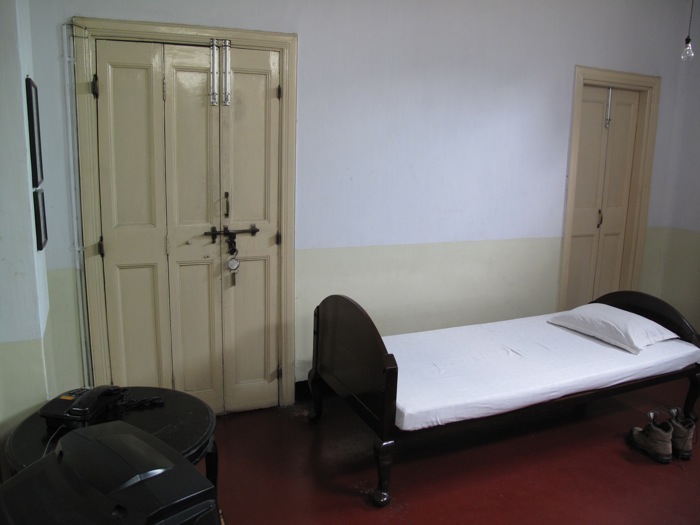
When I alight from the elevator cage the children of the manager are laughing and howling in their adolescent Sikh turbans, playing narrow soccer on the polished red cement floor of the fourth floor corridor. Moments after I have dropped my bags on the single bed, the half-deflated miniature basketball is kicked through my still-open door. On purpose, I am certain. It rolls about the room, and within seconds the curious duo are peering through the curtain at the door, sticking their noses right into my room, demanding to know how tall I am. I've been here ten minutes, and I could live here forever.


 The hotel's website (they are not out of date) almost proudly announces that none of the rooms are air-conditioned. The bed, edged away from the wall, better to be under yet another churning ceiling fan, has no top sheet. This saves everyone time and bother. You would be no more likely to require a top sheet than to walk out into Calcutta wearing a sweater.

It is 11am. I stretch out under the helicopter downdraft, close my eyes, and lean into the single pillow. I have flown all night from Africa, with a 2am to 6am layover in Mumbai. I couldn't be more tired, but I am ecstatic to find myself in the most splendid ten dollar hotel in all of Asia.