Showing posts with label vietnam. Show all posts

9/30/2012

Half the Sky on PBS


Naptime at New Light, a children's hostel and daycare in the Kalighat red light district in Calcutta, India. Founded and run by my friend Urmi Basu, New Light aims to break a cycle in which caste, environment, tradition and stigma combine to force children to follow the footsteps of their mothers into prostitution.

Half the Sky, the PBS / Show of Force production based around Nick Kristof and Sheryl WuDunn's bestseller about women confronting the most gruesome problems and issues they face in the (primarily) developing world, will finally be broadcast this coming Monday and Tuesday, October 1st and 2nd, at 9PM EST, on PBS. (Channel 13 in NYC). But check, as they say, your local listings.

Working on this series consumed much of my 2011; I made multiple trips to Asia and Africa, many of which I blogged about in one way or another in these pages last year. Working on "Half the Sky" was a deeply moving and rugged experience, and I hope you'll find the time to watch it. This is one of those rare cases where I really do feel that a film has the potential to bring about positive change in the world!


A wheelchair made from a $2.99 WalMart lawn chair, at the Edna Adan maternity hospital, in Hargeisa, Somaliland. Edna's hospital trains midwives, an incredibly successful, simple, and comparatively inexpensive way to combat the staggering rate of maternal mortality in Somalia.

4/30/2011

Going back to Vietnam

My story on the phenomenon of Vietnam War tourism and US veterans who return to visit the places they once fought ran yesterday in the Sueddeutsche Zeitung, although not in their online edition. Today is the anniversary of the Saigon airlift. Here's the pre-translation original:

On the telephone, Mr. Vu speaks English with a clipped, military precision, quickly dispensing with the logistics of the next day’s excursion. “Do you need to visit Khe San?” he asks. “No? Fine. Just to confirm: the driver will pick you at 10:15 in Hue and bring you here to Dong Ha, where you will collect me and drive up into the DMZ.” Mr. Vu sounds like the real deal, a veteran of the Vietnam war; it is almost like the planning of a tactical assault. Mr. Vu is one of the very best, but there are many people in and around the ancient Imperial City of Hue who do what he does. Vu is a DMZ tour guide who takes visitors and Vietnamese alike on customized trips through the many notorious locales dotted along the former border between North and South Vietnam.

Replica of the "Peace Bridge"

Demilitarized zone tourism is a thriving business in Hue, something that would be impossible if the wounds were still fresh. The savage conflict that unfolded here is quickly receding into the fog, not of war, but of distant memory. Overwhelmingly youthful, the population of Vietnam seems focused on the future and the country's bustling, Chinese-style economy, while America is deeply mired in the conflicts in Iraq and Afghanistan that have defined war in the present millennium. In the inevitable comparisons the lessons of Vietnam would seem to have been forgotten; for most, the war has become history. But not for the veterans who fought here.

Along the esplanade on the north bank of the Perfume River, near the gates of the famed Hue Citadel, street vendors hawk used dogtags, the steel identity badges all GIs wore around their necks, listing their name, blood type and religious affiliation. Apparently authentic, they are lined up on a low stone wall along with other knick-knacks: North Vietnamese medals, Soviet-style enameled communist friendship pins, and antique Chinese porcelain. Not far away, behind the ancient and imposing walls of the old city, stand rows of tanks and US artillery seized by the North in the conflict known only here as The American War. Dozens of agencies dotting the tourist quarter of the city offer tours to the DMZ. Options range from an inexpensive day in a bus full of other travelers to the kind of individual tailored experience Mr. Vu offers, on which former servicemen can seek out the particular places that were of personal significance to them forty and more years ago.

 Inside the Vinh Moc tunnels, where North Vietnamese lived underground on the edge of the DMZ in order to avoid American bombs. The network of burrows is now a showcase bit of propaganda intended to underline the resilience of the outgunned but ultimately victorious North.

Mr. Vu, it turns out, is 34 years old, born in 1976, the year after the Saigon airlift. He is extraordinarily knowledgeable. He knows which branches of the US forces served where, and when, and which regiments were involved in which conflicts. On the drive to the preposterously named “Peace Bridge,” across the Ben Hai River, Vu pulls out a binder full of maps and Life Magazine photographs showing the landscape as it appeared in the late 1960s. The tranquil but dreary rice paddies stretched out on either side of the 17th parallel appear in them as a cratered, lunar devastation, like a heavily polka-dotted carpet.

It is gray, and raining, and peasants are driving their water buffalo along the muddy banks above the paddies. There is almost nothing left to indicate that the DMZ was the scene of some of the war’s heaviest fighting. The southern half of Quang Tri province, below the Ben Hai, was the first area in the south to fall, and the area to the north, Mr. Vu says, was the most heavily bombed of all.

Replica of the battle-scarred and bullet-holed loudspeakers used by both sides to broadcast opposing ideologies across the Ben Hai River.

In many ways, this is a simulated experience. The Peace Bridge is a copy, right down to the guard booths at each end and the towering columns of gunmetal gray loudspeakers, non-working replicas of the ones which used to face-off, broadcasting competing propaganda across the river in an incessant, deafening battle of volume. All this was bombed to splinters; these reproductions have only been here for the last ten years or so, Mr. Vu says, to satisfy the tourist demand. Why, a visitor wonders, do so many people want to see the DMZ?

“Most of my clients,” he says, “are in their 40s and 50s. Khe San, Hamburger Hill, the DMZ, these places are familiar to them from books and movies.” DMZ tourism has gotten lots of free publicity from Hollywood. Nonetheless, the phenomenon began with Vietnam veterans in 1991, the moment the US eased travel restrictions that had prevented its citizens from visiting the country. “So many of them are my clients,” says Mr. Vu. He estimates that in 1999, when he began giving tours, 30% of those he guided had seen active duty in Vietnam, and still today at least one in ten are veterans.

Mr. Vu with artillery shells, carefully repainted with the identifying codes and letters of US ordnance of the period.

Rob Allerheiligen, who was a First Lieutenant in the US Marine Corps in 1969, at Monkey Mountain outside of Danang, wrote in an email that “I think I always thought I would come back some day.” He spent a day in 2010 with Mr. Vu. “Even though I had not been stationed at any of the sites we visited, I had friends who were, and I have read enough about Marine Operations…to know what I was looking at and to be impressed at what those Marines accomplished there.” He says he experienced a “funny feeling” landing at Danang almost 41 years to the day after he deployed. “There was a flutter in my stomach and an increase in my heartbeat.”

Glenn Prentice experienced the siege of Khe San on the notorious hill 881S as a forward artillery observer, one of only 17 out of 350 Marines there who was neither killed nor wounded. In 1995 he felt “overtaken by an overwhelming urge to go back to Vietnam,” and returned on his own to the hilltop scene of his youthful trauma; the siege began on his 19th birthday, in 1968. “You come back with guilt that you survived,” he says. But the sense of obligation he feels as a survivor seems not only to extend to his fellow American servicemen; after making friends with a North Vietnamese colonel who had fought at Khe San as his enemy, he collaborated on building a water treatment plant in a village near Hue, and since his unlikely friend's death he has helped the man's daughter with her college expenses. “I promised I would take care of his family,” Prentice says.

“When you have so many traumatic events, and when you are so young, they are basically permanently imprinted in you,” he says. “You need to go back, because at times it feels surreal.” He has now returned 14 times since his first revisit, and helps other veterans who aren't sure how, or whether, they can manage the trip. Their reactions “run the whole gamut,” he says. “Sadness, depression, relief.”

“They are very quiet, and don't really want to share,” says Mr. Vu, barreling back towards Hue in a minivan through the misty rice paddies of today's utterly transformed Vietnam. “They're very emotional. I don't know why.”


4/06/2011

The Social Life of Caged Birds, on PRI's "The World" UPDATED


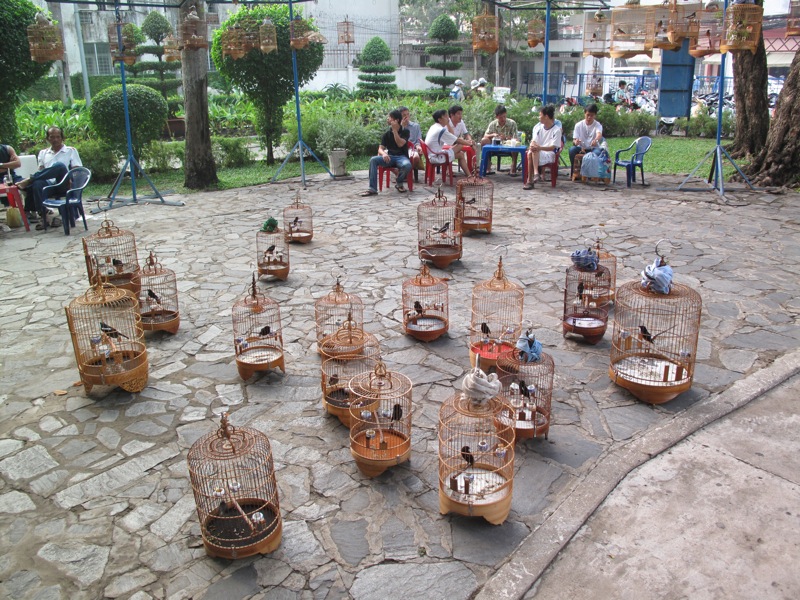
On weekend mornings at dawn, Saigonese songbird aficionados like to bring their pets to a café in the corner of one of District One's most popular parks, where they drink coffees and teas, and chat, perhaps about birds, perhaps not. Meanwhile the birds make friends among neighbors of their own kind, at least to the extent possible while trapped in their bamboo prisons. They also do their best to out-sing one another.


I realize this is rather short notice, but my "audio postcard" about these caged-bird fanciers in Ho Chi Minh City runs on PRI's "The World" today on your local NPR affiliate. In case you missed it, I'll post a link here later, the segment is now available online at The World's website, along with a groovy slideshow of my photographs.


3/13/2011

The Don of Flans

Super-delicious Vietnamese street food, example #646B

Flan in bite-sized nocturnal take-away cups near the market in Dalat, fifteen cents per.

3/08/2011

I've known a few guys like that

I'm safely back in Brooklyn where it is pleasant, but chilly, at least compared with balmy Saigon. All in all it was a fabulous trip to Vietnam, even if I failed to completely miss the winter. I now judge these things by the wealth of blog-worthy images and experiences that I come across, and in this regard Vietnam was extraordinarily rich. So I still have a number of Vietnam-related posts to dole out.


Here's one, a Hanoi restaurant I didn't eat at.

3/02/2011

A visit to Van Long Nature Preserve

Cuc Phuong National Park, about three hours south-south-west of Hanoi, is visited primarily by birdwatchers and those wishing to see the Primate Rescue Center, where various gibbons, langours and macaques confiscated from poachers or rescued from cages are rehabilitated with the ultimate goal of reintroducing them into the wild. One of those primates, Delacour's Langour, is among the ten rarest in the world, with less than 200 remaining in their only habitat, the karst limestone jungles of northern Vietnam.

They are not doing well, and we are the principal threat to their survival. (Humans are by far  the commonest primate, with over 8 billion of us now having colonized every corner of the globe. We are the Cockroach, Norway rat and House sparrow of the primate world, able to adapt to almost any environment and thrive). Having seen some Delacour's in their cages at the Rescue Center, I decided to try and spot them in the "wild" on my way out of the park. The only place they are regularly found is at Van Long Nature Reserve, a sort of minor appendix to the National Park, some twenty kilometers outside the park entrance. This primeval lake is surrounded by mist-shrouded limestone pinnacles and inhabited by thousands of egrets and herons. It is also what is politely known as a tourist trap.


Turning off the minor highway from Ninh Binh to Nho Quan, one follows a road suitable for tour buses to the lake's edge and finds at the end of it a restaurant-resort complex with too many rooms and overpriced food, and a dozen stalls set up in the dust selling embroidered tablecloths and sun-hats embroidered with the Vietnamese communist star. The only way to visit the lake is to hire a boat. Not a problem; there are countless boats lined up along the embankment and a majordomo who assigns each group their particular vessel and boatman. The price of the boat has already been charged at the ticket desk, saving one the unpleasant task of haggling. (The price is absurdly reasonable, not to say third-world, something like three dollars for an advertised ninety minute tour).

Tourism is, of course, the new colonialism. Here I monkey around taking autoportraits of myself being ferried around Van Long by a diminutive Vietnamese boatlady while she simultaneously scans the hillside for monkeys to show me.

The lake has many boats of many different sizes, ferrying tourists of all nations out onto it, but none of them are motorized, which is blissful, and I appear to be the only one on this particular afternoon who has come to try their luck at seeing the Delacour's Langour, a handsome black monkey with a long tail and, apparently, white shorts. Sightseers are steered east along the lake, while monkey-fanciers bear left, down a spur of the lake trapped between facing walls of limestone. None of the other boats have taken this route, and within minutes of departing the dock I am all alone, surrounded by misty reedbeds and lily-pads. Well, all alone except for the tiny oarswoman valiantly rowing my considerable bulk around in her boat.


The disappointing aspect of visiting Van Long is similar to that of visiting Giverny, where Monet allegedly invented impressionism by painting the waterlilies in his garden. One realizes that, much like Monet, those Chinese painters who painted stylized mountains of dripping rocks, stunted trees and swirling clouds did not actually invent a new way of seeing; instead, they were accurate and realistic painters who sought out, or were surrounded by, incredible landscapes.


Just as soon as we have taken our own route, and the gabble of my fellow dominant primates has paddled out of earshot up the lake, we hear haunting and booming calls coming out of the mountains. They can only be simian in origin. I glance at my guide. She points up into the fog-shrouded rocks above us and whispers conspiratorially to me in Vietnamese. I shrug, uncomprehending. She points again. Does she see something, or is she just indicating the source of the sound? I scan the area of the hillside she is indicating. I see nothing but tortured streaky black and white rock, and vibrant green shrubbery. There are clefts and caves and canyons. The Delacour's could be anywhere up there.

I am certain I hear a return call, coming from the facing rocks to our left; the sound is too present to be the echoes of the first, which we also hear. I point out the other side of the boat. She shakes her head; she does not agree. We row on.  She rows on. Egrets by the hundreds flush from the marshes, fly up and around us, and then resettle a hundred meters further along, waiting for us to paddle up and flush them again. Kingfishers zoom above the reeds. I see white-browed crake, and coots, quite uncommon here in Vietnam.


As I'm watching one bird or another the boatwoman whispers again, urgently. She is now pointing to our left, and from her attitude it is clear that she sees something important. I bring up the binoculars and see them immediately, scampering about on the brutal rock face. All black-monkeys with white diapers, almost extinct, Delacour's Langour.

 Do you see those two pairs of white shorts, below, in this detail from the image above? With tails extending from them?

I'm hoping the wave goodbye means my gratuity was sufficient.

2/26/2011

Gassy Feeling

 Today's sunshine in Dong Hoi, Quanh Binh province, was the first I have seen in at least ten days, five of which I spent shrouded in mist in Cuc Phuong National Park. I arrived here last night with rotting laundry after spending all day on the train crossing North Annam on my slow, rail-bound route back to Saigon. Dong Hoi is a pleasant and little visited fishing port city only an hour or so north of the former Demilitarized Zone, meaning it was flattened during the Vietnam war. Now it is calm and balmy; I emerged from the air-conditioned railway car to discover that I had left the Vietnamese winter definitively behind to the north.

Just steps across the street from my excellent and comfortable hotel, the Nam Long, I found the riverfront fishing boat refueling fleet, wooden vessels outfitted with large diesel holding tanks and standard-issue gas pumps sprouting from their decks. Smoking on board is not advised.*


The concept of branding seems to have great traction in Vietnam. As I noted recently on facebook, if I had a dollar for every iPhone I saw on the streets of Hanoi, I could afford my own iPhone. The notion extends to gasoline sales. I have seen many of the small, rural oil-barrel mounted, hand-pumped gasoline dispensers sporting a crudely painted "Shell" logo.


Here in Dong Hoi, the news that BP is responsible for the toxic death of a major world fishery seems not to have penetrated, for the company is still getting free, hand-painted advertising.

Another hand-painted logo, the "P" for Petrolimex, which sounds like a joint Peruvian-Mexico oil company, but is actually Vietnamese.

 Note the gas pump shrouded in blue polytarp, and the two others, one on each vessel in the background. Just pull your ship into the adjacent berth and gas up with the extra-long hose.

*Although I'm told you can stub a cigarette out in diesel fuel and it won't ignite.

2/24/2011

And no, I'm not staying there...


 In Ninh Binh, the "Mark of the Beast" Hotel. Just like the Eagles said, the kind you can check into, but you can never leave. 

2/18/2011

No Country For Old Birds

Caged Hwamei (Melodious Laughingthrush), Hanoi. I have yet to see one in the wild.

It has been more than ten years since my last intensive birding exploration of Asia, and I had forgotten just how oppressive this continent can be, if you happen to be a bird. It isn't that people here don't love our little feathered friends, it's that they love them so much that they want to keep them in cages at home, or eat them as crispy fried snacks. One Vietnamese in Dalat put it to me this way: "Vietnam people don't want to have to go to the forest to hear birds sing. They like it, and they want to have birds at home, so they can hear it every day!" Between the hunting, the trapping, the snacking, and the shooting of birds with slingshots, a perfectly acceptable pastime for small boys here, the avian world in Vietnam is under constant attack. (Anecdotal reports suggests that in neighboring Laos the situation is far worse; travelers report seeing nary a wild bird there, and of walking in forests almost devoid of birdsong).

The results of this human versus bird armageddon are that even in the deepest, best protected forests, the birds are very, very wary. The innocent birder who wishes nothing more than to see the poor little critters through some high-quality optics must settle for distant views of cautious and skittish creatures going out of their way to place leaves, trunks and branches between themselves and any visitor. Even families of birds that elsewhere in the world are often curious and confiding, like the genus Parus, the titmice and chickadees of European and North American feeders, stay at least three times as far away from intruding humans as they would on other continents. One must be patient and silent.

Here's a compilation of threats I've encountered in my travels here:

1. At a coastal forest preserve near Binh Chau I came upon this concerted effort to catch terrestrial gamebirds, such as pheasants, partridges and silverbacks. I saw similar snares on Sulawesi in Indonesia fifteen years ago. The pictures are a bit difficult to follow, as the whole idea is that the traps blend into the forest background.


Over a long stretch where secondary forest bordered on a clearing, perhaps several hundred meters, someone had created an obstacle course of chopped brambles, twigs and brush. Note the diagonal line of brush running from the upper left to the lower right, above. It is only about eighteen inches high, but heavier, meatier birds like pheasants and partridges are reluctant to fly unless absolutely obliged to, and the spines and tangle of these narrow twigs prevents them from easily hopping over. Every five meters or so the hunter leaves a gap in the "fence" for the bird (or small mammal) to pass through on the way back from feeding in the clearing to the relative security of the forest. Across the gap is the hair-trigger for the snare, below.

Note the horizontal string across the lower third of the right hand half of the image above. When the bird hits this string, the trigger is jostled, and the loop, held in tension by a bent sapling, yanks the bird into the air. Below is an image of the tripwire from above. The vertical string to the upper left is attached to a springy, bent-over branch.


Above is the sapling, bent over by the tensioned string. Below, the taught string, before I released the mechanism.


2. Those birds not destined for the pot, or the skewer, tend to be champion singers, prized for their morning serenade. While life in a cage is perhaps preferable to being eaten, the number of caged birds in Vietnam is staggering. Walking down busy urban streets in the early morning one hears all manner of deepwoods jungle species calling out from tiny wicker homes hung on balconies and from the eaves of homes and businesses.
Below, a bird shop in Hanoi.


Green Magpie. I have yet to see one in the wild.

3. So-called mist nets are used by scientists to catch forest birds without harming them, so that they can be measured, weighed, banded and released. But very fine fishing nets work just as well, to catch birds for food or for the cage trade. At the bottom of a trail outside of Dalat, well-known to birders, at the southern end of Lake Ho Tuyen Lam, I found at least a hundred meters of this netting strung in a loop around a wooded stream. The sites favored by birders are also interesting to the trappers. This netting was in poor condition, and to judge by the dead Mountain Fulvettas it had caught, was not being regularly attended (or perhaps Mountain Fulvetta is a worthless species to the trapper and he therefore had not even bothered to untangle these corpses).


The small white lozenge in the center of this net is a float; these are very fine gauge gill nets used locally for fishing small species of freshwater fish.

I'm afraid I admit to having at it with my pocket knife. I cut down, shredded and balled up all the netting I could pull out of the bushes. Like the thousands of miles of "ghost nets" abandoned or broken off and drifting on the high seas, fishing on and on for fish that will never be eaten, netting like this will continue to catch and exterminate birds indefinitely, until wind and broken branches tangle it into inefficiency.

4. Scene: A long row of foodstalls at the Sapa barbecue pavilion in extreme northwest Vietnam. The vendors clamor for each passing visitor to choose their particular restaurant, which is much the same as all the others.


Me: What's that, next to the marinated pork ribs and the broccoli-rabesque vegetable wrapped in beef tenderloin?
Girl: Birds. Small birds. (I look incredulous, or perhaps mystified. The girl flaps her arms like wings and repeats).


2/16/2011

A great idea for a Red Hook Bed and Breakfast

Enjoy waterfalls sightseeing, Jungle trekking, Elephant riding, Dug-out boating, and your very own Gongs show. (click image to enlarge).

The so-called "hill-tribes" of Vietnam, numerous ethnicities resident in the most remote areas of the country, near the Cambodian and Lao borders, have traditionally been oppressed, repressed and marginalized by the dominant "ethnic Vietnamese." Adding to their burden of racial discrimination, many of the southern hill-tribes threw their lot in with the South and the Americans during the war, suffering for it after the defeat. These valiant fighters were known as the Montagnards; many of them moved to live in the Carolinas after my government valiantly recognized their unique level of service and extended a green-card welcome in the denouement of the war. Those who remain continue to be treated as second-class citizens, but their "rustic" way of life and "colorful" costumes make them a major draw for tourists, who are offered countless opportunities to experience "authentic" hill-tribe life via visits, tours, sleepovers in long-houses elevated on stilts and the like. The ensemble of hill-tribes are generally referred to as "minority people."

Also on offer, spend an evening with a minority.

2/14/2011

Progress is a woman's best friend


The shops in Buon Ma Thuot, a mid-sized city in the hot western lowlands of Vietnam, not far from the Cambodian border, were full of tabletop gas ranges, a critical barometer for a certain level of development. The humble gas range, while not a full on home oven, is a great leap forward in cooking efficiency from charcoal. When an economy reaches the stage where most families can aspire to, and attain, a home kitchen appliance like this, the piecemeal clearing of forests for charcoal production wanes (although valuable timbers are still looted). Those members of the family who do the cooking are no longer at constant risk of tuberculosis and other respiratory illnesses caused by smoky cookfires. The kitchen moves indoors. This is modern efficiency, progress.

However, assuming the Vietglish (or Chingrish, for these burner units are likely made in China) on this model more or less accurately reflects the marketing thrust of the manufacturer, gender stereotypes are still firmly planted in the premodern, charcoal-cookstove era.

2/09/2011

Language Barrier


Asia sometimes feels like a wall of incomprehension, a collection of impenetrable languages. After almost a month here, I still don't speak more than a few words of Vietnamese (coffee, beer, noodle soup, my repertoire is exhausted). It is disorienting to pass day after day in streets filled with language that I can only register as noise, and I'm in awe of travel writers who spin compelling and informative narratives out of experiences lived surrounded by alien tongues. Writing about Latin America seems so much more natural to me, as a spanish speaker, than trying to decipher what is going on beneath the surface of a place like Vietnam. Still, one can't learn the language of every single place one visits before writing about it.

A couple of my recent posts have suggested (at least to me, and perhaps to close readers, if I have any) that Vietnam is all go, go, go, a country brimming with youth and focussed on the future, the streets teeming with motorbikes, an avalanche of free enterprise, the war a distant memory. It is an easy impression to get, and without language it might be difficult to get any other. But it isn't altogether correct, especially the last point.

Be clear that the language barrier is the traveller's problem. The dilemma is that to experience "the real Vietnam," one needs to avoid the tourist enclaves, where the English-speaking Vietnamese are gathered, making money by speaking English. The people one meets with whom communication is easy are almost certainly in the tourism business. They are guides, travel agent operators, hotel desk clerks, and the odd exile or emigrant, returned for a visit. But in avoiding them, communication becomes limited to gestures, a pantomime routine of eating, sleeping, and laundering. So one has to take one's stories where one finds them.


At the Cat Tien National Park canteen, a brief conversation with a tour guide on his lunch break starts when he asks me how long I have been in the park. Four days, I say. He looks Vietnamese, but his English is so good he might be a tourist.

"Where are you from?" I ask, just in case. I had embarrassed myself minutes earlier by asking four Taiwanese birdwatchers, one of whom attended Stanford, if they were Japanese.

"I'm from Saigon." Nobody calls it Ho Chi Minh City, except government officials. "You?"

"New York, America."

"I ask my people where they are from, and they say they are British, but on my paperwork it says they are American." I understand he is talking about his clients. "They like to look at birds."

"They lied to you about where they are from? Why would they do that?" (I have yet to meet anyone in Vietnam who resents me for being American.)

"Maybe they are British, but they work or live in the USA, sometimes it is like that. That's all."

"Maybe. You have a tour company?"

"I take the permit from my friend. Once, I had my own tour company. But, too much politics. I don't like. I know politics. After the war I was sent into exile."

He looks my age, with just a few gray hairs on his well-combed black head. But he is almost ten years older: "I joined the army when I was eighteen," he says. "I wanted to make the change to the Air Force, and become a pilot."

This was in 1972, when joining the South Vietnamese armed forces already must have looked like a bad idea on the ground. It would have required a certain amount of optimism. Youthful enthusiasm, perhaps. I don't say so though, for there is something odd and pointed in his delivery. He has slipped with an ease uncharacteristic of the people here into a sort of war memorial mode, without any real prompting from me.

"A tiny, dark room," he says. "No support. Shackles on my ankles. Eat. Sleep. Toilet. No food." He gestures to the miniature dish on the table into which one pours a personal serving of soy-sauce as a condiment. "Rice. One bowl, a little bit bigger than this, every day. All the time dark."

"You mean something like internal exile," I say. "Where were you?"

"Mekong Delta region," he says. "Prison."


Prison can be a metaphor for exile, but he means, quite plainly, that he was in prison. It is particular tragedy when the darkest days of a life are forever remembered as the most profound. My friend has slipped so easily into a terrible reverie, thirty-five years later.

"How long were you in exile?"

"Nine months. I shrink. My stomach shrink. I get thin. Before, I used to eat. I liked to eat. Now, still, I eat little." He points to his half eaten lunch of instant noodles. "I am full."

"No support," he says again, "no support at all," and I understand why his clients might have claimed to be British.