I had a crazy start to the week. My friend WoWe asked me if I wanted to join him and see what might dribble out the end of my pen while he photographed a gang of international culinary superstars spending 72 hours in New York to prepare for an all-star tribute dinner for Wylie Dufresne. Okay, I said, sounds like fun. Here's one of many possible dispatches:

Last Tuesday afternoon on Clinton Street in Manhattan's Lower East Side, chef Wylie Dufresne's molecular gastronomy restaurant WD50 appeared to be closed. The sun streaming over the tenements made the windows glow a dull, mottled brown: they had been blocked out from the inside with lengths of butcher's paper, as if the place was under renovation. Inside, however, the kitchen was a hive of activity, full to bursting with an astonishing gathering of some thirty head chefs from the best restaurants around the globe. Apples were being cored and mousses were being frothed. Magnus Nilsson of Sweden's Fäviken and Agata Felluga of Jour de Fête in Strasbourg were hip to hip, braiding shallot shoots into little nests of “Longevity” brand noodles, purchased in nearby Chinatown. René Redzepi of Noma, ranked #2 on the influential World's 50 Best Restaurants list, was sampling a variety of hot chile infusions with Ben Shewry of Melbourne, Australia's Attica (#21). Iñaki Aizpitarte (#17) and Kobe Desramaults (#72--the “50 Best” actually has 100 restaurants on it) were piping caviar-laced chicken liver parfait into those cored apples.
Wylie
Dufresne was not present. In the basement, event producer Alexandra Swenden had assembled a team that was madly editing video footage to be tweeted and uploaded later in the evening. Out in the dining room, seemingly immune to
all the stresses of the kitchen, the impresario Andrea Petrini had
only one concern: with hours to go until dinner would be served,
could this giant international secret possibly be kept from the
pioneering chef whose restaurant they had all occupied?

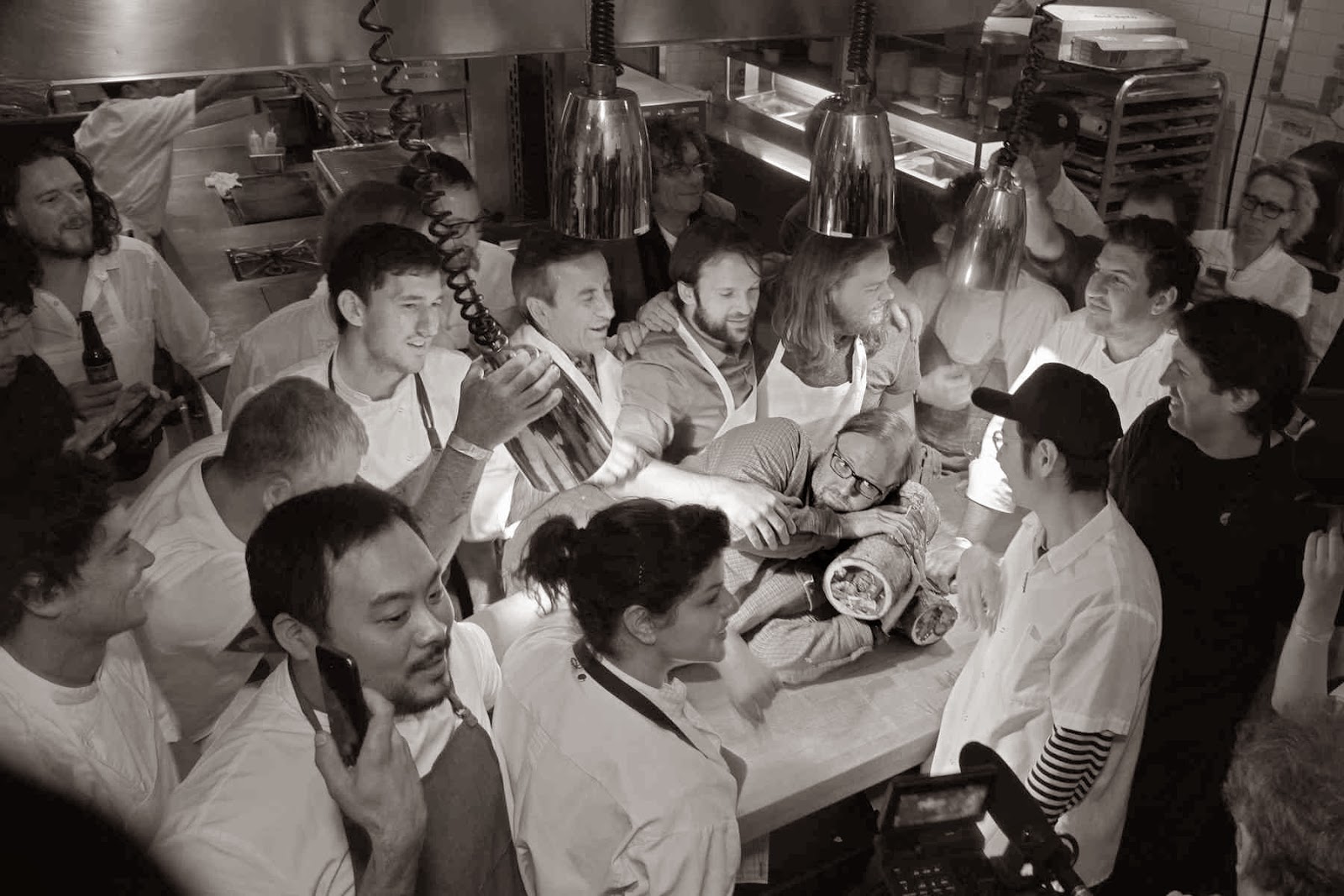
Agata Felluga, Blaine Wetzel, Virgilio
Martínez, Fulvio Pierangelini, Claude Bosi, Daniel Burns, Ben
Shewry, René Redzepi, Alex Atala, Rosio Sanchez, Ana Ros, Rodolfo
Guzman, Karime Lopez, Magnus Nilsson, Danny Bowien, Daniel Patterson
and Gabrielle Hamilton are just the people in this photograph I got
to meet and chat with and even interview over the three days of
Gelinaz! preparations. Daniel Boulud is in there, too, but I didn't
really get to talk to him. I did meet him, at Frankie's Spuntino on
Monday night. He walked up while I was talking to Frankie Falcinelli
and when Frank introduced us he said “do I know you? I don't think
I know you.” I don't think he intended to be rude, I imagine he was
just wondering if I was some Gelinaz! chef he hadn't met yet, but I
never quite recovered enough to ask him to talk to me later. David Chang and I had plans, but apparently he started running the kitchen at WD50 to get things back on schedule
Tuesday night and so he eluded my interviewing stamina. That's why
I'm only an accomplished home cook, not a chef. All the other people
who aren't named: I hope to meet you another time and I don't mean you any disrespect.
This surprise dinner for one of their own was the most recent in a series of undefinable culinary events presented by Gelinaz!, a loose collection of chefs that is part think-tank, part spectacle and part gathering together of friends who like to cook. Petrini, a longtime food journalist and talent scout, is the co-founder and the cement that binds them together, much like the transglutaminase “meat glue” that Dufresne uses to make his infamous shrimp noodles. Coincidentally, this is likely the actual dish immortalized in the recent premiere of HBO's Silicon Valley as “liquid shrimp.”
Gelinaz!
started in 2005 “as a joke,” Petrini told me. His good friend, chef
Fulvio Pierangelini “was known world-wide for being a pain in the
ass, always complaining that people were stealing his ideas and his
recipes. So I proposed that he go onstage with a bunch of other chefs
who were re-imagining his dish and we would do away with copyright
forever.” Perhaps the only thing all subsequent Gelinaz! events
have had in common is this core idea of many chefs concocting their
own versions of a specific dish. At a June, 2013 event in Ghent,
Belgium, diners were served twenty interpretations of an 1861 Cauderlier recipe for chicken in pig's feet jelly.
We
live in an era uniquely obsessed with food and its preparation.
Cookbooks, now almost invariably tied to a particular chef and
restaurant, are one of the few thriving areas in “old”
publishing, despite the mind-boggling number of recipes and
preparations available on the web. As evidenced by HBO name-checking
Wylie Dufresne, high cuisine is pop culture, and an art-form. Last
night's dinner is as worthy of conversation and serious discussion as
the latest Wes Anderson film or that recent museum show that just
opened. “We live in difficult times,” Petrini explained to me as I was trying desperately to dodge hot saucepans and
scurrying sous-chefs. “Food is something that can reassure us”.
The old standard of excellence in food was the Guide Michelin,
which, Petrini says, “judged food by the criteria of the upper
classes.” The idea was that a regular family would save its money
to go to a great restaurant, perhaps once or twice a year. Today,
that seems absurd. “For young people,” Petrini says, “food is
everywhere.”
On
the web, we have instant access to menus and photographs from the
most far-flung of the world's temples to eating. Places like
Nilsson's Fäviken, in a remote corner of rural central Sweden, would
likely never have become must-eat destinations without the
information era. But meticulously prepared food is not a commodity
that can be ordered from Amazon. The global promise of the internet
has also brought a great uprooting which with food has had the
paradoxical effect of making us desperate to regain a sense of place,
a sense of craft. We want access to unique ingredients and
preparations that in the past might have remained unknown. Craft in
general, and food in particular, is an antidote to the emptiness of
consumer culture, and to the mass production and anonymity that are
the less welcome side effects of the information technology
explosion. Food grounds us, and an innovative, memorable meal is
something everyone can aspire to create. It is no coincidence that so
many of the World's 50 Best chefs here, many assisted along
their way to stardom by Petrini's significant influence as its french
chairman, are foragers, cooks who make it a point of pride to use
ingredients so fresh and so local that they are often found growing
only in the immediate surroundings of the restaurant. Places like
Noma and Attica turn the winemaking notion of terroir into a
guiding culinary principal.

Monsieurs Wylie and Andrea
Petrini is modest, with a profound sense of humor he expresses daily in his wry smile and his choice of wardrobe. At WD50 he was wearing a pale lemon-colored flannel shirt trimmed all the way around at the bottom with a row of dangling white lace balls that looked as if they might have been stolen from your grandmother's lampshade. “I'm not trying to influence anything,” he said, but chef after chef commented that they first met Petrini because he came to eat at their restaurant when it was still comparatively unknown. Rodolfo Guzman struggled for five years to keep open his restaurant Boragó, in Santiago de Chile. Then he was named #8 on the Latin American 50 Best list. “Overnight, we were booked one month in advance,” he explained to me, while picking through his arsenal of endemic Patagonian murtilla berries. “It was like a gift. It's why I am here.” Redzepi remembers meeting Petrini at Noma only a few months after he had opened: “That's why he knows everybody, because he discovered everybody.”
Petrini is modest, with a profound sense of humor he expresses daily in his wry smile and his choice of wardrobe. At WD50 he was wearing a pale lemon-colored flannel shirt trimmed all the way around at the bottom with a row of dangling white lace balls that looked as if they might have been stolen from your grandmother's lampshade. “I'm not trying to influence anything,” he said, but chef after chef commented that they first met Petrini because he came to eat at their restaurant when it was still comparatively unknown. Rodolfo Guzman struggled for five years to keep open his restaurant Boragó, in Santiago de Chile. Then he was named #8 on the Latin American 50 Best list. “Overnight, we were booked one month in advance,” he explained to me, while picking through his arsenal of endemic Patagonian murtilla berries. “It was like a gift. It's why I am here.” Redzepi remembers meeting Petrini at Noma only a few months after he had opened: “That's why he knows everybody, because he discovered everybody.”
At WD50, time was running short. The sun had set, and Dufresne was due to walk through the doors at 7:30 PM, lured to the restaurant on his day off by bogus reports of a refrigeration catastrophe. The ten-course meal--what Petrini called “remixes” of three of Dufresne's signature dishes, including the shrimp noodles—was as ready as it could be. Seventy non-paying guests—each chef had invited two—were hushed into silence in the dark dining room. In the kitchen behind, the lights dimmed; the only sound to be heard was the roar of the range hoods. Thirty of the world's best cooks had worked seamlessly together preparing for this moment, their egos apparently left at home. Now they crouched in the gloom in their colleague's kitchen. Precisely on time, Dufresne entered. In the middle of his own dining room he was greeted with a wide-screen television playing videotaped greetings from one chef after another. “Where are they?” he murmured in the dark, “where are they?” Suddenly, the lights went on, and there they were, hugging him, and serving him reimaginations of his own food. At once the world seemed smaller, friendlier, and a whole lot more delicious.

All photographs courtesy WoWe
Update: I don't want to jinx anything, as it hasn't run yet, but this story has now been acquired by the Suddeutsche Zeitung. If you want your own story, be in touch, as I have many more.
Another Update: A gently longer version of this story will run in the Suddeutsche Zeitung Feuilleton tomorrow, April 19th, with more images by WoWe.


