11/04/2010

Preparations 503 and 506

At risk of offending the fine folks who invited me to their shit-shoveling festival a few weeks back in the Loire valley, as recounted a couple of posts ago, I want to revisit the subject of biodynamic farming, because I'm now feeling I let those promoting the agricultural theories of Rudolph Steiner off a little too easily. It's easy to do so, and I think I know why. Because the goals of biodynamic farmers are so closely aligned with the natural wine, organic, fresh and local, and slow food movements, the more kooky elements that go into biodynamics have never emerged as a favored target of secular humanists. With all the evil in the world, why bother going after the possibly self-deluding biodynamic farmer? Furthermore, there seems to me to be little doubt that Steiner was prescient in comprehending the ravages of what would become industrial agriculture, and biodynamics is broadly concerned with soil health and sustainability, more than sixty years before that term became the overused mantra of the green movement. Why risk the perception that you are opposed to a thriving ecosystem, healthy eating, and happy animals by attacking biodynamics?

I wrote in that previous post that biodynamics "typically goes well beyond the basic prescriptions for organic farming." This is essentially true, but only if we are talking about the kind of co-opted organic farming decried by Michael Pollan, in which giant, industrial farms produce "organic" products on vast monocrop farms in order to exploit the marketing value of the term. And that wasn't what I meant: "organic" used to mean, to me, small, thoughtful pesticide-free farming of diverse plantings in a varied and complete ecosystem. Compared with this sort of agriculture, the ways in which biodynamics "goes well beyond...organic" seem upon further reflection to be limited to the mystical and the magical, namely the bizarre Steinerian preparations 500 through 508. The question then becomes: are the results of the biodynamic method superior to the results from any other less dogmatic approach to artisanal, pesticide and chemical-fertilizer-free farming? Are biodynamic farms superior in any way to other farms farmed by farmers deeply invested in soil health, the environment, and tasty eating?

 Preparation 506, in which Dandelion flowers are blanched and then packed into the peritoneum of a cow. This tiny bundle is then buried over the winter before being used as a sort of homeopathic additive to compost.


There are plenty of believers eager to point out that scientific evidence exists for the superiority of biodynamics. Some basic googling will bring up a host of such claims, but nothing I waded through went one simple step further and told you what that evidence is, or, heaven forfend, actually linked to a study demonstrating the point. If you want to enter deeper in this debate, take a look at Biodynamics is a Hoax, in which Napa vintner Stuart Smith pulls absolutely no punches under the subheading "Someone has to speak up."
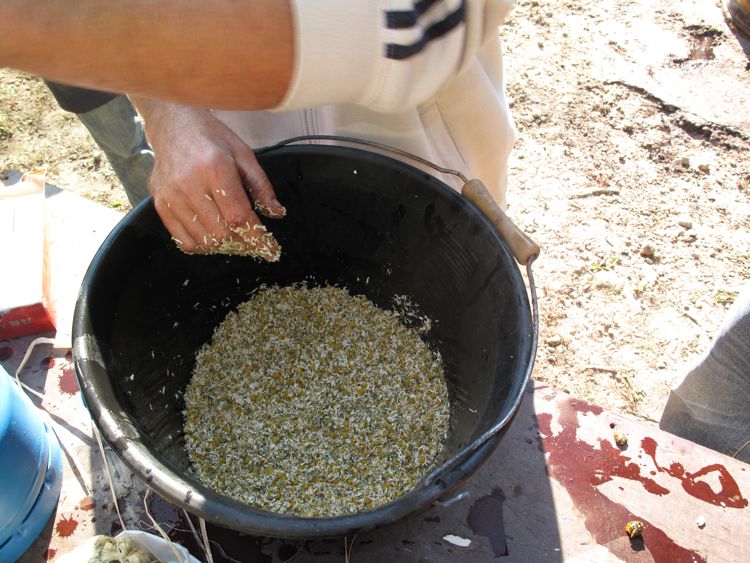
 Chamomile flowers awaiting deployment in Preparation 503.

The moistened flowers are pushed through a funnel, stuffing for a length of cow intestine. 

 The finished product, a chamomile sausage. It's very attractive, but the problem is that I can't find anyone who can explain why adding this to your spring compost will "reactivate" the soil...

There is, sadly, a more cynical perspective from which to consider the success of biodynamics, at least in the wine world. Thierry Puzelat, with whom I spent most of October learning how to make wine, is a very good example of the kind of conscientious farmer who cares deeply about his land and vines and produces excellent plonk without subscribing to the strange prescriptions of Mr. Steiner. He has no quarrel with biodynamic farming, and buys plenty of grapes from friends like Bruno Allion who follow the Steiner line, but his own attitude is "show me the evidence." He told me that it is remarkable how often groups come in to the Puzelat cellars for a tasting and ask him "are these grapes produced in biodynamie?" This before so much as taking a sniff of the first glass. In other words, biodynamics has become so trendy that for some the Demeter stamp of approval is more important to their drinking experience, or their self-perception of what sort of wine drinkers they are, than what the wine actually tastes like. While I have yet to meet a biodynamic farmer who I felt was insincere or concerned with anything more than creating the best possible farm environment, in the face of fetishizing like this I'd be very surprised if there aren't some vintners out there who are burying horns full of manure just because they think they will turn to gold.

After the preparation of the magical packets, we dug a hole in the ground and lined it with old slate roofing tiles, in order to avoid cutting open the parcels with a shovel in the spring dig. I have a similar attraction/skepticism for the rituals of Haitian vodoun, which also often involve the meticulous preparation and burial of small parcels, known as wanga

 The burial.


10/29/2010

Desire Line


The shortest distance between two points; a spontaneous mapping of our use of public space; evidence of an ongoing crime, committed by the masses; a pure expression of democratic will, the people manifestly having voted with their feet: a desire line is all of these.

Most simply put, a desire line is a shortcut. It is an unofficial rogue trail carved into the ground by the passage of numerous pedestrians dissatisfied with the sanctioned routes on offer. A lone walker flaunting the conventions of civilization and the restrictions of garden design cannot on his own create a desire line. Such a path is visible only because the grass that once grew there could not survive the busy traffic. The earth is compacted, the exposed rock polished. This takes time, repetition, and the participation of the multitudes.


Sometimes, where it meets the sidewalk, a desire line spreads wide like the bell of a trumpet, indicating that here short-cutters have converged from various directions to follow it. In this way it becomes a cartographic representation of its own use, in much the way that Ed Ruscha's Sunday-morning aerial photographs of empty Los Angeles parking lots serve as graphs of the preferences of the drivers who park in them, legible in the density of the oil-stains dripped onto the pavement from the pans of innumerable automobiles.


Depending on your perspective, a desire line is either a scar marring the symmetry and tidiness of a park, plaza or lawn, or it is the organic biproduct of maximized efficiency. I'm grateful to Laura for introducing me to this basic concept from the field of landscape architecture, for the desire line has almost unlimited metaphoric potential. Is it the result of taking the easy way out, or of standing up to convention? Are desire-liners lazy and lawless, or are they visionaries who think outside (or inside, or across the corners of) the box? Should society value individualism, or conformity?


Resistance to the desire line is futile. The disgruntled groundskeeper should not argue with the commuters hurrying home, ignoring his admonition not to walk on the grass; his quarrel is with the designer, who failed to do necessary research and tried to erase tradition with the rigid geometry of his ego. What hope is there that a fence and a handful of grass-seed can counteract the imperatives of desire?

A desire line serves as its own demonstrative proof of its benefit to the commons; its utility is rendered undeniable by its very existence.

10/24/2010

Poop Horn (Suspension of Disbelief)

One of the more exotic episodes in my recent visit to the Loire valley was a day spent assisting in the creation of some of the semi-mystical preparations used in Biodynamic farming. Practitioners of the Biodynamic method view earth, cosmos, farm, crop and land from a holistic perspective. The health of each, and therefore our own, such farmers argue, are indissolubly linked. A field that is endlessly fertilized with powerful nitrates and sprayed with pesticides in order to maximize annual yields across a monocrop topography is a field that is ailing and poisoned. In this world view, the way most farmers use their land, and the way most of our food is produced, is deeply wrong; the equivalent for a human would be something like an endless repetition of Morgan Spurlock's experiment in Super Size Me, when he eats nothing but McDonald's products for an entire month.


Biodynamics, based on the teachings of Austrian philosopher-shaman Rudolph Steiner, typically goes well beyond the basic prescriptions for organic farming, and it embodies many similar ideas about environmental and soil health. As a general practice, I find it deeply appealing. Bruno Allion's farm and vineyard near Thesee, in the Loire valley, which I visited last week, looks the way a farm ought to look. There is dirt and mud, weeds and trees and grass. There are flowers and bees and ladybugs, and a happy pig in a comfortably big pen. It looks nothing like the vast and sterile monocrop lots on which America's corn and beef is produced.

 Looking over the horns

But what to do when the general appeal of a philosophy promoting a loving stewardship of the land seems diminished by peculiar prescriptions that seem odd, irrational and altogether divorced from the scientific method? This, for me, is the conundrum of Biodynamics. Take, for example, the "cornerstone of the Biodynamic method," Steiner's preparation 500, or cow's horn manure. The basic recipe is simple, if creative. In the fall, fill empty cow's horns with cow shit, bury them underground for the winter, and then dig them up in the spring. Although I'm certain cow dung is a high quality all-natural fertilizer, and cow's horns make perfectly good vessels in which to mature or compost the manure, it now starts to get weird.

 That's the, uh, substance, with which we will shortly begin to fill the horns.

One horn's worth of the fermented dung, generally about 80 grams of the stuff, is mixed into a suspension with 20 liters of rainwater by stirring it in a whirlpool vortex for a full hour. It is then whisked or sprayed over the fields. One horn is used to treat about one hectare of land (roughly 2.5 acres).  Not to bore you, but I did the math, and that comes out to 0.00074 grams of poop per square foot. If you've ever done cocaine, you'll understand this to be a minuscule quantity unworthy of your attention, a speck of fallen dust so small as to be all but invisible. You may also recognize from your long nights crouched over the mirror the way in which the ritual of preparation dominates the event; the horns must be buried in a specific way, and the stirring activity should alternate from clockwise to counterclockwise, perhaps "attracting cosmic influences into the liquid." The spritzing of the fields appears in photographs to be not unlike the splashing of holy water from a Catholic font. Biodynamicists describe the use of Steiner's preparations as a kind of soil homeopathy, and there doesn't seem to be any more scientific proof of its efficacy than there is for most homeopathic medicine. Just like homeopathy, I'd love to believe it works, but it sure does stretch the imagination.

What are we doing? We're making pâté de poop a la corne, you dipshit. I promise I filled some horns up myself, between photographs. (That's my main man Amane Hagiwara on the left. Within a few years I expect that you'll be seeing his name on a wine label or two. If you do, I suggest you buy the bottles).

 Locked and loaded, and ready for burial.

Bruno Allion has a beautiful farm, and he grows some serious grapes. I know, because I spent my first three days in the Loire valley harvesting them.

Looking wistfully into the pit. You gotta believe...


Next week join us for Biodynamic Preparation #503, cow intestine stuffed with macerated chamomile flowers. No, I'm not kidding.

10/19/2010

Forkful of Gamay

For the very last decuvage of the season, the boys down at the Puzelat -Bonhomme operation decided that the visiting gringo was just the guy to get in the tank and scoop out the grapes. The idea is to shovel out 40 hectoliters of sodden, semi-fermented berries (that's 4000 liters) that have been happily bubbling for ten days or so, while their sugar turns into alcohol. The poor bastard in the tank uses a pitchfork to fill one plastic tub after another. These are then carted off to the pressoir to be mechanically trampled. The carters have far less work to do than the forker, and they delight in looking down into the tank and abusing the sweaty and fitness-challenged shoveler within. One tends to get covered in a good amount of wine.

In the tank, or as the British say, in the soup.

Grapes are heavier than they look.

Jerome looks on with some skepticism

Aah, thank you. Yet another empty crate to fill up.

Shin-deep in Gamay

Are we done yet?

10/09/2010

Sticky Fingers

The good news is, I'm toiling in the vineyards of the Loire valley, helping collect grapes for the famed natural vintners Jean-Marie and Thierry Puzelat. The bad news is I'm working hard enough that I barely have time to blog about all the fabulous wine I've been tasting. The day starts at sunrise amidst the dewy vines, and for most of the day my fingers are so sticky and covered in grape juice that I'm afraid to get my camera out, lest I gum it up with natural sugars. Nevertheless, I've managed to take a few snaps.

Côt, the grape that goes into Puzelat's wittily named "In Côt we Trust."

One of my fellow vendangeurs (grape harvesters). Her french is only marginally better than my chinese, which is to say just about good enough for us painstakingly to have established that she is from China. Her silver rice paddy hat wins her the vendange fashion award for 2010. There are painful similarities between my posture picking grapes and those archetypal National Geographic style images of South-East Asian women bent double in the rice paddies.

Grapes. (Not Thierry Puzelat's: note the lack of grass, weeds and wild herbs, and the regimented rows, like box-hedges. These are vines that have had fertilizer treatments and likely been sprayed with pesticides, and they will be harvested by machine, not by our merry band of vendangeurs. Thierry's look wilder and rawer, vines growing in a complete ecosystem. But the mist in the background was irresistible.)

The team to beat when it comes to making time down the rows is a family foursome from Laos, including the eternally smiling matriarch known simply as Mother.

Many more grapes. The only psychological relief from picking comes from reaching the end of a row, but the rows vary wildly in length. One commonly hears expressed such sentiments as "what a bitch of a row that was," although the length of the row has no impact on the length of the day.

I could get in really big trouble here, as nationalism seems to be a strong suit in Eastern Europe, but I'm pretty sure Artur is from Estonia Poland and Igor is from Latvia.

Menu Pineau, or Arbois. Thierry Puzelat is one of the few producers of this all but forgotten grape, with which he makes incredible white wine. That's him humping some sort of case in the background.

The writer's hands at the end of a row of ripe-to-bursting Gamay.

9/25/2010

BREAD P0RN

The comforting slap of sticky dough on smooth butcherblock; the scattering of flour on board and floor and fingertip and eyebrow; the improbable scent of honey rising from a massaged mixture of nothing more than wheat and water; mysteries of chemistry, these same two ingredients altering through time, warmth and sport, changing from simple dust and liquid, first to paste and then to a complex, stringy, glutenous, aerated and breathing mass of living, feeding yeasts; I'm talking, of course, about breadmaking. And that's all before the salt has been added and anything has gone into the oven, when even more sublime transformations take place. Divine odors swirl on the breeze. Crust and crunch form in the primeval steam; trapped gases seeth and bubble beneath the suface, expanding, rising, and stretching. It's a creation metaphor, a geological microcosm. No wonder some form of bread is prepared by virtually every culture on earth.

Until this summer, however, I thought the making of the kind of bread I love a black art, requiring specialized furnaces and implements beyond the reach of home cooks. I suppose I had never seen anything like a Paris baguette, a Berlin brötchen or a rugged, hearty, crunchy, blackened round of Poîlane emerge from from a home oven. Then my main man from Atlas invited me out to his Hamptons hideway, where he was baking Jim Lahey's notorious no-knead loaves, with delicious results. This recipe from the Sullivan Street bakery conjurer was made famous by Mark Bittman a few years ago in the New York Times, and some people mistakenly refer to it as Bittman's bread. Lahey developed his incredibly simple and virtually idiot-proof recipe after recognizing that bread was considered the staff of life and the literal body of Christ long before the development of steam-injected ovens and kitchenaid mixers with dough hooks. Surely, he thought, medieval village bakers didn't spend endless hours toiling to knead gigantic mounds of dough. There must have been an easier way. The development of commercial yeast came in part as a way to accelerate the making of bread, avoiding long hours and overnight waits. Lahey cut way back on the yeast and added the long wait back in. And he made the dough much wetter than Americans, at least, were used to. Mix flour, water, salt and a tiny quarter teaspoon of yeast; cover and leave unmolested for 16 to 18 hours; bake in a tightly closed pot. Delicious.

I was captivated and, as is my way, I've since thrown myself wholeheartedly and wholewheatedly into the rewarding world of bread-baking. I'm growing my own sourdough cultures, to boost flavor and avoid using any yeast at all, and experimenting with a wide variety of flours. I've discovered the uber-geeky bread website the Fresh Loaf, where, as in all earnest subcultures, an entirely separate language is spoken, one of hydration percentages, boules, poolishes, levains, french folds, lames, miches and retarded fermentation. But it is a testament to Lahey's recipe that I still consider his the bread to beat. The simplicity to crunch ratio is seductive, and the learning curve quickly gets steeper when you try to move beyond his technique.

The highlight of the Fresh Loaf mutual admiration society website is the abundant photography of billowing, ruddy loaves sent in by members, never to be tasted or smelled by fellow fresh-loafers, but posted nonetheless for both critique and to attract ego-stroking. I call this Bread P*rn. Here are some of my efforts.

Exhibit A


Basic white bread. The loaf on the left suffers visually from tentative and clumsy slashing, but was no less delicious than the one on the right. They sprung so nicely in the oven that they came out conjoined at the hip, Siamese unidentical twins.

Exhibit B


There is no such thing, I've already come to believe, as "too rustic" when it comes to bread. These may not be pretty, or in the shape of any known traditional loaf, but they were yummy, crunchy and chewy.

Exhibit C


My best effort so far, a combined Jim Lahey-sourdough flax-seeded monster that rose and rose to the point of bursting, and had a perfect just-charred enough bottom. (Put a disk of tinfoil under your dutch oven after about twenty minutes of baking to avoid going one char too far).

Exhibit D


A comparative failure, with an overdense crumb and most of the lift happening in the top third of the loaf, this bread was nonetheless delicious, if extra-chewy. The ghostly dusted exterior is definitely the direction I'm headed, presentation-wise.

Come on over and have a slice!

9/23/2010

I Gemelli Pinarello / The Pinarello Twins


Thanks to the recent weekend visit of heartbroken ex-Brooklynite AK718, who flew all the way from Munich to sample the hand-pulled noodles at Xian Famous Foods and cover the grand opening of my photography exhibit at Sunny's for the international media, I had the good fortune to reconnect with another member of the original German club-crawling posse, Mr. Wolfgang Wesener, portrait photographer extraordinaire, a man who sensibly fled New York twenty years ago, in 1990, just when it was getting boring around here. Now he's back, after moving for a couple of decades to the north of Italy to raise a family, produce olive oil and take pictures of vintners, and it's as if time has stood still; he's still sporting a wardrobe straight from Avenue A circa 1985.

Although he shared many memories from his time away, during which thousands of portraits were snapped, one of the highlights, at least in my estimation, was described in Wesener's modest admission that, why yes, he had indeed photographed Giovanni Pinarello, the patriarch of the Pinarello clan, one of the foremost names in bicycle manufacture. The Don, so it might be said, of Classic Italian Steel. "And I've just come from New Jersey," exclaimed Wesener, "where I purchased, from a man I found on Craigslist, my very own Pinarello, from the 1980s! I can hardly wait to tell Giovanni!"

"Nao e posivel!" I said, or something along those lines. I waved my hands in the air with Tuscan excitement. "Guarda!" "Anch'io!" and so forth, I went on, meaning: No way! I have one too. The exact same size!

Wesener's portraits are made in black and white, so while you cannot appreciate in this picture that his Pinarello is a fetching and rare eggplant purple, while mine is fire-engine red, it is obvious that our immediate resolution to go riding together actually resulted in our going riding together, this very morning.


Photo: Wolfgang Wesener

9/17/2010

Walking to Guantánamo in Red Hook

Short notice, I know, for all but the most rabid blog-followers, but an exhibition of the photographs I took while walking across Cuba in the year 2000 opens tonight, Friday, September 17th at Sunny's in Red Hook, Brooklyn. It promises to be a fabulous evening. From 8PM on at Sunny's, 253 Conover Street in Brooklyn 11231. I hope to see you there!

For those who can't make it, the show will be up until approximately November 1st during Sunny's irregular opening hours (Weds., Fri., and Sattidee evenings from about 6PM onwards).

9/08/2010

Mind if I borrow your pruning shears?

Apparently this guy's gardening proclivities are really pissing off his neighbors. Maybe it's my libertarian streak, but I the way I see it, it's his front yard and he can grow what he pleases. The Guardian has the story, and I stole their photo.

9/06/2010

Laborious Day

About 11:30 last night, having already been blissfully fast asleep for a full hour, I was woken up by my smoke detector, fulfilling its sole function in fine style. I made my bleary way downstairs, following its extraordinarily loud bleating, and the certain scent of smoke. The culprit proved to be a neglected and very scorched pot of tomato sauce on the stovetop of my downstairs neighbor. She was already on the case. No harm done. Crisis averted.

Still, with volumes of acrid marinara smoke now being exhausted into the front yard with a box fan, I decided to sit for a while on my stoop, just in case any passersby had called the fire department. Sometimes New York's bravest are compelled to hose first and ask questions later.

But there wasn't so much smoke, and I probably could have gone back to bed. Instead, as I emerged onto the front porch in my underpants, I heard sounds of the New York of old, or at least sounds I remembered from the lower-east side of the 1980s. A full-on yelling and punching match, just down the block. What the five-oh call a ten-sixteen, "a domestic." A woman screaming; a man, pushing another man backwards down his two slate steps, repeatedly; the man being pushed drunk enough to get up off the sidewalk and keep coming back for more. The woman on a cellphone, beseeching a 911 operator to send help. Me, the neighbor, peering out through the cracked-open screen door. The man doing the pushing following up his thumps with the excellent advise "to just go home." Telling the guy: "if I didn't like you, you'd already be laid out." The thumpee, laid out, but resolutely not going home, then making various attempts to get back in the building. The romantic affiliations of all parties as opaque as the mud of the Gowanus. A squad car, finally, driving up the one-way street the wrong way with the flashers on. Separation. Shouts. Drama. Handcuffs. The police lean the handcuffed man up against my truck. In a loud and drunken voice he describes the cuffs as "irritating." For a moment I wonder whether the driver's side door mirror is okay.

It is now coming just on midnight, and at this point the night is still. The blue flashing lights of the cop cars are flickering on the fronts of the buildings, just like in the movies. No other neighbors have emerged onto the street; Red Hook has become the sort of place where many spend their labor day weekend out of town. But then I hear a sound, a bit like a wheelbarrow, coming down the block from the direction of the water. And a voice: "Hey, look, police...." This delivered not with the urgency that accompanies criminal activity, but in a more questioning tone, as if to wonder: should we be doing what we are doing?

Three men are pushing a large and pristine motor launch along the sidewalk, on a kind of wooden boat trailer. Not a canoe, or a kayak, but a large, Boston Whaler sized outboard, a good eighteen or twenty feet of lapstrake boat. In the middle of the night. When I was about nine years old, the nation's campuses were overtaken with a craze for "streaking." Once, my parents woke my sister and me, just in time to see the bizarre and fabulous sight of a dozen or so stark naked students, pushing a grand piano and a naked pianist on a wheeled piano bench down the street in front of our house. The boat in front of my house was as unexpected and exotic as that piano, but the police didn't bat an eye.

"Where'd you get the boat?" I called out.

"We made it," said one of the men, telling me so much less than I wanted to know. "Really!" They reached Van Brunt, and pushed around the corner.

I went upstairs to bed.