Showing posts with label fish. Show all posts

11/27/2011

Suspension of Fishbelief

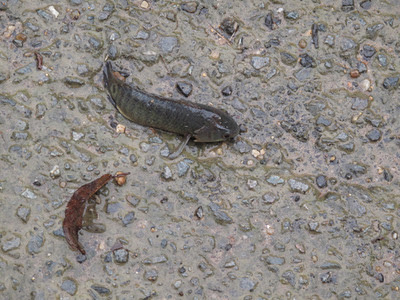
Taman Negara, Malaysia's spectacular and gigantic park, billed as "the world's oldest rainforest," is home to some amazing creatures, including the great argus, essentially a long-tailed chicken, but one so spectacularly plumed as to make peacocks seem rather petite by comparison. Tigers live here, as well as wild Asian elephants and neck-crookingly tall mahogany trees. I saw some spectacular birds (but not the argus--I'll have to go back!), but one of the oddest creatures was this fish, out for a stroll along the driveway, in its own fashion. Casual googling suggests it is an anabantoid, or climbing gourami, one of a number of species perfectly content to leave the water and walk about on the land for hours at a time, presumably in the interest of expanding territory and range.


When I first saw this fish I had an experience you will perhaps share while watching the beginning of this video, namely that the poor animal was being pulled along by some unseen hand, in the manner of a Times Square prankster dragging a twenty-dollar bill along the pavement on a bit of invisible monofilament. I looked around, to see if someone was having me on. Then I followed this little creature for a good hundred feet. Strangely, it stayed on the asphalt. After a time, perhaps exhausted, or having concluded that it was not going to have the luck suddenly to come across an unknown pond, it turned around, and started moving back in the direction from whence it had come.

8/25/2010

The Conclusion to a Newfoundland Adventure

Screech n. Popular name for a variety of cheap, dark Demerara rum bottled in Newfoundland; trade-name of a type of rum marketed with the label 'Screech.'
(from Dictionary of Newfoundland English, 2nd edition with supplement)

Colleen dishes up delicious butter-sauteed cod from the day's catch, cooked al-fresco on a Coleman stove

When we last found ourselves on the shores of Newfoundland, our merry film crew was preparing to undergo a gruesome hazing ritual. (If you haven't already, I suggest you read the first chapter of this adventure HERE.) Although flattered to have been invited to become honorary Newfies, the three of us, once summoned to begin the ceremony, were growing nervous. Gathered on the warm rocks beside the sea, at the invitation of the Penton clan, we were convivially drinking beer and feasting on the endless bounty of the day's catch. Cod, sauteed in butter. Cod, stewed in a pot, with thick slices of bread. Cod, tongues and britches. No words can describe the incredible flavor and life-giving force of the mighty cod, eaten fresh-cooked. A divine delicacy of buttery flakiness, it is the croissant of fish.

 Walter serves up snow-crab legs, boiled in an old propane tank on a beach bonfire. The procedure is simply to dump the whole pot out onto the rocks, gather around, and start slurping.


Cod stew with rounds of bread and butter.

It had, in short, so far been an indescribably pleasant evening, but the tension was mounting. Walter Penton had suddenly appeared to cast a shadow over this happy beach party scene. Dressed from head to toe in black foul weather gear, he was like a dark storm cloud brewing on the horizon, threatening the evening sunset. He spouted strange and incomprehensible syllables, which we were apparently not yet Newfoundlanderish enough to understand. It was apparent that he was barking commands of some kind.

The ominous Walter Penton, although the crocs and blue jeans peeking out from under his oilskin sort of took the edge off.

The gestures made it clear. We were to sit, the three of us, crushed together like shackled oarsmen on a Phoenician galley, on a low bench. Black oilskin sou'wester hats were placed on our heads. Penton towered over us. Our first task was to repeat examples from his tortured Newfoundlander idiom. He bent over. "Something, something, something, mind your lassies come in barrels," he yelled, inches from our faces. At least that's what it sounded like. His breath smelled of cod, and seaweed. "The wund's gone nar, nar wist, darse gone right outiver." We made feeble attempts to recreate these sentences, understanding nothing, but trying to parrot the syllables we heard. The gathered tribe of Newfoundlanders guffawed as we struggled to make sense of these paleolithic fragments of language. But they were laughing with us, not at us.

The uniqueness and antiquity of the Newfoundland tongue is no joke. Story, Kirwin and Widdowson's Dictionary of Newfoundland English is 770 pages long, and contains many fascinating examples of linguistic mangling and invention. Opening at random to page 496, we find that "slob" refers to a slushy, icy water condition, not any shortcoming in personal hygiene. Instead, to describe someone of "a slovenly, untidy appearance," the word to use, found on the same page, would be "slommocky." "Slub" is a "slimy substance on body of fish; blood, slime, liquid refuse from process of splitting cod," whereas "slop" is both a split and salted undried cod, while also synonymous with "slob," in the Newfoundland sense of the word. Paging on, we find "snub," referring to a cod-fish "with a rounded, blunt snout, believed to be a sign of good luck," and "soaker," "a very large cod-fish," as well as "sound," which is "the air bladder, or hydrostatic organ, of a cod-fish." "Spanish" doesn't mean someone from Spain, it refers to "lightly salted, dried cod-fish of the highest quality," destined for the Iberian market. Newfie English is, in short, a complex, deep and expressive tongue, but one in which most words refer in one way or another to the all-important cod-fish.

For our next ordeal, the lovely Colleen Penton Higgins then instructed us each to remove one shoe and one sock, and to roll up a pantsleg for a kind of pedestrian baptism. Each of us put our naked leg into a bucket of frigid north Atlantic seawater, turbid with bits of kelp and other unspeakable maritime detritus. Colleen then massaged our ankles and calves with this seaweed stew. I found this strangely erotic. Coming from Brooklyn, where I live between the dubious waters of New York harbor and the decidedly foul Gowanus Canal, the weedy water smelled clean and pleasant. Similar seaweed treatments can be had in the finest Manhattan spas, and cost hundreds of dollars.

While hoping that my other leg was about to receive the same treatment I considered proposing marriage, but I was rudely snapped from my reverie by the announcement that we were now to eat "Newfie steak." This proved to be an absurdly large, gray chunk of bologna. As Walter passed me my ration on a toothpick I heard someone in the crowd say: "I can feel the heartburn from here." I had already eaten more than my fill of snow-crab legs, cod-fillets, cheeks, tongues and britches, and this enormous chunk of Spam-like substance was considerably less welcome than the foot massage.

Two more trials awaited us. First was the ceremonial kissing of the cod. Unfortunately we had eaten every last one of the mammoth fish we had caught earlier that day, and there were no cod to kiss. Hurrying back to the shore-line, Walter returned with the gutted carcass of a fish, and declared that it would have to do. I had earlier that day been so excited to catch my own cod that I had given it a big smooch, so I felt I ought to get a pass on kissing Walter's cod, which was nothing but a head attached to a filleted spine. It was hardly romantic. "But don't worry, it's got no tongue," said Walter, cackling.

Advance training for the screech-in ceremony: earlier that same day I proudly smooch my catch.
Photo: Scott Anger

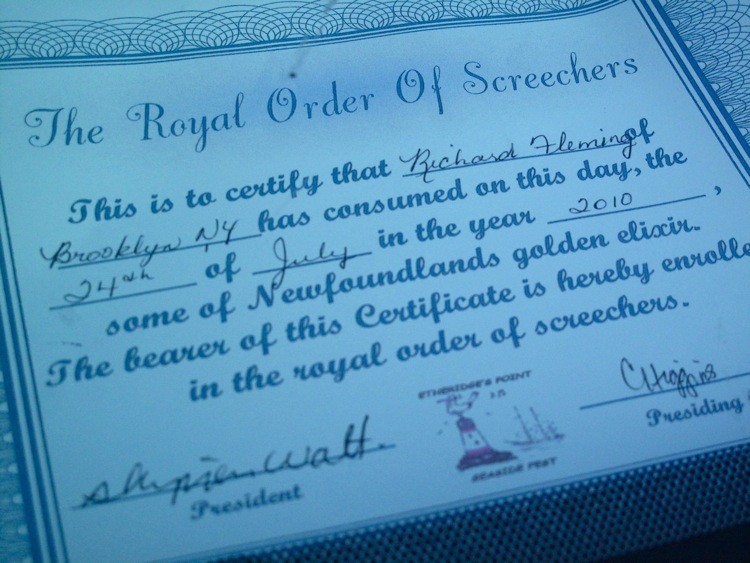
After a perfunctory kiss of the cod-remnants, it was finally time for some screech.  Shots of extraordinarily unpretentious rum, served out of a boot. It was official. We were now Newfoundlanders!


8/12/2010

The Great Screech-In, part the first


In his fabulous book, Cod: A Biography of the Fish that Changed the World, Mark Kurlansky outlines a triangular trade route that ran from the northwest Atlantic cod fisheries south across the ocean to Africa's slave coast, and then back to the Antilles. Sugar, rum and molasses from the Caribbean was shipped north and then traded for salted cod along the coast from New Bedford to Newfoundland. This dried, preserved fish was then offloaded in exchange for slaves in Senegal, Dahomey and Ghana, and also used to feed the human cargo on the Middle Passage to the Caribbean. There, slaves and fish were traded for molasses and rum, and the cycle recommenced. This explains why bacalao, salt cod, is still the most commonly encountered fish dish in Puerto Rico, Cuba and the Dominican Republic, all islands in the fish-friendly, but codless Caribbean sea.

I saw vestiges of this trade during a recent film shoot on Fogo Island, at the epicenter of what were once the richest cod-fishing grounds on earth, along the north-east coast of Newfoundland. Cod are almost a religion here. Although there were no descendants of slaves anywhere to be seen, I drank from a bottle of Newfoundland Rum.

Once a place where dockside fish-processing plants worked around the clock dealing with the seemingly endless bounty of the sea, Fogo is an island that has suffered in recent decades. In 1992, with cod stocks dwindling toward extinction because of industrial overfishing, Canada instituted a total moratorium on taking the species. Fogo's story since then has included a lot of underemployment, brain-drain, and a mass migration to St. John's and other larger Canadian cities in search of work.


But despite the hardships the island has suffered, it is difficult to imagine a friendlier welcome than the one we received on Fogo. I cannot remember ever being more overwhelmed by the warmth of a people. I've slurped sago soup on tiny islands in Indonesia, supped on pork stew at impoverished homesteads in Cuba, and enjoyed couscous on camel-blankets spread out by Tuareg nomads under the Saharan night sky, but as far as I am concerned, the new ultimate in hospitality is being invited to eat butter-sauteed cod-tongues with Fogovians.

I could argue that this is because Newfoundlanders and I actually speak the same language, English, but it isn't true. Fogoans, or Fogies, or whatever they are called, talk with a kind of tormented backwoods Irish brogue that makes the rest of Newfoundlanders sound like a bunch of network news announcers, even though people from that province are ridiculed throughout Canada for "talking funny." Apparently linguists and anthropologists come to Fogo to learn how the Irish spoke, four hundred years ago. Cut off from the rest of Canada by a lot of water and a whole bunch of French people, Newfoundland is a kind of island nation unto itself, and Fogo is a remote island off of that island.

Tastes like lobster!

The two highest honors that can be bestowed on the foreign visitor to this remote outpost are to get to go cod-fishing with Aidan Penton, and to be "screeched in" by his brother Walter and sister Colleen. We learned that we were to receive both of these accolades on our next to last day on Fogo, when Aidan proposed that we venture out onto the high seas in search of cod. He then added casually, but rather ominously, that should we return with some fish he would then hand us over to his siblings to be properly screeched.

"Uh, screeched?" Deborah Dickson, Scott Anger and I looked at one another, puzzled. Was this some sort of strange vestigial term, a linguistic remnant of medieval Ireland?

"Well, it's about making you honorary Newfoundlanders," said Aidan. "But I kenn't tell you any more dan dat." Now Deborah and I looked at one another with alarm. Once, we had together crossed the equator on an aircraft carrier and experienced firsthand the bizarre and degrading shellback ceremony, during which newbie equator-crossers are tormented and hazed by their more senior Navy crewmen. Screeching? I pictured branding irons and fishhooks and a cod-gut massage. "Do we have to?" I asked.

"Now, don't go getting all worried," said Aidan. "You'll enjoy it. Let's fish!" Soon we were headed out from Joe Batt's Arm toward the Little Fogo Islands in an open boat, with Aidan watching for the particular alignment of landmarks that would tell him we were floating atop prime cod habitat.

Fish stocks have rebounded enough since 1992 that Newfoundland now enjoys a brief season during which cod can be taken in small numbers, exclusively on hand lines. Old-school fishing. We threw our hooks and silver jigs overboard in 80 feet of water and almost immediately started pulling fish into the boat.

Cod are "ground-fish," meaning they like to hang near the bottom, and the approved technique is to let the weighty silver jig all the way down to the ocean floor before tugging on it smoothly and swiftly, pulling it up a just few feet and then letting it back down. This is called "jigging," and the idea is to fool the cod into thinking that the metal lure is a panicked Capelin, the smelt-like bait-fish that is their primary sustenance.

Me, inordinately proud to have caught the smallest cod of the day
Photo: Deborah Dickson

In short order we had filled a large plastic tub with cod. They are a beautiful and regal fish, as Kurlansky argues. (Those who declare that cod are "ugly" are agitators and malcontents unlikely to be made honorary Newfoundlanders). Although the temptation was immediately to indulge in cod sushi, we resisted, and instead turned back, heading for port and the unexplained horrors of the screech-in.

The moment of judgment had arrived. When got back to port, a driftwood fire was already blazing on the sloping slabs of granite beside the bay. Nestled in the red-hot coals was a large cauldron, fashioned from a decapitated propane tank. The lid was a slab of metal carved from a stop-sign. We were served beer, perhaps to anesthetize us against the coming torments. At the shoreline, Penton friends and family squatted on the rocks, swiftly eviscerating the freshly-caught cod with gleaming blades that flashed in the sun, like Capelin trying to escape. They threw the guts directly into the harbor, where gulls swooped and squabbled over the offal.


It was a grim scene. The unearthly gabbling of the gulls, the smoke rising into the air, the handfuls of guts being chucked about. What on earth could possibly be in store for us? Clearly it was to be some sort of trial by fire. Suddenly, Walter Penton emerged from the fish-gutting shack in a full set of black oilskins and sou' wester hat, like some sort of crazed Gestapo fisherman. He had a pirate's gleam in his eye, and he was puffing maniacally on a corncob pipe.


to be continued...
7/10/2009

Adios, albacore...


Walking along a sandy trail through dry tropical forest, toward the frothy blue Caribbean, Laura and I met coming down the path one of the staff of our rustic lodging in Tayrona National Park, the Finca Don Pedro. There we had pitched our tent between two coconut trees in an immaculately manicured jungle clearing. Our friend, one of the guys responsible for collecting dried coconut husks and weedwhacking the constant onslaught of tropical growth into a serviceable lawn, had just returned from the beach. Laden with fish, he had been at the shore at just the right time to purchase the pick of the morning's catch. He was carrying a string of bright-eyed snapper, some jack, and a long, silvery, eel-like tangle he declared was "mas sabroso que el dorado" (even better than mahi-mahi). The fish that caught my eye, however, was a diminutive tuna, fifteen inches of steely wet sheetmetal, sleek and stiff and glistening. He called it an albacora.

It was our last morning in the park. We said goodbye, heading along the coast to make the long trek up to Pueblito, the ruins of a pre-Columbian indigenous village hidden away in the foothills of the Sierra Nevada de Santa Marta. This massive, isolated clump of the Andes tumbles down into the Caribbean here. The vast boulders scattered along the coast, the craggy, sandy terrain, and the last remnants of towering coastal forest are what make Tayrona such a spectacular place.

All day long I thought about that fish. Laura is amazed at my unfailing ability to manufacture stress and anxiety out of even the most blissful of situations, and later that afternoon, as we sat on the pearly-white sand and dabbled our toes in the azure water, things were no different. "I should have offered to buy that fish right then and there," I whined. "I should have put a deposit on it." Laura pointed out that nobody else was staying at Finca Don Pedro except for three Argentine hippies we suspected of being vegetarian. "I don't know," I said. "I'm worried. I'm going to be really bummed if he already unloaded it. What if we arrive back in camp and someone else is feasting on it?"

At dusk, we hurried along the trail through the forest, swatting mosquitoes. Once back at Don Pedro's I wasted no time, poking my head in the doorway of the outdoor kitchen, an array of propane burners and a makeshift sink set up in a thatched lean-to. "I want to inquire about a fish we saw this morning," I said. "Do you still have it?"

The owner of the fish was summoned, and I was led in the gloom to a battered styrofoam cooler, tucked between the stalks of two banana plants growing out behind the open-sided hut where the workers sleep in a row of hammocks. There was the tuna, illuminated in the glow of my headlamp, packed tightly in ice. After a quick and most reasonable negotiation, it was ours.

"Do you mind cleaning it for me?"


Cooking methods are not subtle in the jungle. After a few slash marks down the side of the fish, in it goes to the vat of bubbling oil. A few minutes later,
voila!


Sabroso!
Conversation was limited, as we were too busy gorging.

1/30/2009

Honestly, though, I loved the fish...


The new Georgia Aquarium in downtown Atlanta is billed as the world's largest. It is spectacular, a place you absolutely must visit if you pass through. The tanks are so massive that one seems to be walking through a tunnel burrowed through distant oceans. It is also a Godawful, horrid representation of everything wrong with our consumerist, market-driven culture, an opportunity to stand in a long line like mutton at the abattoir, waiting to spend $27 to be assaulted by the sights and sounds of the food court at your local mall.


The customer, relieved of their entrance fee, enters a vast hall teeming with schools of people, like fish. The ambiance is one of shopping mall. Immediately across from the entrance is the café and snack shoppe, so situated that the public will waste no time yielding up more of their cash. Prominent dioramas proclaim the corporate sponsors of the different exhibits. Home Depot, or its materials, built a part of an exhibit, for instance. UPS flew in the whales for free, and they aren't shy about telling you. Enormous, flashy, three dimensional graphics dangle in the grand hall, as if no contemporary child could possibly enjoy an experience that does not present itself with the aesthetics of a Disney DVD.

Worse, the educational component of this incredible institution seemed limited to a few of the usual platitudes about not wasting water and helping to keep the oceans clean, posted here and there in unlit corners of the walkways on bits of colored cardboard. Any educational awareness I might have taken away from the experience was certainly overshadowed, in terms of prominent graphics, by the announcement that the freshwater meander was sponsored by the Southern Company, a vast hydroelectric and nuclear power concern. Call me a curmudgeon, but this is blood money. To propose to me that I might save the world by remembering to turn off the water as I brush my teeth, while simultaneously providing a greenwashing for a massive power company is, pardon the pun, a damming indictment of the whole affair. It leaves a muddy, brackish taste in the mouth. I know, I know, why not just accept that this is entertainment, not an educational opportunity?

Apologists will tell us that without the corporate sponsorship by companies trying to link this simulated wilderness experience to their brand it would be impossible to build such spectacular exhibits. I'm unwilling to accept that trade, even if the vastest of the tanks seems to be an almost ocean-sized affair, crammed with multiple species of sharks, dense schools of fish of a multitude of species, and, most impressively, no end in sight. The giant nurse sharks look small in it, and they have enough room in the adept underwater architecture to swim away and out of view. We have no sense that these fish have boundaries, that somewhere deep beyond them is another wall. The public ride through an undersea tunnel on a slow-moving conveyor-belt.

Only the Beluga whales seem confined, circling in repeated patterns, like inmates doing pushups in their cells. A whale in a tank, however spacious, is like a goldfish in a shotglass.


Only in the most pristine conditions could one hope to have comparable views in the wild.


For an additional fee customers can arrange to go diving with the nurse sharks.


At the aquarium shop you can buy this creepy, burkaesque dolphin mask, along with thousands of delightful dolphins, simpering sharks, baby belugas and other stuffed, fluffy variants on the cuddly, but we could not find one inch of shelf in this vast store, in the world's largest aquarium, given over to even one serious book about fish, oceans, or ecosystems
.

10/15/2006

How about steamed, with a little butter and lemongrass...?

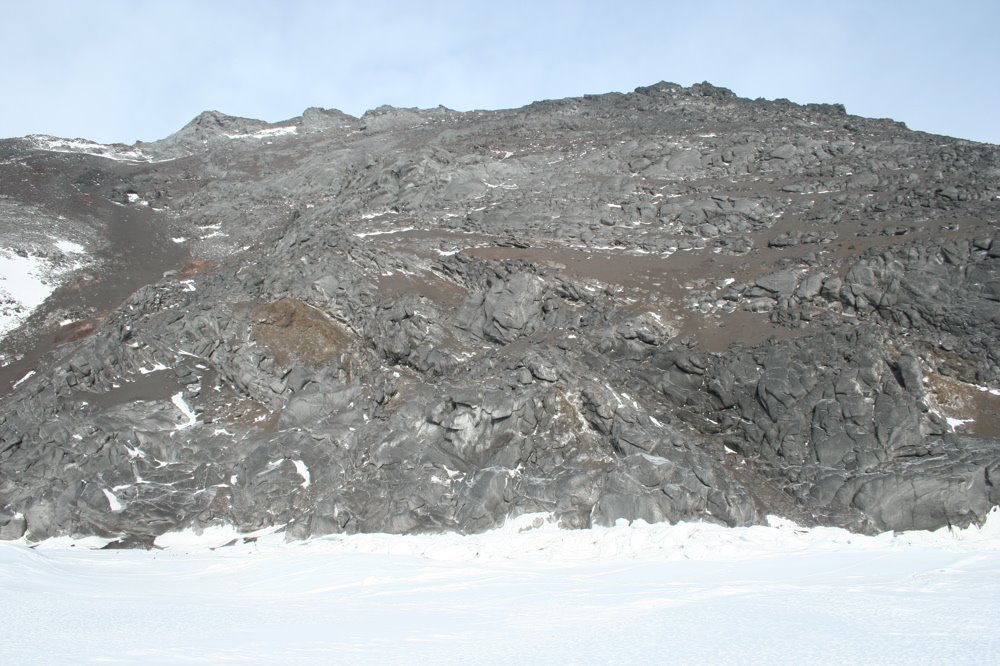
It's much steeper than it looks, that's why they call it Inaccessible Island


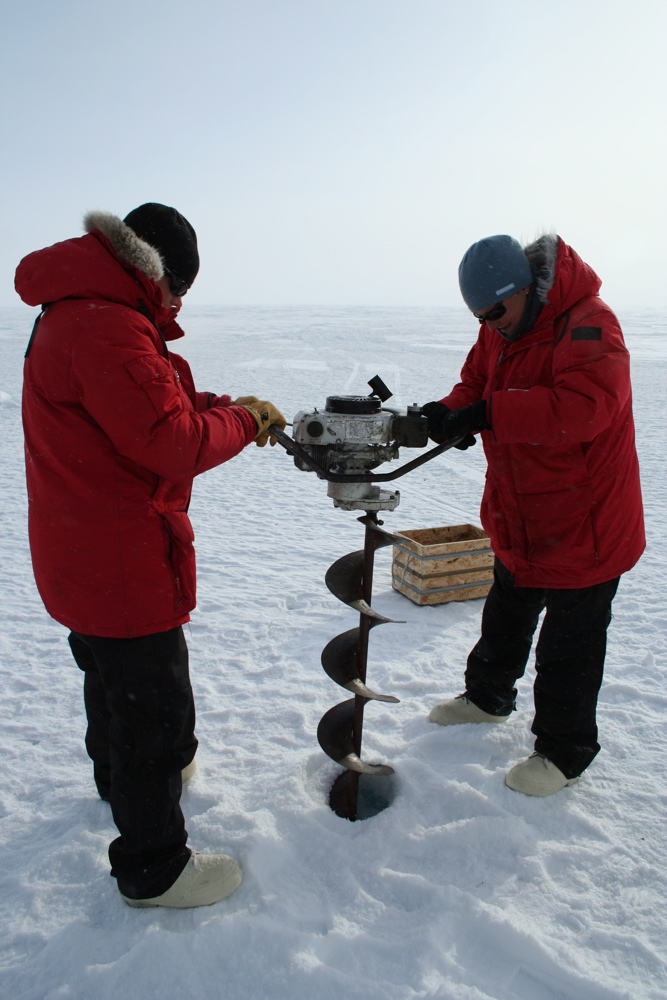
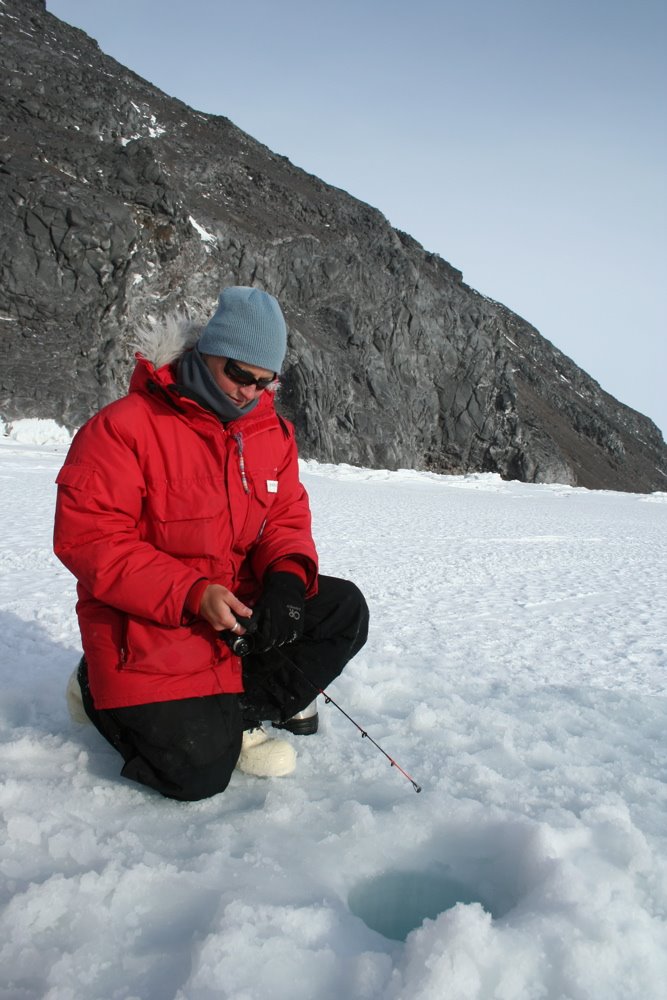
Yesterday, feeling we hadn't been out of McMurdo in an age, and then only in the middle of the night to groggily shoot landscapes, we decided to go fishing at the foot of Inaccessible Island. With a posse of three lady marine biologists and one dude, on skidoos and by Pisten Bully convoy, we headed out for the fishing holes. A Minnesotan friend of mine in college, a veteran ice-fisherman from the land of ten billion lakes, once spent an evening recounting to me the joys of winter fishing in Minnesota. The sport has all the rich cultural complexities and unassailable traditions that characterize all subcultures; in Minnesota the winter fish huts are dragged out into the middle of huge frozen lakes with Ford Pickups, and sit there for the entire season, complete with generators, television for the football games, wood stoves, Hudson Bay blankets and all the other conceivable comforts that make for endless pleasant afternoons of fishing. Namely beer.


What time is kickoff?

There is no structural difference between Minnesotan ice fishing and Gretchen, Mackenzie, and Anne's approach to their scientific work; the only big contrast is in what they do with their catch. My college friend Tim swore that when the fish were biting on the Minnesotan ice he and his buddies would pull them out and slap them to the sides and roof of the truck, where the fish would promptly freeze solid to the cold metal. Once the vehicle had been converted into a sort of frozen fish sculpture they would then drive to McDonald's and go through the drive-through to try and freak out the burger jockeys. Instead our friends the marine biologists do everything possible to keep their catch alive, rushing them into a cooler of sea water the moment they pull them up, to avoid the fish freezing. The water underneath the sea ice maintains an almost constant temperature year-round of negative 2 degrees C, and the fish they catch are extremely intolerant of variations in temperature. They are interesting in part because a sort of natural anti-freeze flows through their veins.

It's never too early to schedule your mandatory ice probe...

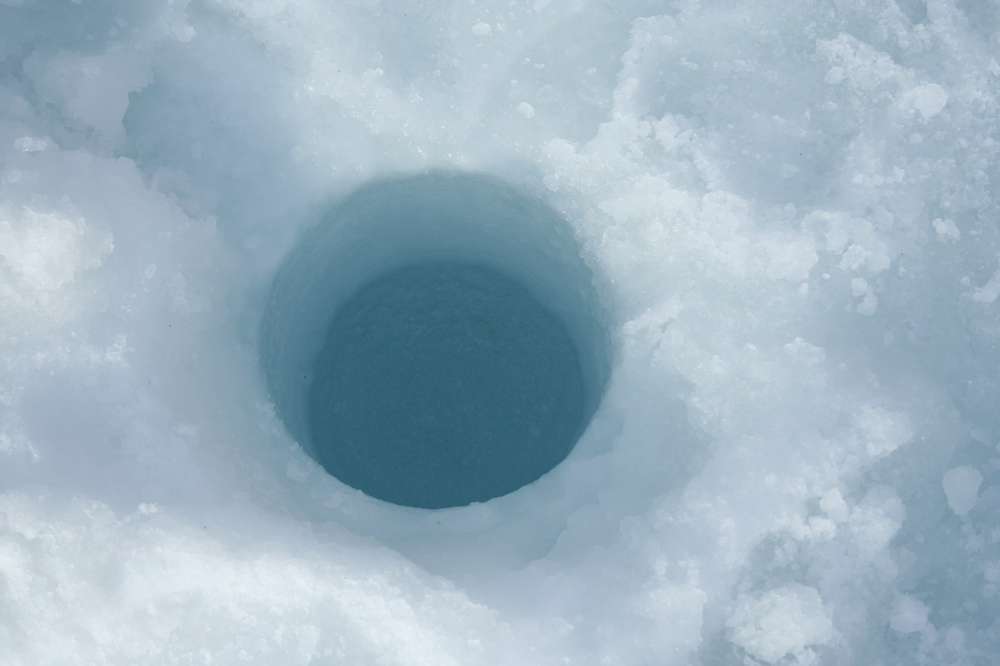
At one point a passing seal exhaled below and a rush of bubbles set the surface of the hole aboil

It was delightful to watch these scientists, as competitive in their fishing as any beer-swilling Minnesotans could be, dropping their neon glow-worm lures down freshly-drilled holes off the ends of absurdly short fishing poles--ordered, of course, from a speciality fishing rod outfit in Minnesota. In a couple of hours they pulled out some 35 fish, which are now to be found swimming in tanks on the lowest level of the Crary lab. The moment Anne pulled up a fish Mackenzie would seize her own rod and announce "I'm going in," taking over the hole for her turn.


That's a cute little pole you got there, darlin'


Mmmm, another day done. Time to pop 'em in the skillet!