Showing posts with label fishing. Show all posts

4/21/2013

Call me anytime you like

Here at antarcticiana we consider one of our core missions to be the calling out of mendacious, cynical and counter-human corporate behavior. Whenever possible, we enjoy battling greed and incompetence with snark and vitriol. But we aren't hypocrites, and when presented instead with excellence we feel duty-bound to share the good news with our vast readership. Therefore, we are proud to present the first ever antarcticiana award for superlativity in the field of customer service. The winner is USAirways.

Last week, I had a quick one-day job down in Virginia Beach. To get all the way there and back, and fit in a day of filming, required a bleary, pre-dawn trip to LaGuardia Airport, a USAirways shuttle to DC, and a quick USAirways connection onward to Norfolk. Under normal circumstances, I look at those promotional charging stations that Samsung now has dotted throughout the world's airports and I think: that's a recipe for losing your phone. In Washington I was still dozing, however, and my phone's charge was diminished. With a whole day in the field in front of me I needed all the juice I could get. At the gate at Reagan I plugged in, and then sat just a few feet away, half-guarding my phone while reading Keith McCafferty's The Royal Wulff Murders, crime fiction set in the trout fishing paradise of riverine Montana.* A fellow crew-member appeared, the USAirways flight was called. Minor distractions. Guess what: Those Samsung charging stations are a recipe for losing your phone.

On board the Norfolk flight our kindly USAirways stewardess informed us that the USAirways airplane doors had been closed and that it was therefore time to turn off all electronic devices. I patted my pockets, but I already knew. I had a feeling of dread not unlike that induced by turbulence, although we were still on the ground. I stewed and seethed with self-loathing. Hadn't I said to myself, just as I was plugging in my immaculate Samsung Galaxy S-series smartphone: you're going to forget that.? Indeed I had, and indeed I did.

Once airborn I took advantage of the USAirways in-flight beverage service to explain my plight and ask for advice. The stewardess immediately asked for all the details. "I'll talk to the USAirways Captain, and we'll call it in," she said. "We should still be within radio range of Reagan."

"It's in a blue protective cover, and must most certainly still be plugged into the Samsung console just to the right of USAirways gate 35," I said, somewhat breathlessly. She handed me a USAirways napkin, on which I wrote down the salient details. Meanwhile, she went to fetch me a USAirways club soda. She returned, took the napkin, got on the cockpit telephone and described the emergency to the Captain. Minutes later, she came back to my seat again. "The Captain has spoken to our people in concourse "C," and they are sending someone from USAirways to look for your phone."

The DC to Norfolk flight is only some twenty minutes, and we were soon in the terminal. I borrowed the producer's phone and immediately called my own. It was answered, by a USAirways employee from baggage services. She had recuperated the phone and said it would be waiting for me at the baggage desk near the baggage claim on my way back through the airport that evening. Meanwhile, the pilot of the aircraft, overhearing my conversation, suggested that I call again before getting on my return flight, and said that baggage services would likely bring the telephone to my Washington departure gate. I was mightily impressed. Here I was, standing in the terminal, discussing my lost telephone with the archetypal Captain, a guy who had taken a pause from his busy day to discuss my problem. Silvery gray hair still cut in military fashion; gold bars on navy uniformed chest; that stentorian, reassuring voice I had heard over countless aircraft PA systems: "If worst comes to worst, call them up and they will Fedex it to you." USAirways.

Nonetheless, I fretted all the day long. The phone having been found was one thing, actually getting it back into my paws was another. I pictured the phone being tossed into a giant cardboard box full of other phones left behind at other Samsung charging stations by other morons. I carefully calculated the minutes we would have to transfer to our connection on the way home. Then, disaster. The Washington flight was delayed. The competent USAirways agent at the checkin quickly reticketed us, but through Philadelphia. A quick taxi-ride from LGA, and shortly before midnight I collapsed on the sofa at home, phoneless. By now, I was certain, the phone's battery would be dead, the post-it note someone might have stuck to it would have become unstuck, and it would soon join the vast graveyard of the expired and unclaimed.

The next morning, Fedex account number in hand, I searched through piles of old newspapers and dirty socks, looking for the landline. Reduced to using the speaker feature on the base station, I quickly reached a competent USAirways baggage services employee. On Friday morning my phone arrived, wrapped like fish in yesterday's DC tabloid. Thank you, USAirways!


*Fly-tieing murder mysteries apparently represent an entire sub-genre of crime writing. Who knew?

2/12/2012

Fishing and Faith

It takes a lot of faith to venture out into the Atlantic Ocean day after day to cast one's nets from a dugout canoe, propelled only by hand-carved wooden paddles. Protection is needed. The resting fishing boats pulled up on the beach in Monrovia are a testament to that faith and to that need; there is scarcely a single vessel without a biblical citation or a praise to the Lord emblazoned on the side. But like tap-taps, the ornately painted microbuses that serve as the entirety of Haiti's public transit system, the decoration of the Monrovia fleet juxtaposes a variety of elements from the spiritual, athletic and political worlds. Painting the insignia of the Manchester United Football Club on the side of a wheelbarrow, or of a canoe, is about making an association with the very best. The painter provides, literally, a brush with greatness. Your paintjob affiliates you with supremacy, whether represented by the divine, or a star attacking midfielder. You show respect, you ask for protection, you brand yourself, you are endorsed.

 The hand-carved fleet, at rest

 "Fresh and Ready / Only God #2"

 "In Jesus Name / Chelsea Football Club / Acts 5:10 (Miraculous signs and wonders wrought among the people)"

 Chelsea FC, detail

All praises be to the United Nations

 "Manchester United / Only God #1"

 "Heavenly Father"

Fixing the nets

8/25/2010

The Conclusion to a Newfoundland Adventure

Screech n. Popular name for a variety of cheap, dark Demerara rum bottled in Newfoundland; trade-name of a type of rum marketed with the label 'Screech.'
(from Dictionary of Newfoundland English, 2nd edition with supplement)

Colleen dishes up delicious butter-sauteed cod from the day's catch, cooked al-fresco on a Coleman stove

When we last found ourselves on the shores of Newfoundland, our merry film crew was preparing to undergo a gruesome hazing ritual. (If you haven't already, I suggest you read the first chapter of this adventure HERE.) Although flattered to have been invited to become honorary Newfies, the three of us, once summoned to begin the ceremony, were growing nervous. Gathered on the warm rocks beside the sea, at the invitation of the Penton clan, we were convivially drinking beer and feasting on the endless bounty of the day's catch. Cod, sauteed in butter. Cod, stewed in a pot, with thick slices of bread. Cod, tongues and britches. No words can describe the incredible flavor and life-giving force of the mighty cod, eaten fresh-cooked. A divine delicacy of buttery flakiness, it is the croissant of fish.

 Walter serves up snow-crab legs, boiled in an old propane tank on a beach bonfire. The procedure is simply to dump the whole pot out onto the rocks, gather around, and start slurping.


Cod stew with rounds of bread and butter.

It had, in short, so far been an indescribably pleasant evening, but the tension was mounting. Walter Penton had suddenly appeared to cast a shadow over this happy beach party scene. Dressed from head to toe in black foul weather gear, he was like a dark storm cloud brewing on the horizon, threatening the evening sunset. He spouted strange and incomprehensible syllables, which we were apparently not yet Newfoundlanderish enough to understand. It was apparent that he was barking commands of some kind.

The ominous Walter Penton, although the crocs and blue jeans peeking out from under his oilskin sort of took the edge off.

The gestures made it clear. We were to sit, the three of us, crushed together like shackled oarsmen on a Phoenician galley, on a low bench. Black oilskin sou'wester hats were placed on our heads. Penton towered over us. Our first task was to repeat examples from his tortured Newfoundlander idiom. He bent over. "Something, something, something, mind your lassies come in barrels," he yelled, inches from our faces. At least that's what it sounded like. His breath smelled of cod, and seaweed. "The wund's gone nar, nar wist, darse gone right outiver." We made feeble attempts to recreate these sentences, understanding nothing, but trying to parrot the syllables we heard. The gathered tribe of Newfoundlanders guffawed as we struggled to make sense of these paleolithic fragments of language. But they were laughing with us, not at us.

The uniqueness and antiquity of the Newfoundland tongue is no joke. Story, Kirwin and Widdowson's Dictionary of Newfoundland English is 770 pages long, and contains many fascinating examples of linguistic mangling and invention. Opening at random to page 496, we find that "slob" refers to a slushy, icy water condition, not any shortcoming in personal hygiene. Instead, to describe someone of "a slovenly, untidy appearance," the word to use, found on the same page, would be "slommocky." "Slub" is a "slimy substance on body of fish; blood, slime, liquid refuse from process of splitting cod," whereas "slop" is both a split and salted undried cod, while also synonymous with "slob," in the Newfoundland sense of the word. Paging on, we find "snub," referring to a cod-fish "with a rounded, blunt snout, believed to be a sign of good luck," and "soaker," "a very large cod-fish," as well as "sound," which is "the air bladder, or hydrostatic organ, of a cod-fish." "Spanish" doesn't mean someone from Spain, it refers to "lightly salted, dried cod-fish of the highest quality," destined for the Iberian market. Newfie English is, in short, a complex, deep and expressive tongue, but one in which most words refer in one way or another to the all-important cod-fish.
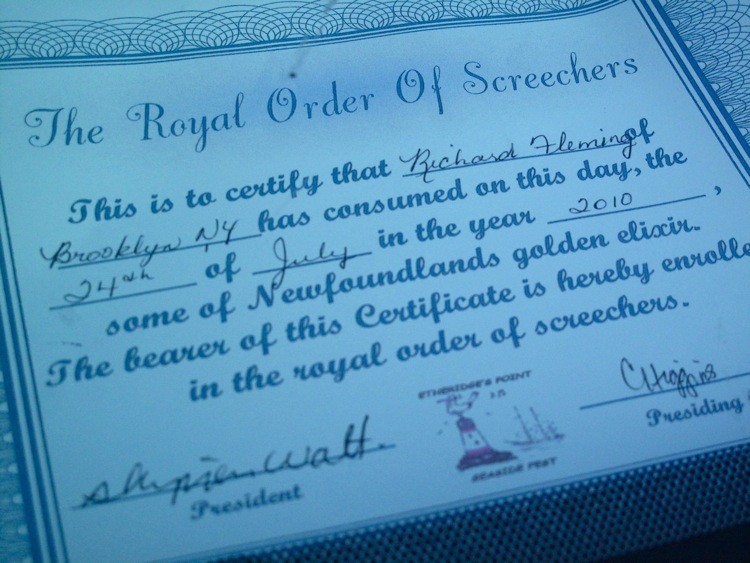
For our next ordeal, the lovely Colleen Penton Higgins then instructed us each to remove one shoe and one sock, and to roll up a pantsleg for a kind of pedestrian baptism. Each of us put our naked leg into a bucket of frigid north Atlantic seawater, turbid with bits of kelp and other unspeakable maritime detritus. Colleen then massaged our ankles and calves with this seaweed stew. I found this strangely erotic. Coming from Brooklyn, where I live between the dubious waters of New York harbor and the decidedly foul Gowanus Canal, the weedy water smelled clean and pleasant. Similar seaweed treatments can be had in the finest Manhattan spas, and cost hundreds of dollars.

While hoping that my other leg was about to receive the same treatment I considered proposing marriage, but I was rudely snapped from my reverie by the announcement that we were now to eat "Newfie steak." This proved to be an absurdly large, gray chunk of bologna. As Walter passed me my ration on a toothpick I heard someone in the crowd say: "I can feel the heartburn from here." I had already eaten more than my fill of snow-crab legs, cod-fillets, cheeks, tongues and britches, and this enormous chunk of Spam-like substance was considerably less welcome than the foot massage.

Two more trials awaited us. First was the ceremonial kissing of the cod. Unfortunately we had eaten every last one of the mammoth fish we had caught earlier that day, and there were no cod to kiss. Hurrying back to the shore-line, Walter returned with the gutted carcass of a fish, and declared that it would have to do. I had earlier that day been so excited to catch my own cod that I had given it a big smooch, so I felt I ought to get a pass on kissing Walter's cod, which was nothing but a head attached to a filleted spine. It was hardly romantic. "But don't worry, it's got no tongue," said Walter, cackling.

Advance training for the screech-in ceremony: earlier that same day I proudly smooch my catch.
Photo: Scott Anger

After a perfunctory kiss of the cod-remnants, it was finally time for some screech.  Shots of extraordinarily unpretentious rum, served out of a boot. It was official. We were now Newfoundlanders!


8/12/2010

The Great Screech-In, part the first


In his fabulous book, Cod: A Biography of the Fish that Changed the World, Mark Kurlansky outlines a triangular trade route that ran from the northwest Atlantic cod fisheries south across the ocean to Africa's slave coast, and then back to the Antilles. Sugar, rum and molasses from the Caribbean was shipped north and then traded for salted cod along the coast from New Bedford to Newfoundland. This dried, preserved fish was then offloaded in exchange for slaves in Senegal, Dahomey and Ghana, and also used to feed the human cargo on the Middle Passage to the Caribbean. There, slaves and fish were traded for molasses and rum, and the cycle recommenced. This explains why bacalao, salt cod, is still the most commonly encountered fish dish in Puerto Rico, Cuba and the Dominican Republic, all islands in the fish-friendly, but codless Caribbean sea.

I saw vestiges of this trade during a recent film shoot on Fogo Island, at the epicenter of what were once the richest cod-fishing grounds on earth, along the north-east coast of Newfoundland. Cod are almost a religion here. Although there were no descendants of slaves anywhere to be seen, I drank from a bottle of Newfoundland Rum.

Once a place where dockside fish-processing plants worked around the clock dealing with the seemingly endless bounty of the sea, Fogo is an island that has suffered in recent decades. In 1992, with cod stocks dwindling toward extinction because of industrial overfishing, Canada instituted a total moratorium on taking the species. Fogo's story since then has included a lot of underemployment, brain-drain, and a mass migration to St. John's and other larger Canadian cities in search of work.


But despite the hardships the island has suffered, it is difficult to imagine a friendlier welcome than the one we received on Fogo. I cannot remember ever being more overwhelmed by the warmth of a people. I've slurped sago soup on tiny islands in Indonesia, supped on pork stew at impoverished homesteads in Cuba, and enjoyed couscous on camel-blankets spread out by Tuareg nomads under the Saharan night sky, but as far as I am concerned, the new ultimate in hospitality is being invited to eat butter-sauteed cod-tongues with Fogovians.

I could argue that this is because Newfoundlanders and I actually speak the same language, English, but it isn't true. Fogoans, or Fogies, or whatever they are called, talk with a kind of tormented backwoods Irish brogue that makes the rest of Newfoundlanders sound like a bunch of network news announcers, even though people from that province are ridiculed throughout Canada for "talking funny." Apparently linguists and anthropologists come to Fogo to learn how the Irish spoke, four hundred years ago. Cut off from the rest of Canada by a lot of water and a whole bunch of French people, Newfoundland is a kind of island nation unto itself, and Fogo is a remote island off of that island.

Tastes like lobster!

The two highest honors that can be bestowed on the foreign visitor to this remote outpost are to get to go cod-fishing with Aidan Penton, and to be "screeched in" by his brother Walter and sister Colleen. We learned that we were to receive both of these accolades on our next to last day on Fogo, when Aidan proposed that we venture out onto the high seas in search of cod. He then added casually, but rather ominously, that should we return with some fish he would then hand us over to his siblings to be properly screeched.

"Uh, screeched?" Deborah Dickson, Scott Anger and I looked at one another, puzzled. Was this some sort of strange vestigial term, a linguistic remnant of medieval Ireland?

"Well, it's about making you honorary Newfoundlanders," said Aidan. "But I kenn't tell you any more dan dat." Now Deborah and I looked at one another with alarm. Once, we had together crossed the equator on an aircraft carrier and experienced firsthand the bizarre and degrading shellback ceremony, during which newbie equator-crossers are tormented and hazed by their more senior Navy crewmen. Screeching? I pictured branding irons and fishhooks and a cod-gut massage. "Do we have to?" I asked.

"Now, don't go getting all worried," said Aidan. "You'll enjoy it. Let's fish!" Soon we were headed out from Joe Batt's Arm toward the Little Fogo Islands in an open boat, with Aidan watching for the particular alignment of landmarks that would tell him we were floating atop prime cod habitat.

Fish stocks have rebounded enough since 1992 that Newfoundland now enjoys a brief season during which cod can be taken in small numbers, exclusively on hand lines. Old-school fishing. We threw our hooks and silver jigs overboard in 80 feet of water and almost immediately started pulling fish into the boat.

Cod are "ground-fish," meaning they like to hang near the bottom, and the approved technique is to let the weighty silver jig all the way down to the ocean floor before tugging on it smoothly and swiftly, pulling it up a just few feet and then letting it back down. This is called "jigging," and the idea is to fool the cod into thinking that the metal lure is a panicked Capelin, the smelt-like bait-fish that is their primary sustenance.

Me, inordinately proud to have caught the smallest cod of the day
Photo: Deborah Dickson

In short order we had filled a large plastic tub with cod. They are a beautiful and regal fish, as Kurlansky argues. (Those who declare that cod are "ugly" are agitators and malcontents unlikely to be made honorary Newfoundlanders). Although the temptation was immediately to indulge in cod sushi, we resisted, and instead turned back, heading for port and the unexplained horrors of the screech-in.

The moment of judgment had arrived. When got back to port, a driftwood fire was already blazing on the sloping slabs of granite beside the bay. Nestled in the red-hot coals was a large cauldron, fashioned from a decapitated propane tank. The lid was a slab of metal carved from a stop-sign. We were served beer, perhaps to anesthetize us against the coming torments. At the shoreline, Penton friends and family squatted on the rocks, swiftly eviscerating the freshly-caught cod with gleaming blades that flashed in the sun, like Capelin trying to escape. They threw the guts directly into the harbor, where gulls swooped and squabbled over the offal.


It was a grim scene. The unearthly gabbling of the gulls, the smoke rising into the air, the handfuls of guts being chucked about. What on earth could possibly be in store for us? Clearly it was to be some sort of trial by fire. Suddenly, Walter Penton emerged from the fish-gutting shack in a full set of black oilskins and sou' wester hat, like some sort of crazed Gestapo fisherman. He had a pirate's gleam in his eye, and he was puffing maniacally on a corncob pipe.


to be continued...

7/10/2009

Adios, albacore...


Walking along a sandy trail through dry tropical forest, toward the frothy blue Caribbean, Laura and I met coming down the path one of the staff of our rustic lodging in Tayrona National Park, the Finca Don Pedro. There we had pitched our tent between two coconut trees in an immaculately manicured jungle clearing. Our friend, one of the guys responsible for collecting dried coconut husks and weedwhacking the constant onslaught of tropical growth into a serviceable lawn, had just returned from the beach. Laden with fish, he had been at the shore at just the right time to purchase the pick of the morning's catch. He was carrying a string of bright-eyed snapper, some jack, and a long, silvery, eel-like tangle he declared was "mas sabroso que el dorado" (even better than mahi-mahi). The fish that caught my eye, however, was a diminutive tuna, fifteen inches of steely wet sheetmetal, sleek and stiff and glistening. He called it an albacora.

It was our last morning in the park. We said goodbye, heading along the coast to make the long trek up to Pueblito, the ruins of a pre-Columbian indigenous village hidden away in the foothills of the Sierra Nevada de Santa Marta. This massive, isolated clump of the Andes tumbles down into the Caribbean here. The vast boulders scattered along the coast, the craggy, sandy terrain, and the last remnants of towering coastal forest are what make Tayrona such a spectacular place.

All day long I thought about that fish. Laura is amazed at my unfailing ability to manufacture stress and anxiety out of even the most blissful of situations, and later that afternoon, as we sat on the pearly-white sand and dabbled our toes in the azure water, things were no different. "I should have offered to buy that fish right then and there," I whined. "I should have put a deposit on it." Laura pointed out that nobody else was staying at Finca Don Pedro except for three Argentine hippies we suspected of being vegetarian. "I don't know," I said. "I'm worried. I'm going to be really bummed if he already unloaded it. What if we arrive back in camp and someone else is feasting on it?"

At dusk, we hurried along the trail through the forest, swatting mosquitoes. Once back at Don Pedro's I wasted no time, poking my head in the doorway of the outdoor kitchen, an array of propane burners and a makeshift sink set up in a thatched lean-to. "I want to inquire about a fish we saw this morning," I said. "Do you still have it?"

The owner of the fish was summoned, and I was led in the gloom to a battered styrofoam cooler, tucked between the stalks of two banana plants growing out behind the open-sided hut where the workers sleep in a row of hammocks. There was the tuna, illuminated in the glow of my headlamp, packed tightly in ice. After a quick and most reasonable negotiation, it was ours.

"Do you mind cleaning it for me?"


Cooking methods are not subtle in the jungle. After a few slash marks down the side of the fish, in it goes to the vat of bubbling oil. A few minutes later,
voila!


Sabroso!
Conversation was limited, as we were too busy gorging.

9/11/2008

Fishing for the essence of photography

Once again I've been thinking hard about photography, and its uses, because above and beyond printing my forthcoming magnum opus, my publisher, Commons Books, is also soon to release a companion book of photographs I took in Cuba, while I was walking about the place. So I've been revisiting Roland Barthes, and Susan Sontag, and some of the other theoreticians of the medium, who I often neglected back in college. Why is it that photography is the bastard stepchild of the art world? What it is about the medium that prevents it from being taken seriously, that makes it so difficult to hang a photograph in a museum next to a painting, instead of in its own little ghetto of flat, glossy bits of paper?

Whether or not you are into theory, a major issue seems to be that the very ubiquity of photographs, the ever-increasing ease of making and displaying them, conspires against their perceived value. Millions of photographs must now be taken every day across the globe, and the vast majority of them are purely commemorative. They are taken to capture moments and experiences; they are of weddings, birthdays, visits to places or people, automobile accidents, and large buildings. The commemorative object (the blue ribbon at the horse fair, the bowling trophy, the snapshot) is almost by definition not a piece of art; it invokes not its own qualties, but seeks rather to conjure the emotions and recollections of a past glory or achievement, even one as modest as standing in front of the chain-link fence at ground zero. Contrast this with painting, sculpture, or poetry, the very undertaking of which implies an artistic intent.

On a recent day off here in upstate New York, we drove from Newburgh, down route 9W, to the temptingly named Sloop Hill State Unique Area. We are suckers for the unique, hence one of photography's problems. Sloop Hill turned out to be a small and charming park beside the wide Hudson, where, in deep shade, surrounded by pockets of burning sunshine, a group of fishing enthusiasts had gathered to memorialize the catching of a trout. It is easy to take pictures of people taking pictures, because your subjects themselves are busy asserting the normalcy of picture-taking and are therefore ill-equipped to argue that you are invading their privacy.

We snapped, and bantered. The trout had not been caught in the river, but elsewhere, in a reservoir. I failed to ask why it had been brought here, in a large red cooler (not pictured) to be photographed. It weighed more than 7 pounds, and was the largest trout the man holding it had ever seen.

Because of the challenging light conditions, or perhaps because he seemed to think it unseemly that I should take more photographs of the man and his fish, than he, the man's friend, might take, the photographer snapped again and again, providing many angles from which I was able to capture the process of the fish being memorialized. For each picture that he took of a man holding a fish, I was able to take my own picture, of a man taking a picture of a fish-holding man. Through it all, the subject remained impassive, his unwavering, emotionless face betraying not a hint of a smile, or a suggestion of pride, as if the enormous, glorious cadaver should be allowed to speak for itself.

I may not know what art is, but I know what I like.


.

1/19/2008

Broad Channel Beauty

The annual early January trip to Jamaica Bay Wildlife Refuge, in aid of getting the new year's bird list off to a healthy start, didn't uncover any spectacular rarities, but we did encounter a beast of a mailbox in Broad Channel. The evidence is far too ugly to post here, but luckily there's a whole website dedicated to this sort of thing.

2/09/2007

Reading: Hooked by G. Bruce Knecht


Albatross, of which I'm rather fond after seeing many of them on my recent jaunts to the cold southern ocean waters off New Zealand and Australia, are being killed in the thousands by long-line fishermen. The birds eat fish, fish bits, and fish offal. In long-line fisheries tremendous mile-long fishing lines, with hundreds of subsidiary branching strands, each with dozens of hooks baited with fish, are suspended in the ocean in the hopes of catching many tons of bigger fish all in one go. As the mass of hooks drift below the surface, albatross and other birds feast on the catch and the remaining baits, swallowing the hooks themselves. Those that do not sustain fatal injury to their internal organs drown.

The leader of one of the pelagic birding trips I went on in Kaikoura pointed out a terrible irony here. The broad acceptance and use of long-line fishing dates to the very successful "dolphin-safe" campaign, which forced tuna fishermen to abandon purse-sein netting, another fishing technique which drowned thousands of dolphins each year. So where the dolphins once suffered, now the albatross suffer. The broader point is that modern fishing techniques capture their prey in vast, industrial quantities and cause horrifying collateral damage to all sorts of creatures, from birds and marine mammals to non-target fish species.


The devastation of the world's fish populations themselves is the subject of Hooked, by G. Bruce Knecht, a writer with a much broader environmentalist streak than one would expect from someone at the Wall Street Journal. It is one of my shortcomings as a birdbrain that I might normally be unlikely to pick up a book about the Patagonian toothfishing industry. In fact, "nothing but a bunch of books about toothfish" could almost serve as a generic indictment of those sad and unwanted dusty volumes that sit on the shelves of low-budget travelers lodges everywhere, those manky coffee-stained Louis L'Amour novels offering themselves in trade for the invariably superior volume one has just finished while on vacation. But down in McMurdo station my friend Gretchen of the chicks who fish, and her posse, were all reading Hooked. They said it was much more exciting than it sounded, so even though they are all marine biologists and dna geeks I thought I would check it out.

Something like the hip fish salesmen and bi-coastal restauranteurs he describes, who changed the name of the Patagonian toothfish to "Chilean sea bass" and watched its popularity explode, Knecht takes what on the face of it seems a dull subject and weaves an exciting tale full of fish-piracy, courtroom drama, and urgent high-seas satphone conversations, set in slick and stinky fish markets, the Hamptons mansions of illicit fish-moguls and the dining rooms of posh restaurants across the globe. Following the story of an Australian intercept of suspected toothfish poachers, operating in a trawler under Uruguayan registry, Knecht sucks the reader along in his wake, ending chapter after chapter with some cliff-hanging moment of toothfishing suspense, until you arrive at the last pages, breathless from the narrative tension of it all. Only then do you relax for a moment and realize that you've been in a page-turning frenzy and stayed up late into the night reading a book about industrial fishing.

Included in what amounts to an environmental call-to-arms masquerading as a paperback thriller are delicious and not-so-delicious factoids that illustrate, once again, just how very little we know about the food we eat in America. Just as we haven't the vaguest idea what state or country a particular steak might come from we have generally zero concept of the origins of our fish. But at least you know what a cow looks like, or is supposed to look like; presented with the pristine white flesh of some sea bass fillets spread out on the ice at the local Fairway I realize I haven't the foggiest idea of how big a toothfish might be, or what color, or what shape its snout might be. Let alone which ocean it came from, or what method was used to catch it. What can you tell me about Orange roughy? That it is trendy, and delicious, perhaps, but not much more. Knecht tells us that this fish, now threatened with commercial extinction just as the toothfish is, was not always so prized. Orange roughy used to be known as "slime heads." Mmmm. What are those going for, per pound? Our special tonite: slime head, in a pomegranate-balsamic reduction.


Ultimately, Hooked is about the senseless destruction of the world's fisheries and fish habitats by voracious and unregulated massive scale industrial fishing operations. The unthinkable, the exhaustion of the ocean as a resource, is already a reality. Are we to immediately stop eating fish? No, we need education and awareness and we need to bring the power of the consumer to the dining table, as in the dolphin-safe campaign. As a dozen albatross swooped around our boat, the leader of the pelagic trip in Kaikoura explained that New Zealand has an active long-line fishery, but one that kills no albatross at all. A few voluntary measures to ensure the hooks stay deep enough to be out of range of fishing seabirds are all that it takes to prevent massive slaughter, but no one is influencing the international fleet of trawlers, all dieseling about registered under flags of convenience, to take these simple steps. In the same way, argues Knecht, true international regulation of fisheries could bring fishing back to life as an industry, instead of the desperate last-gasp strip-mining of the oceans that it has become.

12/09/2006

Wild life

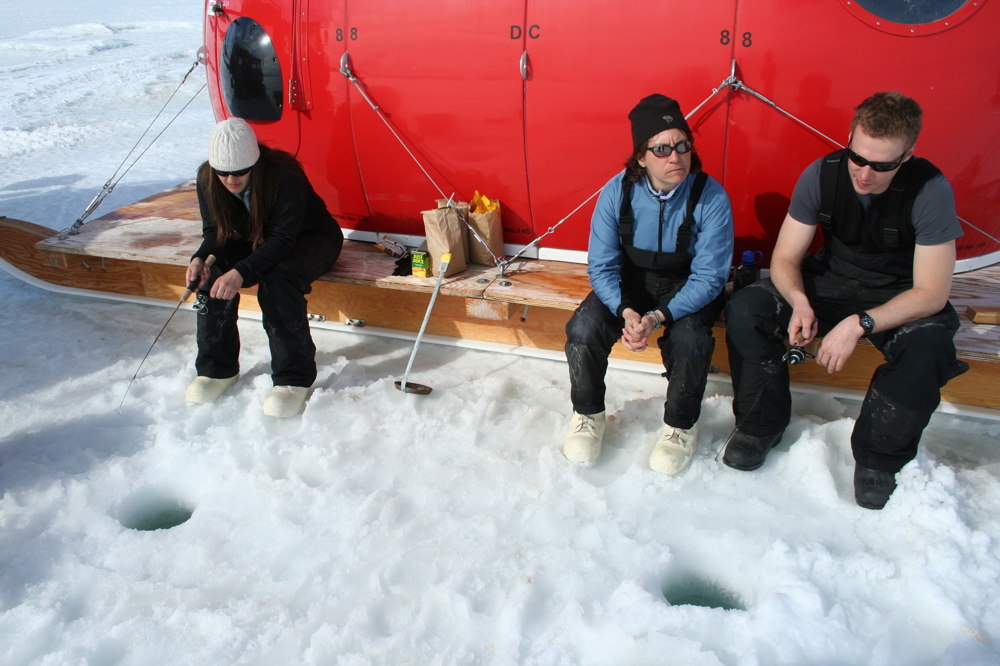
Reestablishing our McMurdo routine, we took a Pisten Bully out on the sea-ice yesterday on a visit to the chicks who fish. They had their Minnesota ice-fishing camp set up almost in the shadow of Bob Scott's Cape Evans hut, the one his expedition used for the fatal journey to the South Pole. It's about an hour and half drive at Pisten Bully top speed, which is to say around 25km from McMurdo.

What a difference two months makes! The ice runway is closed, its surface slushy and its depth perhaps insufficient for the landing of aircraft. The surface of the flagged route across the ice was melting and pitted with pools of water of indeterminate depth. Like New York City potholes after a rainstorm, it is difficult to tell whether you can drive right over them or if they dip deeply down towards the water below. It is one thing to sit comfortably driving a Pisten Bully, which must weigh a ton or so, over the frozen sea in subzero temperatures, with the heat blasting, and quite another to find oneself dodging puddles in a steamy, tropical fifty plus degrees F. With the sweaters stripped off and the windows wide open and the sun beating through the windshield it became all to easy to imagine the ungainly Bully sliding into an advancing melt-crack and sinking very rapidly to the bottom of the Ross Sea.

We passed one recumbant sausage-like Weddell seal after another, their enormous tubular bodies stretched out beside pressure ridges where, we knew, cracks must exist big enough to give the mighty mammals access to the water and its fish. It was lovely and hot and, as Gretchen the fearless fisherwoman put it, "a great day for taking the vehicles swimming."


Jessie, Gretchen and some dude named Tim jigging for "bernies" (Trematomus bernacchii)

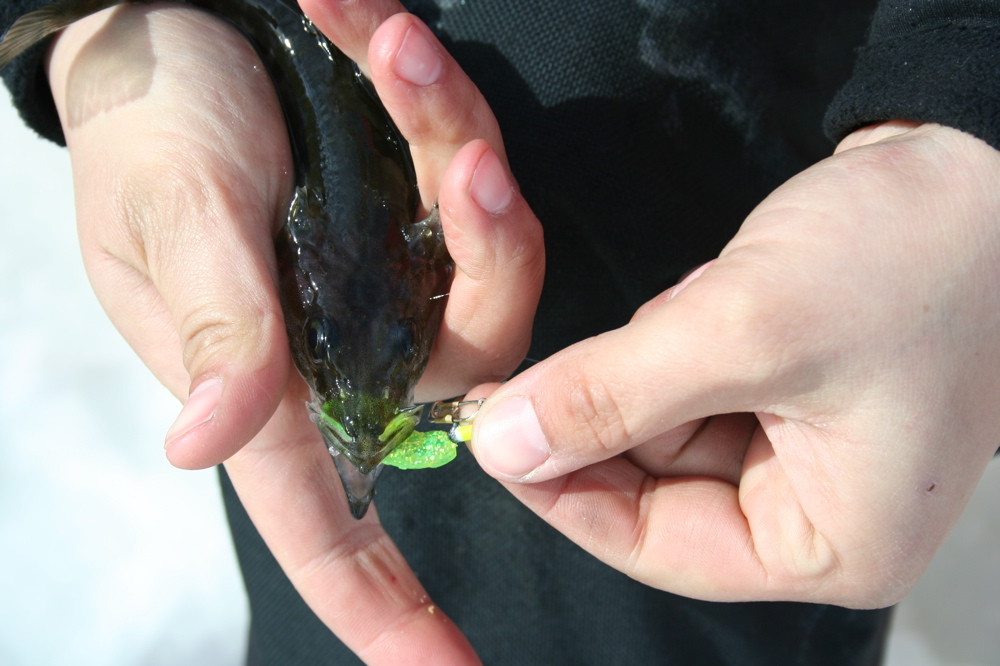
When we arrived at Cape Evans, Gretchen and her posse were reclining on their "tomato" shelter, basking in the sun and fishing with notably less intensity than on our previous visit so many weeks ago. Jess caught a rare and strangely beaked Dragonfish.

The dragonfish has a curious beak: Jessie on the catch and release

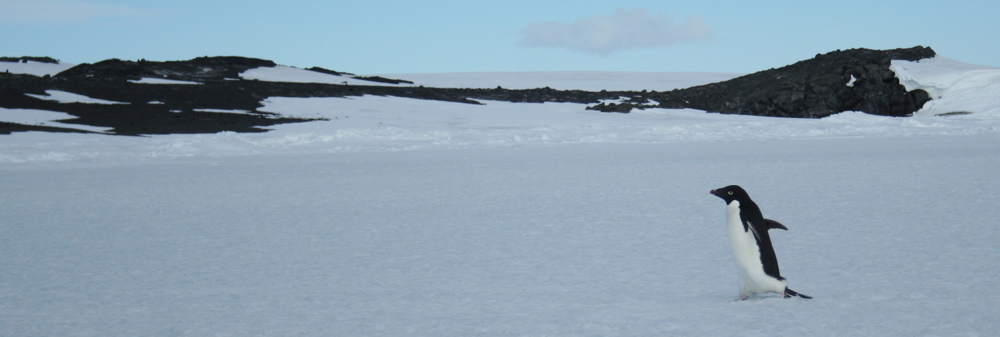
As we interviewed Gretchen about Antarctica's meaning in her life, she spied two Adelie Penguins waddling towards us across the ice. This brought an immediate end to the interview, as I have an "emergency penguin observation work-stoppage" clause in my contract. We walked out to meet them, flapping our arms like flippers and then lying down on the ice when they were about 100 meters off. Very curious, and without surface-based predators, they continued towards us to have a look. Gretchen pointed out that they are the only other family of birds besides parrots who manipulate the feathers of their crown and nape to change the shape of their heads to suit, perhaps, their mood. This was a piece of ornithological trivia unknown to me, a lifelong birder. We were soon able to see this behavior displayed.


The penguins continued, heading directly towards Scott's hut, as if they intended to visit its relics, and then continued past it onto an expanse of black volcanic rock. Here, perhaps lulled by the surface heat, they collapsed for a nap.

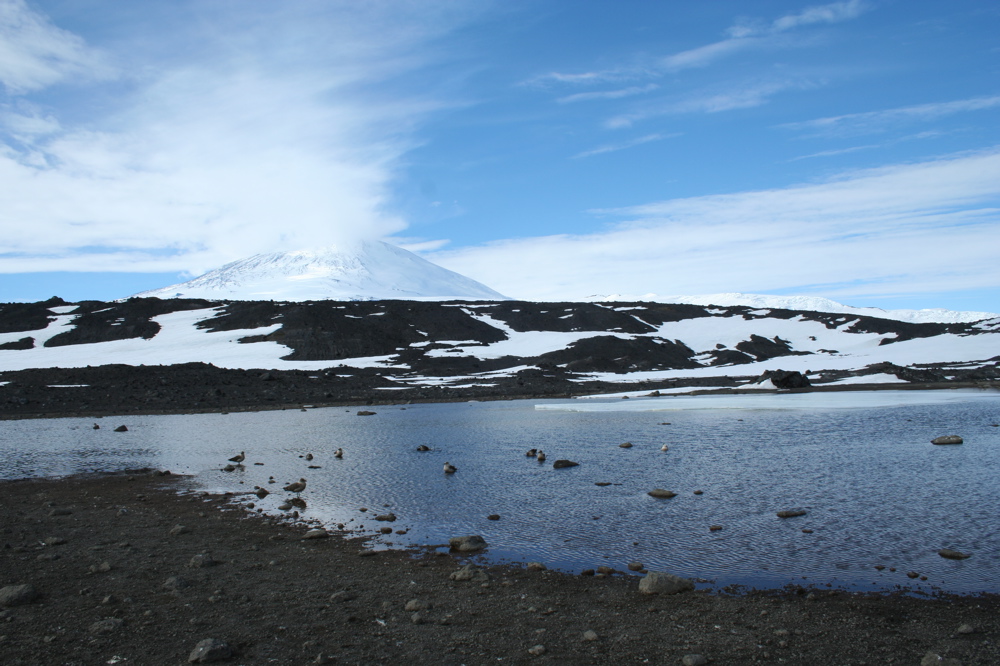
Erebus, pond, and a smattering of skuas


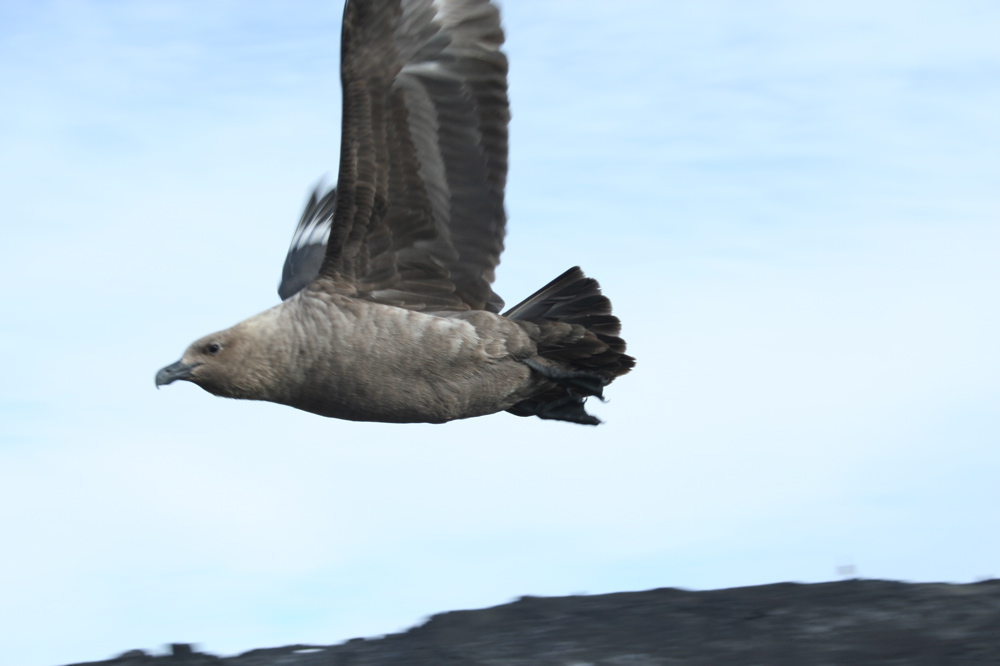
Nearby, the same passive solar gain of this black rock had created a pond, in which 15-20 skuas were splashing and washing and carrying on. Extraordinarily aggressive large gull-like marauders, they feed on the few delicacies the Antarctic ecosystem has to offer: penguin chicks and eggs, seal placentas and dead seals, fish scraps from Gretchen's bait pot and candy bars stolen from the hands of hapless McMurdoites crossing from the dining hall to the dorms.

Catharacta maccormicki, The South Polar skua. Note the pale nuchal collar, characteristic of this species.