Showing posts with label birds. Show all posts

11/01/2011

"Going Greenly into the Future," a screenplay

There was no response from the media relations office of "elegantly" Glenwood Properties in response to numerous emails inquiring why their recent marketing campaign prominently features what appears to be Merops pusillus, the little bee-eater, an insectiverous bird widespread across most of sub-Saharan Africa, but unknown from New York City or anywhere else in the Americas.


At the offices of Global Glut Realty Corp., Joe and Schmoe sit at a polished black granite conference table, wearing Brioni suits. Manhattan, viewed through the smoked glass floor-to-ceiling windows of a corporate high-rise, stretches out beneath them.

SCHMOE: They're nice apartments I have, Joe, all over the city. I don't understand why they're not renting.

JOE: You're out of date; you need to get with the whole ecological revolution. People want their place to be sustainable and stuff.

SCHMOE: What the hell is that supposed to mean?

JOE: You know, like, long lasting, and, uh...natural.

SCHMOE: WTF? You mean I have renovate? I just redid all these places. They're like minty fresh.

JOE: Nah, you don't have to do nothing. Just emphasize the environmental aspect in your New York Times adverts. Green, green, green. That's the word everyone is using. Make it green.

SCHMOE: C'mon, stop yankin' it. The apartments are painted white. Who the hell wants a green apartment?


JOE: Not green the color, you moron. Like, as in natural, you know whuttum saying? Like a spinach milkshake or some shit. Like, yoga. Put a tree in there, dickhead. I dunno, put a picture of a fountain, some bubbly water. Just make sure you call it green in big letters. Paint a picture of a tree, or a goddamn bird or something. You see how I'm helping you, here?


SCHMOE: A bird? What do I know from birds? You mean, like a parrot, or what?

JOE: No, you jerk. Like some wild natural creature, you know, that flies around in trees and stuff.

SCHMOE: How am I supposed to take a picture of a bird?

JOE: You really are thick today, Schmoe. Let me order us up a couple of frappuccinos, get that brain working. Look, it's not particle physics. Just go on the internet, and get a nice picture of a bird, and just kind of place it tastefully in your ad, there. You'll see; people will be signing leases in no time.

4/06/2011

The Social Life of Caged Birds, on PRI's "The World" UPDATED


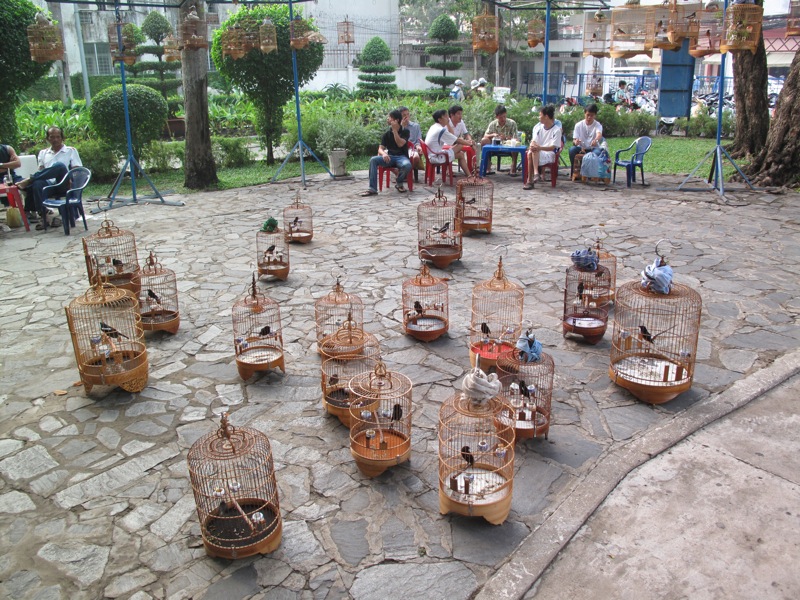
On weekend mornings at dawn, Saigonese songbird aficionados like to bring their pets to a café in the corner of one of District One's most popular parks, where they drink coffees and teas, and chat, perhaps about birds, perhaps not. Meanwhile the birds make friends among neighbors of their own kind, at least to the extent possible while trapped in their bamboo prisons. They also do their best to out-sing one another.


I realize this is rather short notice, but my "audio postcard" about these caged-bird fanciers in Ho Chi Minh City runs on PRI's "The World" today on your local NPR affiliate. In case you missed it, I'll post a link here later, the segment is now available online at The World's website, along with a groovy slideshow of my photographs.


2/18/2011

No Country For Old Birds

Caged Hwamei (Melodious Laughingthrush), Hanoi. I have yet to see one in the wild.

It has been more than ten years since my last intensive birding exploration of Asia, and I had forgotten just how oppressive this continent can be, if you happen to be a bird. It isn't that people here don't love our little feathered friends, it's that they love them so much that they want to keep them in cages at home, or eat them as crispy fried snacks. One Vietnamese in Dalat put it to me this way: "Vietnam people don't want to have to go to the forest to hear birds sing. They like it, and they want to have birds at home, so they can hear it every day!" Between the hunting, the trapping, the snacking, and the shooting of birds with slingshots, a perfectly acceptable pastime for small boys here, the avian world in Vietnam is under constant attack. (Anecdotal reports suggests that in neighboring Laos the situation is far worse; travelers report seeing nary a wild bird there, and of walking in forests almost devoid of birdsong).

The results of this human versus bird armageddon are that even in the deepest, best protected forests, the birds are very, very wary. The innocent birder who wishes nothing more than to see the poor little critters through some high-quality optics must settle for distant views of cautious and skittish creatures going out of their way to place leaves, trunks and branches between themselves and any visitor. Even families of birds that elsewhere in the world are often curious and confiding, like the genus Parus, the titmice and chickadees of European and North American feeders, stay at least three times as far away from intruding humans as they would on other continents. One must be patient and silent.

Here's a compilation of threats I've encountered in my travels here:

1. At a coastal forest preserve near Binh Chau I came upon this concerted effort to catch terrestrial gamebirds, such as pheasants, partridges and silverbacks. I saw similar snares on Sulawesi in Indonesia fifteen years ago. The pictures are a bit difficult to follow, as the whole idea is that the traps blend into the forest background.


Over a long stretch where secondary forest bordered on a clearing, perhaps several hundred meters, someone had created an obstacle course of chopped brambles, twigs and brush. Note the diagonal line of brush running from the upper left to the lower right, above. It is only about eighteen inches high, but heavier, meatier birds like pheasants and partridges are reluctant to fly unless absolutely obliged to, and the spines and tangle of these narrow twigs prevents them from easily hopping over. Every five meters or so the hunter leaves a gap in the "fence" for the bird (or small mammal) to pass through on the way back from feeding in the clearing to the relative security of the forest. Across the gap is the hair-trigger for the snare, below.

Note the horizontal string across the lower third of the right hand half of the image above. When the bird hits this string, the trigger is jostled, and the loop, held in tension by a bent sapling, yanks the bird into the air. Below is an image of the tripwire from above. The vertical string to the upper left is attached to a springy, bent-over branch.


Above is the sapling, bent over by the tensioned string. Below, the taught string, before I released the mechanism.


2. Those birds not destined for the pot, or the skewer, tend to be champion singers, prized for their morning serenade. While life in a cage is perhaps preferable to being eaten, the number of caged birds in Vietnam is staggering. Walking down busy urban streets in the early morning one hears all manner of deepwoods jungle species calling out from tiny wicker homes hung on balconies and from the eaves of homes and businesses.
Below, a bird shop in Hanoi.


Green Magpie. I have yet to see one in the wild.

3. So-called mist nets are used by scientists to catch forest birds without harming them, so that they can be measured, weighed, banded and released. But very fine fishing nets work just as well, to catch birds for food or for the cage trade. At the bottom of a trail outside of Dalat, well-known to birders, at the southern end of Lake Ho Tuyen Lam, I found at least a hundred meters of this netting strung in a loop around a wooded stream. The sites favored by birders are also interesting to the trappers. This netting was in poor condition, and to judge by the dead Mountain Fulvettas it had caught, was not being regularly attended (or perhaps Mountain Fulvetta is a worthless species to the trapper and he therefore had not even bothered to untangle these corpses).


The small white lozenge in the center of this net is a float; these are very fine gauge gill nets used locally for fishing small species of freshwater fish.

I'm afraid I admit to having at it with my pocket knife. I cut down, shredded and balled up all the netting I could pull out of the bushes. Like the thousands of miles of "ghost nets" abandoned or broken off and drifting on the high seas, fishing on and on for fish that will never be eaten, netting like this will continue to catch and exterminate birds indefinitely, until wind and broken branches tangle it into inefficiency.

4. Scene: A long row of foodstalls at the Sapa barbecue pavilion in extreme northwest Vietnam. The vendors clamor for each passing visitor to choose their particular restaurant, which is much the same as all the others.


Me: What's that, next to the marinated pork ribs and the broccoli-rabesque vegetable wrapped in beef tenderloin?
Girl: Birds. Small birds. (I look incredulous, or perhaps mystified. The girl flaps her arms like wings and repeats).


1/25/2011

The Bird Wave

The catchment pond at "the dam" at Ta Nung Valley, which likely fills up during the rainy season.

I'm not saying I'm better than you. Far be it from me to grip you off, as the Australians say, but I've just seen four Gray Crowned Crocias. You're impressed, I know, although you may never even have heard of a Gray Crowned Crocias before. I had, but I'll be the first to admit I haven't the faintest idea how it's pronounced. Is it CROW-SEE-UHZ? That seems the most probable, but CROWshus sounds reasonable and even CROAK-EE-US is plausible. Birdwatching is full of obscure family names like this, ones which no birders actually know for certain how to pronounce. That's right, we're talking about a bird, here. But as my brother might once have said: what does it matter, for a name is just a social construct. The point is, I saw it.

I cannot claim to be the Christopher Columbus of Crociases (Crociae?). The groundwork had been done for me. After much consulting of the internets, I located the world's most famous, number-one top spot for viewing these cuddly, charming, and oh-so-very endemic feathered amigos, a place known as the Ta Nung Valley, just twenty-minutes motorcycle ride from my hotel in Dalat, in the province or state or department or whatever they call them of South Annam, Vietnam. The only state, province or department in the world in which Gray Crowned Crociaii are to be found, skulking about quietly and discreetly in the dense foliage.

The Ta Nung Valley is a rather grandiose name for a heavily wooded creek-bed, one which has, however, miraculously escaped the worst of the mad third-world woodchopper's chainsaw, at least so far.* The development of an "eco-resort" seems to be proceeding there. Sadly, in the Vietnamese context, this means cutting lots of things down and creating a sylvan but sterile park-like environment, usually complete with cement giraffes and over-manicured topiary. For now, however, the far wall of the Ta Nung Valley is still thickly forested with a lovely diversity of massive trees. There is enough jungle left to make finding the Crocias no easy matter.**

An as-yet-unlogged giant of the forest

As I will demonstrate in a future post, Vietnam is no place to be a bird. In the public perception here, if they have any purpose at all, our feathered friends of all shapes and dimensions are for keeping at home in cages, for eating, and for small boys to target with slingshots. I had forgotten, in the ten years since my last serious birding foray in Asia, in the nearby Philippines, just how skittish and nervous birds in the region tend to be. Even the smallest, most curious and confiding species keep at least triple the usual distance between themselves and any human intruder. Numbers are generally low, and the birds keep well hidden.

The Ta Nung Valley is in this regard a pre-industrial relic. Some trip reports I consulted suggested that a slow day there could be dismal and unrewarding, an exhausting tramp through a silent, birdless forest, especially if one missed the crucial morning chorus between 6 and 8AM. But on my first visit, a sort of scouting mission, I arrived at the very unbirdy hour of two in the afternoon, and found the place humming and chirping with activity. Every birder's dream is the unexplained phenomenon known to birders from Britain and its former colonies as a "bird wave," and to the less romantic Americans as a "mixed flock." One theory is that because many eyes and inclinations make it much easier to spot predators, birds of multiple species, with different diets, habits and sizes will often band together in disorganized parties, moving through the forest together in a gang, so that a patch of jungle that one moment was silent and still will minutes later be alive, a veritable hive of activity. Although there are notable species that never participate in such waves, this phenomenon is consistent across the globe, from the New Jersey woodlands of spring migration to the Andean slopes, the African forests (what's left of them), and the Asian jungles.

 Hey baby, mind if I quickly check your leaf structure?

The avid birder wandering the forest waits and hopes to stumble into a bird wave the way a man crawling the Sahara seeks an oasis. Nonetheless, coming upon a bird wave is an anxiety ridden episode. Consider, as we discuss waves, surfing. The surfer waits patiently, paddling, watching the horizon, letting innumerable opportunities slide beneath her surfboard, before identifying the wave worthy of being ridden, committing, and then trying to make the most of it with grace and finesse. Will all that time be wasted, with a flubbed ride, or the realization that just behind lurked a bigger, better wave? So too, the birder, when the long-awaited wave arrives, must seize the moment, efficiently, remaining calm under pressure. Suddenly, the surrounding trees will be thick with activity. Dozens of flitting shadows and chirps divide the attention of the binoculars. It is crucial, in these situations, to know what one is about. It is easy to waste your time on commonplace species and find the wave has moved, dispersed to who knows where, before you have managed even a handful of identifications. One tears one's hair in frustration. Some waves are small, and hold only the more populous species. Others are gargantuan, multi-level affairs, involving ground-loving species, canopy dwellers and a frenzy of mid-story activity that remains with you until you are sated.

Ta Nung, on that first afternoon, was one big wave from start to finish. Set after set of perfect rollers, crashing in on the beach. Arriving at the dam, I found the surrounding trees pulsating with avian activity. I scarcely dropped the binoculars onto my chest for two hours.

The ideal in a wave is to be able to identify the more common species from the quickest glimpse of a feather, in order to move on, to look for something rarer. Not to be confused by the mass of activity. To recognize a shape, a flit, a motion, as something new and unusual. Here, species like Mountain Fulvetta and Ashy Bulbul may be represented in a bird wave by dozens of individuals. White Throated Fantail and Gray Headed Canary Flycatcher attend virtually every wave. One must not be distracted by their ubiquity, or the shy and retiring prizes will slip away while you are sorting through the hoi-polloi. The Crocias is such a prize, a sluggish and gentle forager that moves calmly and imperceptibly through the foliage of the upper middle story. I did not see one.

But the goal for the afternoon was met, and I saw many exciting species new to me. More importantly, I left feeling prepared for the following morning. I knew the Ashy Bulbul from the quickest flash of its olive-yellow wing panel. The Mountain Fulvetta would never distract me again; virtually any smallish gray and brown shape within ten feet of the ground, I knew, would prove to be one. I would look past the background noise.

The dam
Although this looks like a flower, fallen to the forest floor, it was in behavior something more like a mushroom. Dense and fleshy, it appeared to have sprung open from a red bulbous growth something like a red croquet ball, attached firmly to the ground. I have no idea. Anyone? UPDATE: It's Rafflesia. Thanks, Dodo!

At 5:30 in the morning, the sky still black, I slipped on my helmet and threw a leg over my rented motorbike,  revved the engine and turned on the headlamp.*** Twenty minutes later, when I arrived at Ta Nung, the sky was rapidly going blue-gray. I found the gate at the top of the trail, open the day before, locked. I parked the bike, jumped three low strands of barbed wire, and hiked fearlessly past the frenzied barking of the guardian's dogs. He emerged, did not look happy to see me, but said nothing. I gave him a smile and a wave. Less than a hundred meters below his house, the day began in earnest with a massive single-species flock of at least forty White Cheeked Laughingthrushes, a bird I had not seen the day before. A very good omen. From there, it went on, one blaze of glory after another, one vast tidal wave of frenzied birding until 11:30 in the morning when the sun was blisteringly high in the sky and the activity finally lagged. Today I'm exhausted. I'm taking the day off, internetting and eating noodle soup. I don't want to grip you off, but yesterday was the tsunami of bird waves.

Oh, and the Crocias? You must be wondering. A major accomplishment, to be certain, but still only one episode in a glorious ornithological orgy.**** For a moment, despite the waves upon waves, I thought they would elude me. In an early monster wave I saw a largish white belly with black streaks, leading a cuckoo-like tail, peering and poking its way through an impossibly dense tangle overhead. I knew immediately that this was my bird, but the wave was on the move, and before I could see anything more it was gone, an unsatisfactory sighting in every way. But not ten minutes further along the trail, the one that goes downstream, below the dam, I found another, a bit lower in the trees, and saw it well as it moved through the leaves overhead. Well enough that I moved on to look at other things. Then looking once again overhead, I saw it again, then three together, sitting tightly packed on a branch, as if for warmth. Some people would call this cute. I call it triumph.

The burbling stream, not far from where I saw not one, not two, but three Gray Crowned Crocias cuddling together, cheek-by-jowl, just under the mid-story canopy, in a tableau something like an inspirational kitten poster on the wall of a dentist's office.

*The use of the term "third-world" seems to be steadily sliding out of vogue. "Developing world" is now to be preferred. While some will imagine this semantic shift has everything to do with political correctness, I suggest they are wrong. The reality is that as the United States slides inexorably downward on the lists that used to define third-worldness--quality of education, healthcare, nutrition, income disparity, etc.--it has become preferable to de-emphasize the competitive aspect implied by the designations of "first" and "second" and "third" worlds. The US will never be "undeveloped," and therefore will never lose ground to "developing."

**As some very recent trip reports on this site have noted, the ecotourism project at Ta Nung is quickly altering the landscape, eliminating landmark trees and making it difficult to find trails. I used a GPS, so any birders needing GPS data leave a comment and I'll get back to you with more details. 

***100,000 VN Dong, or $5, to rent one for the entire day. Are you kidding? How does anyone make any money out of that? 


****For those counting, at some point yesterday I broke 3,000.

6/06/2009

There's a reason they call it cloud forest...


Just back from the Cuchillo de San Lorenzo ("the knife of St. Lawrence") in the Sierra Nevada de Santa Marta, a place I have wanted to visit for a very long time. This particular Sierra Nevada contains Colombia's tallest mountains, despite all the competition from the twin spines of the Andes that carve across most of this country further to the south. But this comparatively small cluster of mountains emerged in isolation, like an island, away from the principal Andean chains, and the therefore has an extraordinarily high rate of endemism in its flora and fauna. To see these unique birds and plants, however, one must climb high up into the mountains, something that has until recently been rather unsafe.


For much of the 1970s, before American growers perfected the cultivation of their crop on their home turf, the Sierra was largely given over to marijuana production; it was the source of the famous Colombian Gold, packed down the mountainsides and loaded into clandestine ships in the jungly coves Magdalena's north coast. In the 80s and 90s the guerilla and then the paramilitaries controlled the zone, then just one of many badlands totally out of governmental control. When I last visited the region, in 1993, I was strongly advised not to go up into the mountains. I took that advice, and so the ornithological riches dwelling in the high altitude cloud forests remained, for me, imaginary. But this time, when we asked around in the placid port city of Santa Marta, the situation was said to be completely calm. And it was, blissfully so. After the thick heat of the coast the mountain air was crisp, oxygenated by steep hillsides of dense forest festooned with epiphytes. Nothing disturbed the tranquility but strange birds darting amongst the gnarled trunks. There were toucans and toucanets, the passive and deliberate Golden breasted fruiteater, and the Santa Marta brush finch, which Laura quickly nicknamed "cheeks," for the dusky patches it has on the sides of its black head. The most dangerous things we could find were the columns of leaf-cutter ants carting their shards of greenery back to their vast nests.


Not all the specialties made an appearance, so we'll just have to take that as an excuse to go back...

4/18/2009

On Safari

An Archetypal Acacia

I don’t know how my fellow sound recordists feel about it, but for me our chosen profession is exciting not in and of itself, but because it leads to innumerable fabulous adventures. No sooner had we disembarked from two weeks on a factory ship in the Indian Ocean, than cameraman and bunkmate Axel Baumann and I found ourselves driving north across the bush. We went from Mombasa to Nairobi, and then beyond, towards the Ethiopian border, to Samburu, a Kenyan national reserve. Here we were to film in the days ahead. For now, blissful time off: the vagaries of scheduling the boat journey had left us with a full forty-eight hours to do nothing but wait for our producer, look at wildlife, and eat from the abundant buffet at our lodge.

The baboons shall inherit the earth

Samburu is a deservedly famous safari destination, and was my first taste of what spotting game is like in a touristed spot. Several upscale lodges and tented camps are dotted along the winding river at its heart. After dawn coffee and biscuits the mini-buses and pop-top land cruisers depart at 6:30 AM sharp in order to have two and half hours of drive time and make it back for breakfast. Dirt tracks wind through riverine forest, acacia scrub and savannah. Nobody is without a camera, and the drivers keep in frequent contact with one another. providing alerts as to sighting opportunities of the so-called “big five,” the largest and most desirable animals. The lesser creatures which interest me just as much, like the tiny Pygmy Falcon or a gaggle of the exquisite Vulturine Guineafowl (2887) don’t make it on the radio, let alone the drabber songbirds like Donaldson-Smith’s Sparrow Weaver, which looks like a tidy overgrown House Sparrow but is rather a local specialty. A healthy group of giraffe or a family of elephant, however, can quickly find itself surrounded by its own gaggle of minivans. In the open bush country the vehicles are visible for miles, and the gathering of cars attract more of their own kind, including private drivers out of the radio loop who drive hastily up, fearful that they might be missing something. There are moments when the whole exercise becomes a rather amusing demonstration that the herd instinct is alive and well in the human species.

The very odd and beautiful Vulturine Guineafowl

But the skies and spaces are huge, and I’m not complaining. The experience remains utterly sublime, filled with breath-taking episodes. Furthermore, without the significant dollars spent by wildlife spotters to justify conservation efforts, this majestic place would likely disappear.

The drab yet exciting Donaldson-Smith's Sparrow Weaver, preparing to weave

I will now describe the most sublime of our many sublime Samburu moments, and don’t read this if you are the sort who likes their travel narratives free of gloating. If you only enjoy stories that offer schadenfreude, recounting the author’s myriad struggles and moments of comic suffering, you had best stop reading right now (and perhaps buy my book instead). The tale I am about to tell is not for those easily made jealous.

Je suis le Giraffe

After a spectacular day of being driven about in the African bush with our heads thrust out the top of a minivan, we headed back toward the lodge across the flat, acacia-dotted floodplain. From luxurious proximity we had watched Elephants, Buffalo, countless Giraffe, hordes of baboons, Grevy’s Zebra and Grant’s Gazelle. Ornithologically, too, it had been a splendid day, filled with such avian delights as Tawny Eagle, White-headed Mousebird, Rufous Chatterer (2893), and Buff-crested Bustard. We were close to the lodge, and to celebrating the day over a cold bottle of Tusker.

The stripes of the Grevy's Zebra are the most elegant of all

The setting sun dappled the stands of acacias with leopard-spot shadows as the weaver-birds flew back to their clusters of intricate hanging nests. Scanning for the last birds of the day in the passing treetops, I spied an elongated pale stretched shape, an anomalous blob near the top of one of those archetypal slope-roofed acacias, the stuff of setting sun picture postcards of the African landscape. “St-st-stuh-stop….” I whispered urgently for perhaps the fiftieth time that day. But I added one new and important word: Leopard! Our driver squeezed down on the brakes. Little following turrets of dust wafted past the side mirrors. “Shhhhh,” I said. “Right there, very close. Very, very close. In the nearest tree. Shhhhh. Back up, about twenty-five feet.” He did, and there it was, perhaps twenty yards away, stretched out along the horizontal upper portion of an acacia trunk, one of two adjoining trees, with nothing behind but low, dense, marshy bush. Creamy white, daubed with its own personal camouflage and dappled with the orange and shadows of the setting sun, the muscular beast turned its languid lemony eye on us, yawned, and relaxed back onto its branch. It was difficult to breathe, faced with such stunning views of this most difficult of large wild cats. “You guys are so very lucky,” whispered John Chavanga, our fixer, from the front seat. “Oh, my.” In the binoculars I could appreciate every spot, every rippling muscle. I soaked in the abundant length of the cat’s whiskers. Beside me, I knew, Axel was doing the same through a 300mm lens.


Minutes went by. “It’s amazing it is still there, putting on a show for you,” said Frances, our guide and driver. “Showing you everything. I have rarely seen one stay for so long. Soon he will go.” And indeed, the cat began to stir, cricking its neck and gently placing a paw further down the trunk, as if testing its exit. Without haste or urgency it walked and jumped its way down to the ground, then walked directly into the enveloping bush behind. We were quivering with excitement, exulting, and hi-fiving over this splendid sighting. The show was over, what a finale to a perfect day!

"Alright, if you nuisances insist on parking there, I'm out of here!"

I’m not sure whether Frances started the car again immediately, or if we sat there luxuriating in silence for a few more moments, or even whether I more heard or saw what happened next, but from behind the two trees there came a violent thrashing of the brush, a rippling movement. I’m now certain I heard it, as well, a rowdy crashing through the bushes. The leopard came streaking back out of the bush and bolted up the neighboring tree in perhaps a fiftieth of the time it had taken to make its languid descent a few moments earlier. Only just behind it followed a charging lioness. She cruised into the clearing, stopping short at the foot of the tree. The leopard looked down in panic. The lion looked up, evaluated. The trunk was narrow, the new cat much heavier than the fugitive. She paced, below, the leopard never letting her out of sight as he turned on his branch. Axel switched lenses. The lioness gave it up as a bad job and strolled back into the bush. Nonetheless the leopard continued to twitch with paranoia; it was no longer worried about us, mere humans in a land cruiser. Frances radioed. Everyone had already gone in, except for one microbus from the Serena Lodge. Eventually, it drove up. We had spent so long enjoying the two-act spectacle that by the time two very grateful ladies arrived and we exchanged whispered greetings, we had had our fill, and we left them alone to enjoy for themselves the leopard, still sitting nervous in his roost.

Simba! (looking resentfully up at the toothsome snack she just missed out on)

All photographs by the illustrious Axel Baumann

1/28/2008

What are you doing here?


Looking off the back deck a couple of weeks ago, which is to say smack dab in the middle of January, I was shocked to spot cavorting in the neighbor's garden a spectacular male Baltimore Oriole. Brilliantly plumaged in orange and black, this bird is an occasional but never common springtime migrant through the grit of Red Hook. It is entirely unexpected in winter. Even the hardiest representatives of its clan should be found passing the season no further north than North Carolina. Global warming? Perhaps.

Unlikely winter visitor; in January it should be far to the south of Baltimore. (I know, my fence needs a little work; luckily spring will soon be upon us)

Then, this week's religious Friday telephone call to the New York Rare Bird alert, 212-979-3070, often transcribed on the web, brought exciting news of a putative first state record for Scott's Oriole, a yellower relative of the Baltimore. This particular individual is so confused we can scarcely blame climate change; it normally resides in the south-western deserts of New Mexico and Arizona. Having arrived somewhat addled in the New York area, its motives unknown, this bird, a first year male, apparently confused Union Square Park with the arid bluffs and canyonlands of its place of birth, taking up residence amongst the starlings, pigeons and restauranteurs.

That thing must be around here somewhere

Once having established that the famous Union Square Greenmarket does indeed operate on Fridays, so that we would be able to purchase organic vegetables and local grassfed beef between bouts of ornithology, therefore metaphorically killing two birds with one stone, we set off for the city in an adrenaline rush. As I've noted before in these pages, it has historically been the kiss of death whenever I go on one of these local rarity hunts, as my presence all but guarantees the permanent disappearance of the sought-after specie. But last August, that curse was lifted.

"What are all you people looking at?" was the most common question innocent passersby asked of the entranced cult of birders

At the southwestern corner of the park, already known, the scuttlebutt had it, as the preferred hangout for the oriole, clumps of binocular-toting birdos stood chatting, but without intensity. There was none of the unified, focussed pointing of high caliber optics that indicates, even from far off, that the bird has been spotted and is under observation. We abandoned this placid scene, delving into the denser foliage at the heart of the urban square, tripping over tourists and pushing old ladies out of the way. Still no bird.

The scene in front of Staples, Union Square, last Friday

We forged on, undeterred by the winos and businessmen braving the cold to slurp lunch-time soup on park benches. There, up ahead, half-way to the greenmarket where the organic turnips were waiting, about even with 16th st., stood another dense knot of birders. This time all had their binoculars clamped to their faces in an almost military synchrony. Necks cocked back as one, the group was staring skyward into a tree, eying a dismal, yellow feathered blob. Scott's Oriole! Or at least so they are saying. Hunched over amongst the backlit twigs at the top of a tall tree, it was impossible to say for sure. It was a yellow and black bird, that was certain.

Dude, I came all the way from Brooklyn, do you mind coming down out of that tree?

No wonder, perhaps, that this alien visitor, adrift in the great city, was almost ignored for more than a month. First seen in early December, it was misidentified for weeks as an Orchard Oriole, a regular summer visitor to the north-east. Although even less likely to be seen in New York in January than my Baltimore, the sighting of a winter Orchard Oriole was not so fabulously thrilling that this bird received sufficient attention for its true identity to be revealed. Perhaps it spent some time hidden in the confines of the elitest, private and key-protected Gramercy Park, just uptown, or perhaps those who visited it were happy to call it an Orchard and move on. In any event it was only last week that expert examination of photographs finally inspired a horde of birding visitors to visit Union Square.

One of the great things about life in New York is that the same guy who will walk by Madonna or George Clooney on the sidewalks of lower Broadway without batting an eye happily leaps into action as a kind of self-anointed tour guide to such obscure events as the appearance of a vagrant Oriole in a city park, marshaling foot traffic and giving the newcomers the latest updates. How else to account for a friendly binocularless man in an enormous orange parka, altogether unfamiliar with the unwritten etiquette of the bird-obsessed, simply swept away in the communal excitement, jumping up and down, gesturing to the crowd that he had found a superior vantage point? And the curious, who perhaps had never shown any interest in a bird before in all their city lives, amazed to see so many freakish and apparently unemployed citizens pointing their expensive optics at a bland dot in a tree, and therefore waiting around, chatting, learning about the weird ways of the bird folk and hoping like the rest of us that the bird would come lower in the trees to offer a view worth telling friends and family about later in the day: the story of meeting the birders incomplete without the punchline of getting a good look at the bird.

March of the zombies? Or the Scott's Oriole (2858), finally on the ground, offering crippling looks?

At last, following, it seemed, a swirl of Starlings, the Oriole took flight in the direction of its beloved southwest. Rushing back towards the intersection of University and 14th St., we arrived at the favored corner in time to find the bird pecking away at some mandarin segments thoughtfully left on the ground in a tiny fenced off corner of the park, just across the street from the Staples superstore. Perhaps not everyone's idea of a wilderness experience, but very satisfying all the same.

Note the dark face with almost black cheeks and the olive-streaked quality to the upper back, both important field marks. This bird was apparently first spotted in early December and was only conclusively identified this week. Superior images are here.