Showing posts with label advertising. Show all posts

6/17/2013

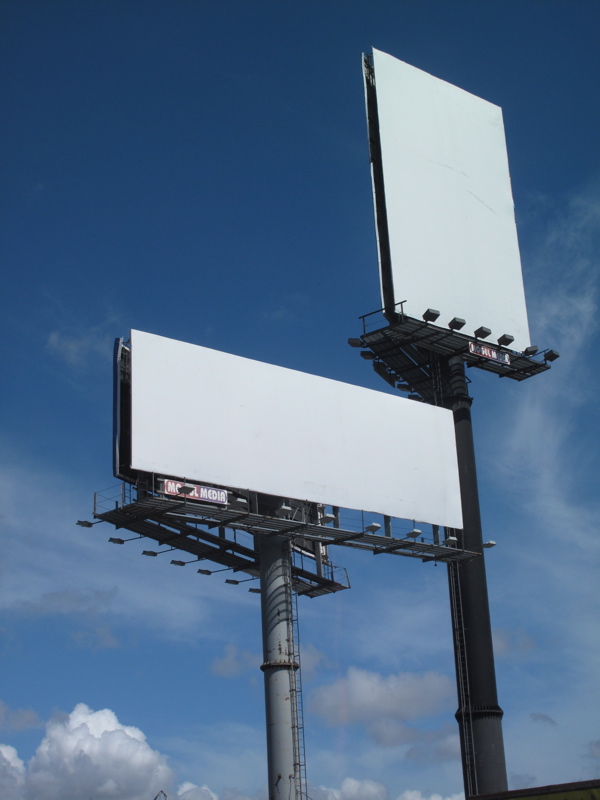
The empty billboards of Greece

Greece is the poster-child for economic collapse, so it should be no surprise that the country is full of empty billboards. On a recent trip we saw highways lined with them, post-apocalyptic and graying. Without a message, these are the most useless of structures, but they are ubiquitous in our built environment. These ghosts of capitalism force you to think about the fascinating relationship between advertising and consumerism, which is both symbiotic and parasitic. Advertising masks itself as a sharing of information. It asks the question: how helpful is it to society if an innovative product, perhaps even a life-saving one, remains unknown? Shouldn't we get the message out? Don't we have a duty to let the people know that ours is better than theirs?

But the billboard gives the lie to all of that. These enormous constructions are a blight on the landscape. Worse than an imposition, they are a criminal theft of visual real estate, jutting up into what would otherwise be a pristine azure sky, a beautiful Grecian view of blue. We are so numb to them and their messages that it takes rows and rows of completely empty ones to remind us how noxious they are.


Much more of my bloviating on the scourge of billboards and their usefulness as an indicator of economic decline is HERE.

4/21/2013

Call me anytime you like

Here at antarcticiana we consider one of our core missions to be the calling out of mendacious, cynical and counter-human corporate behavior. Whenever possible, we enjoy battling greed and incompetence with snark and vitriol. But we aren't hypocrites, and when presented instead with excellence we feel duty-bound to share the good news with our vast readership. Therefore, we are proud to present the first ever antarcticiana award for superlativity in the field of customer service. The winner is USAirways.

Last week, I had a quick one-day job down in Virginia Beach. To get all the way there and back, and fit in a day of filming, required a bleary, pre-dawn trip to LaGuardia Airport, a USAirways shuttle to DC, and a quick USAirways connection onward to Norfolk. Under normal circumstances, I look at those promotional charging stations that Samsung now has dotted throughout the world's airports and I think: that's a recipe for losing your phone. In Washington I was still dozing, however, and my phone's charge was diminished. With a whole day in the field in front of me I needed all the juice I could get. At the gate at Reagan I plugged in, and then sat just a few feet away, half-guarding my phone while reading Keith McCafferty's The Royal Wulff Murders, crime fiction set in the trout fishing paradise of riverine Montana.* A fellow crew-member appeared, the USAirways flight was called. Minor distractions. Guess what: Those Samsung charging stations are a recipe for losing your phone.

On board the Norfolk flight our kindly USAirways stewardess informed us that the USAirways airplane doors had been closed and that it was therefore time to turn off all electronic devices. I patted my pockets, but I already knew. I had a feeling of dread not unlike that induced by turbulence, although we were still on the ground. I stewed and seethed with self-loathing. Hadn't I said to myself, just as I was plugging in my immaculate Samsung Galaxy S-series smartphone: you're going to forget that.? Indeed I had, and indeed I did.

Once airborn I took advantage of the USAirways in-flight beverage service to explain my plight and ask for advice. The stewardess immediately asked for all the details. "I'll talk to the USAirways Captain, and we'll call it in," she said. "We should still be within radio range of Reagan."

"It's in a blue protective cover, and must most certainly still be plugged into the Samsung console just to the right of USAirways gate 35," I said, somewhat breathlessly. She handed me a USAirways napkin, on which I wrote down the salient details. Meanwhile, she went to fetch me a USAirways club soda. She returned, took the napkin, got on the cockpit telephone and described the emergency to the Captain. Minutes later, she came back to my seat again. "The Captain has spoken to our people in concourse "C," and they are sending someone from USAirways to look for your phone."

The DC to Norfolk flight is only some twenty minutes, and we were soon in the terminal. I borrowed the producer's phone and immediately called my own. It was answered, by a USAirways employee from baggage services. She had recuperated the phone and said it would be waiting for me at the baggage desk near the baggage claim on my way back through the airport that evening. Meanwhile, the pilot of the aircraft, overhearing my conversation, suggested that I call again before getting on my return flight, and said that baggage services would likely bring the telephone to my Washington departure gate. I was mightily impressed. Here I was, standing in the terminal, discussing my lost telephone with the archetypal Captain, a guy who had taken a pause from his busy day to discuss my problem. Silvery gray hair still cut in military fashion; gold bars on navy uniformed chest; that stentorian, reassuring voice I had heard over countless aircraft PA systems: "If worst comes to worst, call them up and they will Fedex it to you." USAirways.

Nonetheless, I fretted all the day long. The phone having been found was one thing, actually getting it back into my paws was another. I pictured the phone being tossed into a giant cardboard box full of other phones left behind at other Samsung charging stations by other morons. I carefully calculated the minutes we would have to transfer to our connection on the way home. Then, disaster. The Washington flight was delayed. The competent USAirways agent at the checkin quickly reticketed us, but through Philadelphia. A quick taxi-ride from LGA, and shortly before midnight I collapsed on the sofa at home, phoneless. By now, I was certain, the phone's battery would be dead, the post-it note someone might have stuck to it would have become unstuck, and it would soon join the vast graveyard of the expired and unclaimed.

The next morning, Fedex account number in hand, I searched through piles of old newspapers and dirty socks, looking for the landline. Reduced to using the speaker feature on the base station, I quickly reached a competent USAirways baggage services employee. On Friday morning my phone arrived, wrapped like fish in yesterday's DC tabloid. Thank you, USAirways!


*Fly-tieing murder mysteries apparently represent an entire sub-genre of crime writing. Who knew?

2/08/2012

Working up a thirst

Today's offerings at "Taylor Entertainment Spot," a hole-in-the-wall corner tavern / bodega in Congo Town, Monrovia

The proprietor wandered out of his closet-sized shop to learn why I was taking a picture of his wall, so I struck up a conversation. I know what "Man Power" is, as I had the misfortune to drink some of it in Ghana a few years back. What's "God Father?" I asked.

"It's this," he said, reaching into a plastic bin of empties. A petite bottle of this fine whiskey goes for 80 Liberian dollars. That's about $1.10.


2/07/2012

The Happy Cell Phone Times

Exuberant mobile telephone aficionados, in the Monrovia, Liberia airport.

Photo: David Smoler

11/01/2011

"Going Greenly into the Future," a screenplay

There was no response from the media relations office of "elegantly" Glenwood Properties in response to numerous emails inquiring why their recent marketing campaign prominently features what appears to be Merops pusillus, the little bee-eater, an insectiverous bird widespread across most of sub-Saharan Africa, but unknown from New York City or anywhere else in the Americas.


At the offices of Global Glut Realty Corp., Joe and Schmoe sit at a polished black granite conference table, wearing Brioni suits. Manhattan, viewed through the smoked glass floor-to-ceiling windows of a corporate high-rise, stretches out beneath them.

SCHMOE: They're nice apartments I have, Joe, all over the city. I don't understand why they're not renting.

JOE: You're out of date; you need to get with the whole ecological revolution. People want their place to be sustainable and stuff.

SCHMOE: What the hell is that supposed to mean?

JOE: You know, like, long lasting, and, uh...natural.

SCHMOE: WTF? You mean I have renovate? I just redid all these places. They're like minty fresh.

JOE: Nah, you don't have to do nothing. Just emphasize the environmental aspect in your New York Times adverts. Green, green, green. That's the word everyone is using. Make it green.

SCHMOE: C'mon, stop yankin' it. The apartments are painted white. Who the hell wants a green apartment?


JOE: Not green the color, you moron. Like, as in natural, you know whuttum saying? Like a spinach milkshake or some shit. Like, yoga. Put a tree in there, dickhead. I dunno, put a picture of a fountain, some bubbly water. Just make sure you call it green in big letters. Paint a picture of a tree, or a goddamn bird or something. You see how I'm helping you, here?


SCHMOE: A bird? What do I know from birds? You mean, like a parrot, or what?

JOE: No, you jerk. Like some wild natural creature, you know, that flies around in trees and stuff.

SCHMOE: How am I supposed to take a picture of a bird?

JOE: You really are thick today, Schmoe. Let me order us up a couple of frappuccinos, get that brain working. Look, it's not particle physics. Just go on the internet, and get a nice picture of a bird, and just kind of place it tastefully in your ad, there. You'll see; people will be signing leases in no time.

10/15/2011

Funkin' at the Hill Top Disco

 Snoop Dogg on the wall with Sierra Leone popstars Vida, the late Amara Kabba, and Daddy Saj.

The art of the painted sign is alive and well in Sierra Leone. I've long been a fan of African hand-made advertisements, and have bought more than one right off the facade of a business, to cart across the Atlantic and install on the living room wall. If that sounds to you like a colonialist, exploitative relationship to art-making then you have put your finger on the discomfort sometimes felt when admiring the humble, naive masterpieces that Africans from Mali to Mozambique hang in front of their shops. In my defense I can only describe the smiles of surprise and astonishment on the face of the shopkeeper when offered actual cash money for an ancient and often tattered rectangle of painted plywood.

 Snoop, detail, at the Hilltop Nightclub and Guesthouse, Calabatown, Sierra Leone

The tradition, born out of necessity on a continent where creativity is more abundant than capital, is in some countries under threat. On my last trip to Rwanda digitally printed vinyl signs were everywhere. So far, these suffer from Photoshopitis, and tend to feature sandstorms, flames, lightning bolts, sunsets and masses of billowing clouds, all downloaded at low resolution from google images. The results are pale and tawdry, homogenous in their lack of personality. At home, underemployed, the former sign-painter sits on his hands and stares at the dirt, his paints crusting in the can.

The making of a sign for a tiny roadside business is an economic calculus. The beginnings of a haircutting business, called in Kenya a "saloon" and in Sierra Leone a "barbing shop," might be as modest as a single pair of scissors and a plastic stool set up under a shade-tree. The advertising budget is limited. If the vinyl sign is rising in popularity this is only because it is winning a price-war with the sign-painter.


 The Hilltop is a legendary name in the history of rap music. This was the name of a Bronx after-hours club of the 1970s where some of the first raps were said to have been rapped, and some of the first deejay battles battled. I suspect the Hilltop of Calabatown, Sierra Leone owes nothing to this legacy. This fine establishment is simply at the top of a hill, on a red dirt road, in a semi-rural setting. But they are clearly ready to turn the party out. Just to step inside the place is to understand that it would be inconvenient to live next door.

Donflan would like to go on record as offering our services to return and do a gig here. The club is a series of well-protected cinder-block walled enclosures (African nightlife is primarily enjoyed out-of-doors), much of their many surfaces covered with spectacular murals illustrating the fantasies of disco-going: abundant, curvaceous women, tropical diversion, musical superstardom. No partying colonialist with a fat wallet will carry these off; they are painted directly onto the block walls. We were there during the day, to shoot an interview. The place made me want to put on my dancing shoes, and go back at night.


"What happens at the Hilltop, stays on the hilltop."


3/26/2011

I've always wanted to know the Secrets of Women

Perhaps they would let me enroll.


Spotted on the Rue Capois, Port au Prince, this wall painted with an advertisement for a gender-specific technical school, presumably on the premises. "The Professional Center for Women's Secrets announces its regular classes," including cooking, baking, haircutting and styling, cake decoration and cosmetology.

8/31/2010

Barometer of Middle Age


There was a time when I thought nothing could be more footling than a vanity license plate. And by footling, I mean a perverse combination of frivolous, wasteful and moronic. Why on earth would someone squander their hard-earned cash on a license plate celebrating the name of their dog, or attempt to pack a maximum of self-aggrandizement into eight characters? What sort of freak of nature would buy a Mercedes and then get a plate that says "Benzie"? During my brief stint working at the Water Club restaurant as a temporary automotive storage specialist, I considered personalized license plates to be a waving red flag of slobbery and cultural poverty, an announcement of the complete classlessness of an incoming car's occupants. But that was years ago.


I'm not sure when it happened, but these days I've completely reversed my position. Nothing is or could possibly be cooler than my vanities. Perhaps it's the new but retro "Empire Gold" New York State plate theme. As soon as I saw this design on the road I started looking forward to whenever it is that I will next have to renew my registration. From there it was only a short leap to going ahead and just ordering new plates immediately....

7/13/2010

Economic Recovery Barometer, Bronx and Queens billboard edition

A couple of days ago the NYT ran a breathless story to let us all know that even if times are tough, at least Wall Street is hiring, "in anticipation of an economic recovery." One of the ideas it promotes is that we New Yorkers should all feel good about this, because of the potential trickle-down effects on the local economy. A closer read, with some peering between the lines, suggests that Wall Street is hiring largely because the banks that are too large to fail turned the economic bailout into yet another gigantic cash-sweeping opportunity, and they are so flush with lucre that they need a few extra bodies to help them squeeze the lemon dry.

Here at antarcticiana we have our own notions about how, when and why to call an economic upswing, including the scintillating theory that our nation's economic health can be judged by the billboard rental rate. On a recent drive up to the Berkshires, for what could be termed either a delightful long weekend or just another routine four-day-long stretch of underemployment, the number of blank billboards lining the highways of Queens and, further north, the Bronx, continued to impress. These images may not have the crisp composition of our earlier Gowanus series, but I think they are none the less poignant for having been snapped from a moving car in classic BQE stop-and-go traffic. To us, this spells ongoing slowdown.


One emerging trend is that with such broad expanses of unsold canvas left dangling for so long in prime eye-catching territory, graffiti and street artists are beginning to seize control of the visible landscape.


6/09/2010

The Billboards of Gowanus in the World Media

In case you missed my post a few weeks ago on what the blank billboards of Gowanus have to tell us about economic recovery and our consumer culture, I'm pleased to report that the insightful folks at a major German media outlet took notice and licensed it, lock, stock and barrel. A translated version appears in the Suddeutsche Zeitung today, including extra, never-before-published photographs. It is always gratifying to have one's paranoid musings and anti-capitalist fever dreams elevated to the stature of real news!

6/05/2010

Shrimps, Rice, Haiti and the neo-liberal plan UPDATED

Cooking shrimps with the heads removed is like eating pitted olives. It might be more convenient, and less disturbing, but the tradeoff is a definite loss of flavor. But perhaps to save their customers from having to encounter the bulging eyestalks and delicate tentacles of the head-on shrimp, the Red Hook Fairway doesn't sell them. Suffering from a craving for another of Donald Link's superlative dishes, a spicy, minty Vietnamese take on the Cajun shrimp boil, I was obliged to head down to the Brooklyn Chinatown, which lines 8th Avenue from about 45th to 60th streets. The Hong Kong supermarket on 61st street is even better stocked than the one on Allen and East Broadway in Manhattan, and has all sorts of things that are sometimes difficult to come by, like fresh pork bellies, dressed rabbits and large, meaty shrimps with heads. Near the door and the registers are stacked innumerable brands and styles of rice in hefty twenty-five pound sacks.


As I was paying for my shrimps I spotted something odd, a pile of gleaming white bags adorned with the Haitian flag. The news from the Haitian rice growing industry is not good, so this was a bit confusing. Until at least the late 1980s, Haiti was self-sufficient in rice production, but in recent years the sector has collapsed, thanks largely to the free trade strategies pushed by the United States as part of the neo-liberal plan. United States rice, produced with the help of a variety of agricultural subsidy schemes, began to appear on the Haitian market, undercutting Haiti's unsubsidized domestic rice growers. Haitian farmers, unable to compete on price, stopped growing and producing. The industry collapsed and withered. Recently, in the wake of the earthquake, Bill Clinton admitted that US policy on rice had been devastating and wrong, although he failed to extend his logic to a broader critique of neo-liberalism. "I have to live every day with the consequences of the lost capacity to produce a rice crop in Haiti to feed those people, because of what I did," he said. It is perhaps only a painful coincidence that Bill's home state of Arkansas is a center of US rice production; our country has been pursuing comparable strategies in the production and export of a broad variety of staple foods for the last thirty years. Under the circumstances I thought it highly unlikely that an enormous Chinese supermarket in Sunset Park, already overflowing with bags of rice from Thailand, Vietnam and Japan, would find the floor space for so elusive a specialty, so rare a commodity, as Haitian rice. Is there any Haitian rice still produced at all, and is any of it exported? I wondered.


The Haitian flag, the colorful red and blue motif of the bag, and a vaguely Asiatic almond-eyed version of Aunt Jemima all proved only to be part of a branding strategy. The rice was clearly marked as having been produced in Thailand, and was being sold as "Haitian Princess" brand Hom Mali Jasmine, my favorite variety. But the thai origin of this rice leads only to more questions. It is a strange choice, isn't it, to name your rice after a basket-case of a country, a small, impoverished Caribbean island nation? In Africa these days, small boutiques looking for cachet often calls themselves "Dubai Fashions," or "USA cellphone," associating themselves with the allure of those faraway Shangri-Las, but Haiti doesn't have such resonances of luxury and dominance. In fact, to make a possibly racist observation, it seems to me likely that few customers at the 61st street Hong Kong Supermarket would take away any particularly strong association from this bizarre packaging.

So what it is all about? The only hypotheses I can come up with are that this thai rice was packaged for sale within the borders of Haiti, or to spark the interest of aid organizations shopping for earthquake relief supplies. Perhaps a Bangkok rice executive read Clinton's remarks and saw an opening in the market. Somewhere along the distribution chain it was diverted. Maybe a container fell off a ship in the Red Hook container port, and so this rice ended up in Brooklyn. I couldn't resist buying a bag. I haven't cooked any yet, but I'll report later on its quality.


UPDATE: There is no question that semiotics is a theoretical discipline, not an exact science, and a recent trip to an ethnic grocery in Somerville, Mass., has me wondering whether there isn't something more to the Thai-rice-with-shameless-Haitian-branding story than I have yet uncovered. In the first place, this small purveyor of Asian and Caribbean necessities was also a stockist of "Haitian Princess" brand rice, meaning the stuff did not just get diverted from an aid ship to one random Asian supermarket in Brooklyn. But that's not all, they also had, right next to the Basmati, this:


Who the hell is the cockeyed Madame Gougousse, with her Picasso cubist-period nose, half pointed and half rounded, and her racially ambiguous slash mouth, twised grin and half-shaded face? Frankly, she looks like a satanic version of the Haitian Princess. Note also that the "Five Star Quality" legend written at the top in French, as well as the five stars themselves, are, font and size-wise, identical on the two bags. Only the colors are reversed, as they are in the polka-dotted Aunt Jemima do-rags both women are sporting. It turns out that Madame Gougousse doesn't only adorn rice, she's the mascot for an entire line of tropical products, and she even has her own facebook page.


I'm a firm believer that the simple and obvious solution will very frequently turn out to be the correct solution, but this is all getting so terribly complex that I'm having trouble imagining what that solution could possibly be. And as if Madame Gougousse wasn't enough, there's this:


Currently out of stock at this nameless Somerville grocery, but represented by an empty bag hanging above stacks of other brands, is Madame Roland's White Fragrant rice. Madame Roland has a pair of (partial) Haitian flags crossed above her head, on which she is thankfully not wearing a handkerchief, and seems quite clearly to be of African extraction.

I find it difficult to imagine that there are multiple competing Thai rice companies all vying for the Haitian food-relief market with these many variations on a theme. Evolution, in graphic design as in species, takes time, and I'm left wondering whether there isn't some much more ancient trade relationship about which I am so far ignorant. Perhaps, despite her objectively more demented graphics, Madame Gougousse is well-established, and the Haitian Princess, along with Madame Roland, is trying to ride on her coattails? Or was the now unavailable Haitian rice once so desirable that the Thais, who grow an excellent product themselves, tried to muscle in on the Haitian's export market, perhaps in francophone West Africa? Anyone who can illuminate us, please chime in.