Originally the diary of 4 months spent in Antarctica working as a documentary film sound recordist, this blog has evolved into an online repository for the thoughts, travels and trivia of the writer Richard Fleming. For McMurdo Station, Antarctica, and polar exploration, see August through December of '06. Currently you are likely to find in these pages chronicles of my actual and literary meanderings, as well as notes on my many other passions. Also, did I mention I wrote a book?
6/25/2010
A nautical fundraiser
Our dear friends over at Portside NY, who are preserving and restoring that crusty old tanker, the Mary Whalen, are holding a fundraiser. Barbecue is involved, as well as sunset in NY harbor and much more. I've written before about the delights of life on the decks of the Whalen, and I highly recommend you attend! Brooklynbased has all the info, Here.
And for the last week before this July 3rd event, tickets are discounted to a measly $35!
6/18/2010
My Brother, the Doctor
Yesterday I took time off from my rigorous and demanding schedule of watching three World Cup games per day and drove down to Philadelphia to attend my brother Luke's dissertation defense. Luke had asked me to lend whatever moral support I might have to spare. I was expecting a kind of academic version of a football match, with a coterie of mudslinging professors going forehead-to-forehead with my poor brother, kicking him in the shins and exploiting every opening and weakness in his argument as they rampaged through the hallowed halls of the University of Pennsylvania. While speeding down the New Jersey turnpike, listening to Argentina pummel South Korea on the world's best portable radio,
I imagined myself as a sort of boxing trainer who would crouch in Luke's corner with a towel, ready to mop up the inevitable tears, blood and vomit that would soon be splashing onto the floors of the Department of Anthropology.
In fact, and almost to my disappointment, the event proved to be far more affirmative than combative. I've forgotten the long and challenging title of Luke's doctoral thesis, although I know that it is about linguistic exogamy in the tribes of the upper Rio Negro of the Brazilian Amazon. If you don't know what linguistic exogamy is, don't feel bad; I only know because Luke told me, a few times. It's the practice of only marrying people from a tribe who speak a different language than your own. Much of the terminology in Luke's presentation was so far beyond me that if I so chose I could practice linguistic exogamy myself, simply by marrying a linguistic anthropologist, that remote is their idiom from our own. Words and concepts like "performativity," "virtual metapragmatics," "patrilects," "proleptic," and "signaling indigeneity" flew through the air like hard-hit soccer balls. (By the way, it isn't just me that's clueless, Blogger, on which I'm writing this, thinks all of those words, except for "virtual" and "signaling," are misspelled, meaning they aren't in Google's dictionary either!). Soon I was using the towel I had brought to mop my own sweaty, confused, brow.
But if I had trouble following, not so the committee of professors also in attendance. Professor Greg Urban, making introductory remarks before Luke began to speak, said that the dissertation in question "reshapes our understanding of what is going on in South America in major ways." GOOOOOOOOOAAAAAAL! The Graduate Group Chair, Professor Deborah Thomas, then announced that Luke would have approximately half an hour to discuss his work. Twenty-nine and a half crisp minutes later, he concluded a presentation packed with almost mathematically precise powerpoint slides.
It was at this point I thought the bloodletting would finally begin, and I awaited the first of what I expected would be dozens of excruciating and unanswerable questions, flying flat and fast like an endless series of penalty kicks, with Luke as the hapless goalie. Here, too, I was sorely disappointed; the few questions asked were more like suggestions, softballs intended to promote minor changes in the text that might help catapult this already epic, if specialized, work to new heights of popularity. The subtext seemed to be that after a few slight adjustments, a bestseller, at least in the peculiar language of linguistic anthropology, was not only within reach, but virtually assured. Deborah Thomas then unceremoniously kicked us all out of the room so that the quartet of professors could discuss Luke's fate (apparently, in this sort of trial, the jury stays in, while everyone else leaves). We stood in the hall chewing our knuckles fearfully, while assuring Luke that he had done an excellent job. But these agonizing moments were short; the jury did not deliberate for more than a handful of minutes before we were called back into the salon. "The verdict is, you did a fantastic job," announced Professor Thomas.
OTRO GOOOOOOOOOOAAAAAAAAAL!!!!!!!!!!!!!!!!!!!!!!!!! GOOOOOOOOOOOOOOOLAAAAZOOOOOOOOOO!!!!!!!!!!!
He's the smart one, on the left.
...
In fact, and almost to my disappointment, the event proved to be far more affirmative than combative. I've forgotten the long and challenging title of Luke's doctoral thesis, although I know that it is about linguistic exogamy in the tribes of the upper Rio Negro of the Brazilian Amazon. If you don't know what linguistic exogamy is, don't feel bad; I only know because Luke told me, a few times. It's the practice of only marrying people from a tribe who speak a different language than your own. Much of the terminology in Luke's presentation was so far beyond me that if I so chose I could practice linguistic exogamy myself, simply by marrying a linguistic anthropologist, that remote is their idiom from our own. Words and concepts like "performativity," "virtual metapragmatics," "patrilects," "proleptic," and "signaling indigeneity" flew through the air like hard-hit soccer balls. (By the way, it isn't just me that's clueless, Blogger, on which I'm writing this, thinks all of those words, except for "virtual" and "signaling," are misspelled, meaning they aren't in Google's dictionary either!). Soon I was using the towel I had brought to mop my own sweaty, confused, brow.
But if I had trouble following, not so the committee of professors also in attendance. Professor Greg Urban, making introductory remarks before Luke began to speak, said that the dissertation in question "reshapes our understanding of what is going on in South America in major ways." GOOOOOOOOOAAAAAAL! The Graduate Group Chair, Professor Deborah Thomas, then announced that Luke would have approximately half an hour to discuss his work. Twenty-nine and a half crisp minutes later, he concluded a presentation packed with almost mathematically precise powerpoint slides.
It was at this point I thought the bloodletting would finally begin, and I awaited the first of what I expected would be dozens of excruciating and unanswerable questions, flying flat and fast like an endless series of penalty kicks, with Luke as the hapless goalie. Here, too, I was sorely disappointed; the few questions asked were more like suggestions, softballs intended to promote minor changes in the text that might help catapult this already epic, if specialized, work to new heights of popularity. The subtext seemed to be that after a few slight adjustments, a bestseller, at least in the peculiar language of linguistic anthropology, was not only within reach, but virtually assured. Deborah Thomas then unceremoniously kicked us all out of the room so that the quartet of professors could discuss Luke's fate (apparently, in this sort of trial, the jury stays in, while everyone else leaves). We stood in the hall chewing our knuckles fearfully, while assuring Luke that he had done an excellent job. But these agonizing moments were short; the jury did not deliberate for more than a handful of minutes before we were called back into the salon. "The verdict is, you did a fantastic job," announced Professor Thomas.
OTRO GOOOOOOOOOOAAAAAAAAAL!!!!!!!!!!!!!!!!!!!!!!!!! GOOOOOOOOOOOOOOOLAAAAZOOOOOOOOOO!!!!!!!!!!!
He's the smart one, on the left....
6/16/2010
In case you need a vuvuzela fix between games...
First, what ought to be called permazela, the all-vuvuzela, all-the-time radio station, with zero commercial interruptions. "All killer, and no filler."
Next, tune up your instruments for the concerto, via daniel maier's posterous:
These days, of course, you can always count on Hitler to get a word or two in on the subject.
Last and likely least, life wouldn't be complete without a vuvuzela iphone app. I would have called this "iVuzela," but to be fair, "iVuvuzela" is more annoying, and perhaps that's in keeping.
BP Global's PR machine
There's nothing funny about the ongoing gulf oil hemorrhage, but there's a lot funny about this bogus "BP Global" public relations twitter feed. It's the best thing of its kind since Fake Steve Jobs.
6/15/2010
Comes complete with Vuvuzelas
England versus USA via The Guardian
Germany versus Australia via the Bild-zeitung
6/10/2010
Some specific cases of the Shirky Principle at work UPDATED
A couple of months ago Kevin Kelly identified what he called the Shirky principle, namely that "institutions will try to preserve the problem to which they are the solution." (This is not the only simple, brilliant aphorism by philosopher of the internet, Clay Shirky; if you are unfamiliar with his work I recommend you read Here Comes Everybody,
which is packed with pithy and compelling ideas about ways in which the internet is transformative.)
The notion resonated with me because it explains in one short sentence the systemic failure of international aid organizations, who win battles, but never wars. Those working in hunger relief, for instance, are paradoxically attempting both to feed people and to eliminate their own jobs; the ultimate goal is for 'hunger-reliever' to disappear entirely as a job category. This is not a sustainable model, so despite the best intentions of countless sincere individuals, whose heartfelt desire to help others I in no way wish to impugn, it is easy to understand that the inevitable institutional tendency is to self-preservation. Hunger, therefore, must exist, and even be promoted.
The Shirky principle also helps explain military dictatorships and some of the reasons armies declare war on their own populations, as in Guatemala in the 1980s. Counterinsurgency campaigns often result in a radical mobilization of people willing to join the insurgents, particularly when the military overreaches, treating the civilian population as a target indistinguishable from the guerilla. Cuba in the late 1950s is a perfect example. Such mobilizations are usually presented as an unfortunate side-effect of inevitable "collateral damage," but viewed through Shirky's lens, we understand that such an expansion of an insurgency is a logical, and even desirable outcome for the military; suddenly, more resources are diverted to an institution, the army, in order to combat a problem, a growing revolutionary movement. But in the event that the problem is solved, those additional resources will dwindle, so the army has every interest in promoting and sustaining the insurgency, even to the point of pretending that it still exists, even if it has been weakened, eradicated or dissolved.
An article in the NYT a couple of days ago describing some of the pitfalls of hiring private security forces to protect NATO supply convoys in Afghanistan, is another prime example of the Shirky principle at work. The same day that two large Afghan security companies were banned from working "after a pair of bloody confrontations with Afghan civilians," a supply convoy was attacked. Soon thereafter those security contracts were restored. The suspicion is that the companies colluded with the Taliban to promote the attack, justifying the urgency of their continued employment, despite any human rights shortcomings. There are further suspicions of entirely phony attacks, staged just in case NATO were to start to imagine that things are secure enough for them to move material on their own. Given the lack of transparency that accompanies the widespread outsourcing of military functions to private companies, both Afghan and American, the Shirky principle also sheds light on why the Afghan war is now the longest war in United States history.
UPDATE: I'm tremendously interested in coincidence, particularly in that phenomenon, with which we are all familiar, when a subject, once broached, suddenly seems to crop up repeatedly in a variety of contexts, as if the topic has become a spirit in the air around us. Only hours after I had posted this, reading Raffi Khatchadourian's June 7 New Yorker profile of Julian Assange, the founder of Wikileaks, I came upon this passage: "[Assange] had come to understand the defining human struggle not as left versus right, or faith verson reason, but as individual versus institution. As a student of Kafka, Koestler and Solzhenitsyn, he believed that truth, creativity, love and compassion are corrupted by institutional hierarchies...." (My emphases. Coincidentally, or perhaps not, one of Koestler's many works is The Roots of Coincidence.
)
The notion resonated with me because it explains in one short sentence the systemic failure of international aid organizations, who win battles, but never wars. Those working in hunger relief, for instance, are paradoxically attempting both to feed people and to eliminate their own jobs; the ultimate goal is for 'hunger-reliever' to disappear entirely as a job category. This is not a sustainable model, so despite the best intentions of countless sincere individuals, whose heartfelt desire to help others I in no way wish to impugn, it is easy to understand that the inevitable institutional tendency is to self-preservation. Hunger, therefore, must exist, and even be promoted.
The Shirky principle also helps explain military dictatorships and some of the reasons armies declare war on their own populations, as in Guatemala in the 1980s. Counterinsurgency campaigns often result in a radical mobilization of people willing to join the insurgents, particularly when the military overreaches, treating the civilian population as a target indistinguishable from the guerilla. Cuba in the late 1950s is a perfect example. Such mobilizations are usually presented as an unfortunate side-effect of inevitable "collateral damage," but viewed through Shirky's lens, we understand that such an expansion of an insurgency is a logical, and even desirable outcome for the military; suddenly, more resources are diverted to an institution, the army, in order to combat a problem, a growing revolutionary movement. But in the event that the problem is solved, those additional resources will dwindle, so the army has every interest in promoting and sustaining the insurgency, even to the point of pretending that it still exists, even if it has been weakened, eradicated or dissolved.
An article in the NYT a couple of days ago describing some of the pitfalls of hiring private security forces to protect NATO supply convoys in Afghanistan, is another prime example of the Shirky principle at work. The same day that two large Afghan security companies were banned from working "after a pair of bloody confrontations with Afghan civilians," a supply convoy was attacked. Soon thereafter those security contracts were restored. The suspicion is that the companies colluded with the Taliban to promote the attack, justifying the urgency of their continued employment, despite any human rights shortcomings. There are further suspicions of entirely phony attacks, staged just in case NATO were to start to imagine that things are secure enough for them to move material on their own. Given the lack of transparency that accompanies the widespread outsourcing of military functions to private companies, both Afghan and American, the Shirky principle also sheds light on why the Afghan war is now the longest war in United States history.
UPDATE: I'm tremendously interested in coincidence, particularly in that phenomenon, with which we are all familiar, when a subject, once broached, suddenly seems to crop up repeatedly in a variety of contexts, as if the topic has become a spirit in the air around us. Only hours after I had posted this, reading Raffi Khatchadourian's June 7 New Yorker profile of Julian Assange, the founder of Wikileaks, I came upon this passage: "[Assange] had come to understand the defining human struggle not as left versus right, or faith verson reason, but as individual versus institution. As a student of Kafka, Koestler and Solzhenitsyn, he believed that truth, creativity, love and compassion are corrupted by institutional hierarchies...." (My emphases. Coincidentally, or perhaps not, one of Koestler's many works is The Roots of Coincidence.
6/09/2010
The Billboards of Gowanus in the World Media
In case you missed my post a few weeks ago on what the blank billboards of Gowanus have to tell us about economic recovery and our consumer culture, I'm pleased to report that the insightful folks at a major German media outlet took notice and licensed it, lock, stock and barrel. A translated version appears in the Suddeutsche Zeitung today, including extra, never-before-published photographs. It is always gratifying to have one's paranoid musings and anti-capitalist fever dreams elevated to the stature of real news!
6/05/2010
Shrimps, Rice, Haiti and the neo-liberal plan UPDATED
Cooking shrimps with the heads removed is like eating pitted olives. It might be more convenient, and less disturbing, but the tradeoff is a definite loss of flavor. But perhaps to save their customers from having to encounter the bulging eyestalks and delicate tentacles of the head-on shrimp, the Red Hook Fairway doesn't sell them. Suffering from a craving for another of Donald Link's superlative dishes, a spicy, minty Vietnamese take on the Cajun shrimp boil, I was obliged to head down to the Brooklyn Chinatown, which lines 8th Avenue from about 45th to 60th streets. The Hong Kong supermarket on 61st street is even better stocked than the one on Allen and East Broadway in Manhattan, and has all sorts of things that are sometimes difficult to come by, like fresh pork bellies, dressed rabbits and large, meaty shrimps with heads. Near the door and the registers are stacked innumerable brands and styles of rice in hefty twenty-five pound sacks.
As I was paying for my shrimps I spotted something odd, a pile of gleaming white bags adorned with the Haitian flag. The news from the Haitian rice growing industry is not good, so this was a bit confusing. Until at least the late 1980s, Haiti was self-sufficient in rice production, but in recent years the sector has collapsed, thanks largely to the free trade strategies pushed by the United States as part of the neo-liberal plan. United States rice, produced with the help of a variety of agricultural subsidy schemes, began to appear on the Haitian market, undercutting Haiti's unsubsidized domestic rice growers. Haitian farmers, unable to compete on price, stopped growing and producing. The industry collapsed and withered. Recently, in the wake of the earthquake, Bill Clinton admitted that US policy on rice had been devastating and wrong, although he failed to extend his logic to a broader critique of neo-liberalism. "I have to live every day with the consequences of the lost capacity to produce a rice crop in Haiti to feed those people, because of what I did," he said. It is perhaps only a painful coincidence that Bill's home state of Arkansas is a center of US rice production; our country has been pursuing comparable strategies in the production and export of a broad variety of staple foods for the last thirty years. Under the circumstances I thought it highly unlikely that an enormous Chinese supermarket in Sunset Park, already overflowing with bags of rice from Thailand, Vietnam and Japan, would find the floor space for so elusive a specialty, so rare a commodity, as Haitian rice. Is there any Haitian rice still produced at all, and is any of it exported? I wondered.
The Haitian flag, the colorful red and blue motif of the bag, and a vaguely Asiatic almond-eyed version of Aunt Jemima all proved only to be part of a branding strategy. The rice was clearly marked as having been produced in Thailand, and was being sold as "Haitian Princess" brand Hom Mali Jasmine, my favorite variety. But the thai origin of this rice leads only to more questions. It is a strange choice, isn't it, to name your rice after a basket-case of a country, a small, impoverished Caribbean island nation? In Africa these days, small boutiques looking for cachet often calls themselves "Dubai Fashions," or "USA cellphone," associating themselves with the allure of those faraway Shangri-Las, but Haiti doesn't have such resonances of luxury and dominance. In fact, to make a possibly racist observation, it seems to me likely that few customers at the 61st street Hong Kong Supermarket would take away any particularly strong association from this bizarre packaging.
So what it is all about? The only hypotheses I can come up with are that this thai rice was packaged for sale within the borders of Haiti, or to spark the interest of aid organizations shopping for earthquake relief supplies. Perhaps a Bangkok rice executive read Clinton's remarks and saw an opening in the market. Somewhere along the distribution chain it was diverted. Maybe a container fell off a ship in the Red Hook container port, and so this rice ended up in Brooklyn. I couldn't resist buying a bag. I haven't cooked any yet, but I'll report later on its quality.
UPDATE: There is no question that semiotics is a theoretical discipline, not an exact science, and a recent trip to an ethnic grocery in Somerville, Mass., has me wondering whether there isn't something more to the Thai-rice-with-shameless-Haitian-branding story than I have yet uncovered. In the first place, this small purveyor of Asian and Caribbean necessities was also a stockist of "Haitian Princess" brand rice, meaning the stuff did not just get diverted from an aid ship to one random Asian supermarket in Brooklyn. But that's not all, they also had, right next to the Basmati, this:
Who the hell is the cockeyed Madame Gougousse, with her Picasso cubist-period nose, half pointed and half rounded, and her racially ambiguous slash mouth, twised grin and half-shaded face? Frankly, she looks like a satanic version of the Haitian Princess. Note also that the "Five Star Quality" legend written at the top in French, as well as the five stars themselves, are, font and size-wise, identical on the two bags. Only the colors are reversed, as they are in the polka-dotted Aunt Jemima do-rags both women are sporting. It turns out that Madame Gougousse doesn't only adorn rice, she's the mascot for an entire line of tropical products, and she even has her own facebook page.
I'm a firm believer that the simple and obvious solution will very frequently turn out to be the correct solution, but this is all getting so terribly complex that I'm having trouble imagining what that solution could possibly be. And as if Madame Gougousse wasn't enough, there's this:
Currently out of stock at this nameless Somerville grocery, but represented by an empty bag hanging above stacks of other brands, is Madame Roland's White Fragrant rice. Madame Roland has a pair of (partial) Haitian flags crossed above her head, on which she is thankfully not wearing a handkerchief, and seems quite clearly to be of African extraction.
I find it difficult to imagine that there are multiple competing Thai rice companies all vying for the Haitian food-relief market with these many variations on a theme. Evolution, in graphic design as in species, takes time, and I'm left wondering whether there isn't some much more ancient trade relationship about which I am so far ignorant. Perhaps, despite her objectively more demented graphics, Madame Gougousse is well-established, and the Haitian Princess, along with Madame Roland, is trying to ride on her coattails? Or was the now unavailable Haitian rice once so desirable that the Thais, who grow an excellent product themselves, tried to muscle in on the Haitian's export market, perhaps in francophone West Africa? Anyone who can illuminate us, please chime in.
5/30/2010
Photography, alcohol, college, facebook, and privacy
Somewhere, on the campus of a high-caliber north-eastern liberal arts college that will remain nameless, lurks a budding Martin Parr. Parr is the extraordinarily talented British photographer best known for moments seized in the street. He takes colorful, revelatory frames that skewer the gentility and decorum of his subjects, peeling back the veneer of contemporary civilization to expose, when he is at his most cruel, a kind of lowest-common-denominator of humanity. In the context of elite American institutions of higher learning, to judge by the photographs on this page, that lowest common denominator is the use and abuse of alcohol. But these images are not by Parr; I idly came across them, in a facebook photo album. To be fair to Martin, these are not quite up to his standard, but the photographer is, after all, only a college student.
The pictures, by a photographer or photographers who shall also remain nameless, raise a few intriguing, and perhaps even disturbing questions: How crucial is context to the interpretation of a photograph? If the intention of the photographer is not, like Martin Parr, to capture the defining moment, but rather simply to document one's friends enjoying themselves, does that diminish the artistic worth of the image? Is it possible that the spring-time ambiance of life on today's college campus is so beer-soaked that it is difficult not to obtain Martin Parr-like results whenever one snaps the shutter? And, do I have too much free time? What am I doing on facebook, paging through pictures of people I don't know, at some distant bacchanal?
"I hear Goldman is hiring."
There is a debate raging around facebook, centered on the question of privacy. It is essentially the result of facebook's ham-handed efforts to "monetize" their "product." The facebook "service" or "social-networking site" currently has something like 400 million "subscribers," "members," "clients," "participants," or whatever it is that we are, none of whom pay even one thin dime to share their thoughts, aphorisms, photographs and affiliations with their self-selected group of "friends." Mark Zuckerberg and the other inventor-creator controllers of facebook believe that having 400 million users ought to translate into untold riches, but while everyone understands that this gigantic number somehow represents power and potential marketing muscle, there is no obvious "revenue stream" gushing out of the website. Facebook collects vast amounts of data, and it seems increasingly to be looking for ways to sell that data along to whomever might find it useful. Recently, they made unilateral adjustments to the visibility of their users, making more data publicly accessible. Although these changes can be reversed after navigating and tweaking facebook's opaque and byzantine privacy settings, Zuckerberg and Co. rightly believe that most users either won't manage or won't bother. Savvy users are outraged. Facebook says "if you don't want to share, don't share," and their service is, after all, optional and free. But I have been using the optional and free web-based email services of Yahoo and Google exclusively for more than a decade, and while I understand that email is intrinsically insecure, I presume a certain level of privacy in my communications.
These photographs illustrate some of the issues of the facebook privacy debate, in that I stole them from the page of someone I don't know, not even a facebook friend, but the friend of a friend. This friend had been "tagged" in a picture in this series, and therefore it appeared in my "news feed," and I clicked through to the complete album. Even my "friend," in the way of facebook, is more of a glancing acquaintance, a person from whom I am separated both by generations and zip codes of socio-economic status. We encountered one another in my work environment a few years ago, have not seen each other since, and quite probably will never meet again. Yet countless drunken pictures of this friend's "friends," the country's future investment bankers and civic leaders, are available for my perusal, download, and subsequent exploitation here.
My presumption is that the intent of these photographs is purely commemorative; they are interesting to non-participants in the scene they document only once stripped of identity, becoming in their ensemble a portrait, and even possibly a condemnation, of a collegiate culture of kegs and cans. Note also that the two images above, handed over to a skillful copy-writer and given a line or two of text in an alluring font, might make excellent alcohol advertisements, but that in the context of the rest of the pictures they take on a quite different meaning.
So, anonymous photographer, you leave me mulling over a few paradoxes. And I apologize. I've violated your copyright, but only to draw attention to how interesting your images are. Your compositions are stunning and your thematic unity impressive, but I'm concerned that it's all inadvertent. I'll not reveal your name, because I believe you need to rethink your facebook security settings.
5/24/2010
Kanaval, by Leah Gordon
Haiti has been firmly associated with grim news in the public imagination for so long that to announce that the country has a public relations problem is such an understatement as to seem almost beside the point. While most of the rest of the Caribbean survives, and some of it even thrives, on tourism, Haiti has been deprived of this lynchpin of the regional economy since the 1970s. Whatever fame its beaches and sophisticated franco-colonial nightlife might once have had has been long since eclipsed by a cyclical litany of political and environmental tragedies. Brutal dictatorships, coups d'etat, unrest, gang violence, organized crime, kidnapping, flooding, deforestation and now earthquake are all more likely associations conjured by the word "Haiti" than, for instance, the vision of sipping a perfectly mixed rum punch beneath a palm tree on a sunset beach.
But the country, like most places in the Americas deeply impacted by slavery, has a grand carnival tradition. Even if outside visitors have been few and far between for the last thirty years, Haiti's many calamities have done nothing to diminish local enthusiasm for an annual bacchanal on the order of New Orlean's Mardi gras, or the samba madness of Rio de Janeiro. There may be a silver lining to the neglect of kanaval by the outside world, in that, especially in the smaller regional celebrations of Jakmel, Haiti's artistic and cultural heart on the south coast, carnival has not been turned into a corporate spectacle of sponsored, motorized floats and grand orchestras. In Jakmel, carnival is a diffuse, multi-day pageant of impromptu street theater and neighborhood marching bands. Old carnival traditions, costumes, and characters are well-preserved there, and each year the same archetypal representations of local history and myth come out into the city and seize control of the streets. There just haven't been many visitors there, documenting.
My dear friend Leah Gordon, however, has been photographing Jakmel's carnival for more than fifteen years; I met her in Port-au-Prince on my first trip there, in 1993, and she had already begun taking the pictures that have now, finally, become a spectacular photo book, Kanaval: Vodou, Politics and Revolution on the Streets of Haiti, from the book publishing arm of Soul Jazz Recordings. I've been looking at Leah's images for years, wondering when some canny publisher was going to get it together to gather them together into a volume, and I can't recommend this work highly enough. I was particularly flattered to be asked to contribute an accompanying essay. The book is full of some of the most unique portraits I've ever come across, and you should immediately procure yourself a copy.
All images: Leah Gordon
5/17/2010
Your message here...
Who's gonna work, make the economy grow, if we all hang out in the street?
Well, I don't know, and I don't care, just as long as it ain't me!
Hangin' out with the street people, they got it down,
Hangin' out with the street people, just driftin' from town to town.
I wouldn't trade places with no one I know, I'm happy where I'm at...
Some people would rather work; we need people like that….
-- Bobby Charles
Nothing says "ongoing economic downturn" with quite the same forceful poignancy as a disused billboard. Gowanus is full of them, towering rectangles of dull gray tin spotted with the patchy remnants of abandoned advertising campaigns. At the moment the only message they are sharing with the motorists of the Brooklyn-Queens Expressway is one of empty failure. If there is a particular stage of global slump in which advertising is abandoned altogether, surely we have reached it.
Don't get me wrong, it's not that I wish these mute slabs were still decorated with glossy promotions for soft drinks and home improvement stores. I hate the damn things, and consider them an unconstitutional infringement on my right to enjoy unobstructed views and breezes, and to be free of unwanted visual clutter as I make my way along the roadways my tax dollars pay for. Billboards are nothing less than a form of pollution, and they should be banned nationwide, just as they are in Vermont. But in Brooklyn we have them, so for now I'll settle for finding them more evocative, meaningful, and even beautiful, in their messageless state. With their museum-quality enameled steel frames, these huge erased canvases make for a kind of vast outdoor art exhibition; in a different context the people with all the money might be drooling over them and writing fat checks.
But in light of the current economic crisis I think it is also useful to consider these empty billboards as metaphors for not spending. We live in a country where consumer spending makes up more than 70% of GDP. Our economy would be worse than completely stagnant if we were to stop consuming enormous amounts of stuff all the time. This is what prompted Rudy Giuliani's silly remark in the wake of 9/11 that city residents should "go shopping," to prove that not even terrorists can keep them from their comforting, habitual activities. It is also why real efforts at environmentalism are perennially marginalized and disparaged. "Green" living isn't about whether your coffee filters are made from recycled materials, it has to be about radical constraint on buying and using and replacing, and therefore, radical constriction of the economy. Rampant consumption is essential to the current economic model.
Consumer spending, except for the sliver of it that can truly be said to be spent on absolute necessities, is essentially marketing driven. Absolute necessities are what they call in Latin America the canasta basica, the "basic basket" of so many grains of rice and loaves of bread and tablespoons of oil required for minimal survival; I'm not talking about iPhones.
Except for the vast masses of the poor, people in general have lost sight of the once meaningful distinction between want and need. We have created a culture and an infrastructure in which what were once luxuries are now thought essentials. Given the chronic starving of public transportation in the United States, and the pattern of one hundred years of urban and suburban development, for instance, most now accept the personal automobile as a necessity. So, too, the cellphone. How absurd. Such things are pillars of our consumer society, but we prospered just fine without them. Worse, in order to justify ourselves and support this environmentally catastrophic model, we have very successfully exported (one of our last major exports) this aspirational, consumptive mode of life across the globe.
Advertising would have ceased to exist long ago if it were not effective. But because advertising is so loathsome, and because the creators of goods and services are naturally biased to believe that the market will recognize the superiority of their offerings without the intercession of anything so crass as promotion, many businesses ironically still look at it as a luxury, even as they use it to convey the idea that what they manufacture is a necessity. Given that consumer spending is in large part a creation of the advertising industry, the direct result of a marketing and media machine, what does a breakdown in the communication apparatus like the blighted billboards of Gowanus mean?
Is there a glimmer of hope reflecting off these dull gray surfaces?
Blank slate for a new way of thinking.
An advertisement for nothing. I'll have some of that, please.
5/12/2010
La Onda Verde
Few people in the United States seem to be as charged up about the Antanas Mockus presidential campaign as I am, although there was a Simon Romero story in the New York Times a few days ago. By and large I suspect that the major media here is going to stand on the sidelines scratching their heads until he is elected later this month, and then react in confusion and dismay. Mockus will again be described as "the formerly eccentric mayor of Bogotá," since once you are the president of a country, or even become a major candidate, you are apparently no longer eligible to be "eccentric," unless perhaps your country is in Africa. Mockus will be compared to Chavez and Evo Morales by journalists unable to conceive of a Latin American politics that defies the left versus right duality.
Few, in short, will get the story right. The story I hope people will write is about a green tidal wave of emboldened and motivated youth abandoning their generation's justifiably cynical view of electoral politics to rally their friends and families around a candidate offering change and vision, via a viral new media campaign beyond the understanding or control of the existing structures of power. If that sounds to you anything like the way Obama got into the White House, it isn't a coincidence; the reason I'm comfortable going out on a limb and predicting a Mockus victory is that, just as in that campaign, in Colombia the young graphic designers, facebookers, filmmakers, muralists and deejays have already chosen.
I believe none of the propaganda on this page to be the official creation of the Mockus campaign, although "Evolución" might be, but, like Shepherd Fairey's iconic high-contrast Obama poster (the only relevant and powerful work that artist has ever come up with, in my opinion, but at least he got one big one right), it doesn't matter, as it's all part of an unstoppable message that is spreading faster than bird flu in migration season.
"Old Green Sea Turtles with Antanas Mockus"
"Antanas Simpson"
"Join the Mockus Evolution"
I don't need pollsters to tell me whether Mockus is looking good; you want an unrefutable, unscientific sampling? Searching the "fan" pages (now apparently the "like" pages) for "Antanas Mockus" on facebook reveals 361 results, led by Mockus' official page, which is liked by 597,887 people. Juan Manuel Santos' page, on which the only viable rival candidate looks like an airbrushed Botox victim, is liked by a mere 135,669. Far more telling, however, is the nature of the subsequent unofficial facebook pages. The next four of the top five Santos groups are all actually anti-Santos pages, including "No to the politics of war, I'm NOT voting for Juan Manuel Santos" (with 38,642 likers), "Those of us who do not want Santos for president, WE ARE MORE!" (22,995), "We will not let Santos rise on the basis of FALSE polling" (9,143), and "This inert lump of coal can get more fans than Santos" (10,830). In contrast, I could find only one anti-Mockus page among the first fifty pages devoted to that candidate, on the second page of search results, with a mere 3,328 subscribers. The many, many pro-Mockus pages include "Creatives for Mockus," "People who want their parents to vote for Mockus," "I'm voting for Mockus, ask me why," and "Colombians living in Sweden for Antanas Mockus." See you on May 30th.
5/08/2010
Coming soon to a dentist's office near you...
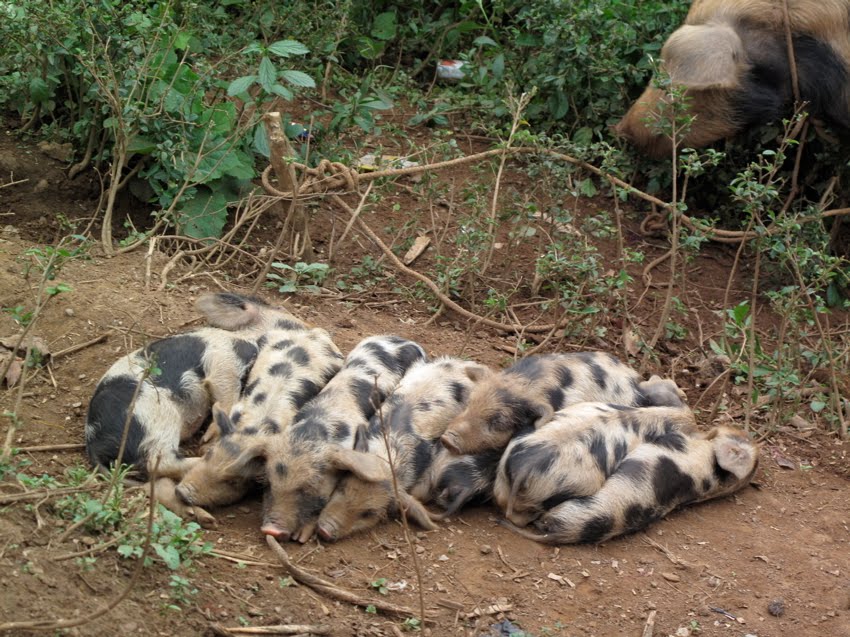
...SOW GLAD TO SEE YOU!
There is a genre of photography often referred to as "inspirational kitten poster." Found hanging on the walls of doctor's offices waiting rooms and second grade classrooms, such art features rays of sun piercing through mystical, cloudy skies, downy, goofy babies, or small, furry animals delightedly nuzzling at their mother's nipple, accompanied with a a textual platitude of staggering flatness, a saccharine biblical verse, or an excruciating pun. "Hang in there"
is a classic example, with its cuddly, nervous kitten dangling from a precarious twig.
I took these photographs in Ilum, in the Guatemalan highlands, a couple of weeks ago. The best caption submitted by a reader wins a smoky one pound slab of premium Polish bacon from Eagle Provisions.
There is a genre of photography often referred to as "inspirational kitten poster." Found hanging on the walls of doctor's offices waiting rooms and second grade classrooms, such art features rays of sun piercing through mystical, cloudy skies, downy, goofy babies, or small, furry animals delightedly nuzzling at their mother's nipple, accompanied with a a textual platitude of staggering flatness, a saccharine biblical verse, or an excruciating pun. "Hang in there"
I took these photographs in Ilum, in the Guatemalan highlands, a couple of weeks ago. The best caption submitted by a reader wins a smoky one pound slab of premium Polish bacon from Eagle Provisions.
5/02/2010
4/29/2010
With a name like that, what's not to like?
Regular readers know that only on the very rarest of occasions does antarcticiana stoop to play the game of political endorsement. But sometimes a candidate is so impressive that we have to get down off the fence of dissatisfaction and exhaustion to shout "Antanas Mockus for president!" You want environmentalism? Mockus is a visionary urban planner and bicycle path specialist. You want transparency? Mockus laid his medical records on the table and explained that despite a diagnosis of Parkinson's he has twelve good years left to lead. You want style, pizazz, and razamatazz? Mockus looks like a cross between Slavoj Zizek, an Amish farmer, and Fidel Castro. You want a man to lead Colombia away from 40 years of conflict and blood? Vote Antanas Mockus!
Warning, cheesy music! We are still waiting for the power cumbia Mockus remix.
4/27/2010
Where there's smoke, there's fire...
We interrupt this orgy of self-promotion (see post immediately below) to bring you the important news that traffic along the Airline Highway in LaPlace, Louisiana slowed to a crawl yesterday when motorists were confronted with billowing clouds of thick and fragrant smoke, pouring out of Jacob's World Famous Andouille. (see post about three posts ago). We received an urgent communiqué from antarcticiana's New Orleans regional correspondent, that fabulous painter, Myrtle von Damitz III, tipping us to the breaking story on NOLA.com, from which I quote extensively:
"Flames have engulfed a rear section of the store, possibly the smokehouse....
"Traffic in both directions along Airline Highway is extremely slow as thick smoke and an acrid smell hangs heavy for several blocks.
"'The car wash guys saw the flames and ran in to tell me to call 911,' said Robin Guillot, owner of the Quick Stop Car Wash, which sits very close to Jacob's. 'We were worried cause we had some cars parked along the side very close to the building.'
"Jerry Lumar was traveling from Norco to LaPlace to get his truck washed when he noticed smoke all over Airline Highway, he said.
"'They have some real good andouille,' Lumar said. 'Thank God nobody was hurt.'"
We agree with Jerry in every way, and we urged von Damitz to stick to this story like a splash of gumbo on a prom dress. A few hours later she sent more info, including comments from LaPlace fire chief John Snyder:
"''our first truck arrived at 3:39 to find heavy smoke in the middle building of the property, which is the smokehouse,' he said.
"The front, or retail portion of the business sustained little or no damage, Snyder said. 'Mostly just the smell of smoke.'
"Most of the inventory was moved to coolers in the back of the business, able to be saved."
Apparently the cause of the blaze was unknown. (I'm not a fireman, but I'll go with "ignited pork drippings." Just a theory.) Thank goodness I still have a giant stick of Jacob's andouille in the freezer to tide me over until they get back up and running.
4/21/2010
Walking to Williamsburg
Ben Anastas and I will be reading on Thursday, April 29th, at the fabulous Pete's Candy Store, at 709 Lorimer Street in beyond-trendy Williamsburg, Brooklyn. This is my first area appearance in some time, and since I have fantasies of disappearing soon to begin another project almost as unlikely as walking across Cuba, it would be wonderful if you could join me.
Pete's is a comfortable and conveniently located bar that has been hosting one of Brooklyn's very best reading series for over nine years. Cold beer and good books guaranteed. That's at 7:30 PM.
If you are the rare person who is reading this blog and still has no idea that I wrote a book called Walking to Guantánamo, I have a website about the book HERE.
4/17/2010
4/13/2010
Um, okay, sure I'd like to go, but maybe not with that guy
For the last couple of decades eco-tourism has been touted as the potential savior of third-world economies on at least three continents. Birdwatching is a key staple of the industry. But when I first came to Guatemala twenty years ago, wandering the countryside with a pair of binoculars was a risky enterprise. The so-called "internal armed conflict" (a current euphemism for the genocide attempted against the majority Mayan highland indian population in the 1980s) was still very much underway, even if its worst atrocities had happened a few years earlier. One risked being thought some sort of gringo military operative. The message that crazed birdwatchers would pay handsomely to wander off the beaten track in war zones just to see small feathered creatures had not yet gotten through to the authorities, who regarded with suspicion any foreigners using high-quality optics. That seems to have changed, to judge by this poster, seen in Panajachel a couple of days ago. It aims not only to entice existing birdwatchers with the splendors of the local avifauna, but to promote the hobby to those unfortunate enough to be not yet infected. "It's worth Birding," gushes the header. (Although I've heard pajarear come out of the mouths of Latin American bird guides, this is the first instance I've seen in print of this invented verb, a direct Spanish translation of the invented English verb "to bird.") How thrilling! Tell me more. Further down are diagrams of the basic equipment, the binoculars, notebook, and field guide, and this excellent advice: "don't make noise, (wear) lightweight clothing in neutral colors, stay on the trails, never approach nests, and go between 5:30 and 9:00 AM." But I have to wonder how many of the unconverted find this seductive.
My favorite part of this promotion is the graphic of the avid birder, who looks like a cross between Fidel Castro and a peeping Tom, with fatigues, and tiny feet. What guidance was the artist given? Was he or she asked to sketch someone ecstatically looking through binoculars? Between the psychotic swirls of his goggle eyes and the red lips pursed in surprise, this birder looks, I'm afraid, like the same inexplicable and demented gringo who might have aroused the suspicions of the military in the dark Central American '80s. Suggesting, I think, that even if the economic value of the birder has been registered, the pastime remains deeply mysterious.
Subscribe to:
Posts (Atom)